We assess portable power stations through a lifecycle lens, from mining and manufacturing to use and end-of-life. We compare energy intensity, material sourcing, and grid electricity mix to gauge true emissions and local impacts. Our focus is on durability, modularity, and recycling pathways, with transparent supplier data guiding policy and practice. As efficiency, charging behavior, and regional water use shape footprints, we’ll outline practical steps that keep the conversation moving forward.
Key Takeaways
- Lifecycle emissions of portable power stations depend on manufacturing energy intensity, use-phase efficiency, and end-of-life handling across sourcing, production, and recycling.
- Grid-connected charging has moderate emissions and benefits from cleaner grids and storage reuse; solar charging offers lowest on-site emissions but is weather-dependent.
- Gasoline charging yields higher local pollutants and up-front costs are lower, but long-term fuel costs and emissions are substantially higher.
- Battery manufacturing footprints hinge on supply chain choices, processing emissions, water use, and regional energy profiles influencing overall impact.
- End-of-life pathways, including reuse, recycling rates, and standardized take-back programs, critically affect long-term environmental outcomes and material recovery.
What Are Portable Power Stations and Why They Matter
Portable power stations are portable battery-based systems that store electricity for on-demand use, enabling temporary or off-grid power without fuel. We assess their role through data-driven policy lenses, focusing on reliability, lifecycle impacts, and system resilience. Our analysis shows value across households, businesses, and emergency planners, reinforcing audience relevance when translating metrics into actionable guidance. We compare energy density, charging efficiency, and end-of-life pathways to illuminate trade-offs and opportunities for standardization. Lessons learned from pilots reveal how grid interactivity, safety standards, and material recycling influence real-world outcomes. We emphasize lifecycle effects—from manufacturing to disposal—to guide responsible adoption. By centering these factors, we provide readers with clear, evidence-based conclusions about why portable power stations matter in a modern, decarbonized framework.
How Batteries Power These Devices: Core Footprint

We can quantify the core footprint of batteries by examining manufacturing inputs, material sourcing, and energy use, then tracing how these footprints propagate through end-of-life and recycling options. Our assessment centers on the manufacturing footprint and lifecycle emissions, linking supplier practices to device performance and policy implications. We’ll present data-driven benchmarks to guide decision-making, reduce impacts, and inform stewardship throughout the battery lifecycle.
Battery Manufacturing Footprint
Battery manufacturing footprints matter because the unseen costs of sourcing, processing, and assembling cells largely determine a portable power station’s environmental balance. We examine how supplier choices, process emissions, and facility siting shape overall impact, focusing on data that informs policy. Our assessment emphasizes lifecycle boundaries: from raw material extraction through cell production and module integration. We compare tiered sourcing strategies, supplier audits, and regional water use metrics to reveal hotspots where improvements yield outsized gains. We highlight transparent reporting on energy intensity, chemical stewardship, and waste handling as prerequisites for credible impact claims. Battery sourcing decisions, contractual requirements, and facility investments drive downstream performance. We advocate for standardized reporting, safer water practices, and responsible demand planning to reduce footprints without sacrificing reliability.
Lifecycle Emissions Impacts
Lifecycle emissions are dominated by the combined energy intensity of manufacturing, use-phase efficiency, and end-of-life handling across the device ecosystem. We examine how these elements cascade into total footprint, guiding policy and investment decisions. In manufacturing, material choices, supplier energy profiles, and regional grids determine embedded emissions, shaping power economics for producers and purchasers alike. During use, efficiency curves, battery degradation, and charging behavior drive sustained energy draw and carbon intensity, influencing user experience and long-term cost. End-of-life processes—collection, recycling, and repurposing—recover materials and shrink waste, yet require standardized standards and incentives. Across the lifecycle, rigorous data collection, lifecycle assessment transparency, and scenario modeling enable policymakers to align incentives with emission reductions while preserving reliability and affordability for consumers.
Battery Lifecycles: Mining, Manufacturing, End of Life
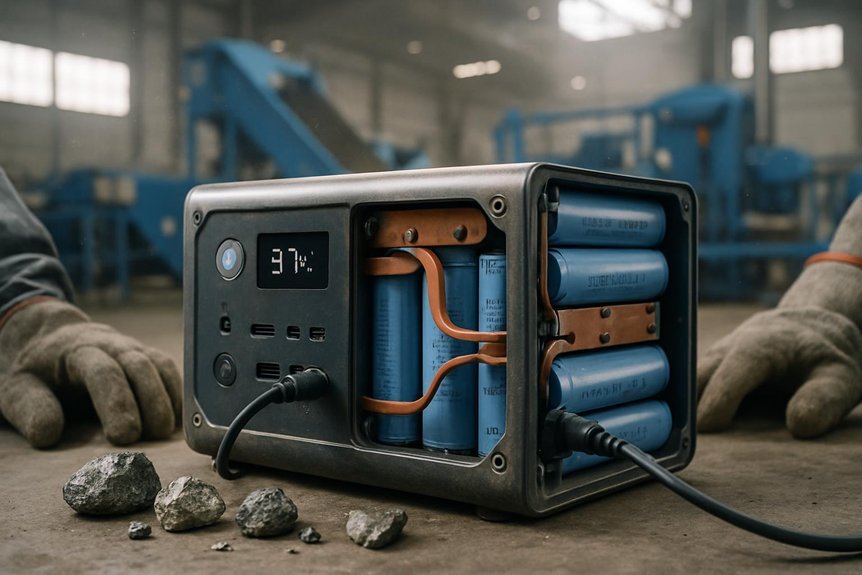
What are the hidden costs behind portable power stations? We examine battery lifecycles to reveal upstream and downstream impacts, guiding policy and practice. Our view is data-driven, lifecycle-focused, and reader-facing, focusing on mining ethics and soil reclamation as core concerns. We quantify trade-offs, not slogans, to inform decisions about repair, reuse, and end-of-life pathways.
- Mining ethics audits reveal supplier risk, community impacts, and governance gaps.
- Manufacturing footprints show energy intensity, water use, and regional variation.
- End-of-life channels highlight reuse potential, recycling rates, and infrastructure needs.
- Post-consumer reclamation efforts emphasize soil restoration, site decontamination, and legacy liabilities.
Metals, Chemicals, and the Supply Chain Behind Batteries
The metals, chemicals, and supply chains behind batteries frame every decision about portable power, from mining ethics to end-of-life pathways. We present a data-driven view of material flows, supplier due diligence, and recycling yields, linking policy levers to lifecycle outcomes. We quantify impacts of cobalt and lithium sourcing, traceability schemes, and refining losses, then assess cradle-to-grave performance. We evaluate supply-chain resilience under geopolitical risk and price volatility, recommending transparency, standardized reporting, and critical-material reuse targets. We acknowledge uncertainties, including unintended consequences of substitution and circular economy constraints, and we propose policy guardrails to minimize harm across stages. Unrelated topic considerations and random idea analogies help frame risk, but we keep focus on robust, auditable pathways—designed to improve efficiency, equity, and environmental justice.
How Charging Sources Shape Emissions and Air Quality
How charging sources influence emissions and air quality hinges on the electricity mix behind each use. We examine grid, diesel, and solar inputs to quantify lifecycle impacts, focusing on upstream emissions, device use, and end-of-life discharges. Our view centers on policy levers and incentives that shift behavior toward cleaner power, reducing irreversible degradation of air quality over time. We also consider consumer incentives that align short-term charging choices with long-term environmental goals, without sacrificing reliability.
- A city grid powered by clean energy lowers overall PM2.5 and NOx during charging, improving local air quality.
- Diesel backups raise immediate pollutants, highlighting trade-offs in remote sites.
- Solar charging narrows emissions during peak demand, smoothing the grid.
- Public incentives steer consumer behavior toward lower-emission, lifecycle-conscious choices.
Emissions in Real Life: Gas, Grid, and Solar Charging
We compare real-world gasoline emissions, grid-use impacts, and solar charging to highlight lifecycle trade-offs for portable power stations. Our analysis uses emission data, usage patterns, and energy-source mixes to inform policy implications and performance standards. By framing emissions across gas, grid, and solar pathways, we set a baseline for improved efficiency and cleaner integration.
Gasoline Emissions Real-World
What’s the real-world impact of gasoline emissions from portable power stations when they’re used alongside grid and solar charging? We analyze lifecycle emissions, capture efficiency, and real-use behavior to inform policy. In practice, emissions arise during fuel delivery, engine start-ups, and transient loads, influencing urban air quality, climate metrics, and consumer costs. We compare grid-sourced and solar-backed charging to reveal marginal gasoline contributions, guiding cleaner options and standards. Our data-driven view highlights trade-offs between portability, reliability, and emissions controls, emphasizing a lifecycle perspective over isolated events. We acknowledge factors like maintenance, fuel quality, and usage patterns that drive outcomes beyond headlines, avoiding unrelated topic chatter and random chatter misinformation.
- Fuel supply chains lighting up localized pollution plumes
- Engine starts triggering sudden CO2 and NOx spikes
- Transient loads amplifying particulate and hydrocarbon release
- Policy levers shaping efficiency, durability, and end-of-life recyclability
Grid-Use Emissions Comparison
Grid-use emissions sit at the intersection of fuel logistics, engine dynamics, and electrical infrastructure, so we compare real-life gasoline use with grid-powered charging and solar-backed charging to reveal marginal emissions. We quantify grid storage emissions, fuel-chain losses, and inverter efficiencies to map lifecycle costs across options. Our evidence shows gasoline yields higher near-term local pollutants, while grid and solar charging shift emissions upstream to generation and daytime solar. Policy implications favor diversified portfolios, grid upgrades, and demand-response to minimize peak emissions. Lifecycle analysis supports targeting low-carbon grids and storage reuse to reduce overall footprints. Readers gain a decision framework for portable power investments that emphasizes emissions-aware charging timing and device longevity.
| Route | Emissions Profile | Cost Implications |
|---|---|---|
| Grid charging | Moderate, grid-mission dependence | Higher capex, lower fuel cost |
| Gasoline | High local pollutants | Lower upfront, higher fuel cost |
| Solar charging | Low on-site, weather-dependent | Moderate capex, minimal fuel |
Water and Soil Impacts of Production
Water and soil impacts arise early in the production of portable power stations, shaping environmental performance as components like lithium batteries, lithium-ion cells, and casings are sourced, manufactured, and assembled. We present a data-driven, lifecycle-focused view that links supplier practices to site outcomes, emphasizing water impacts and soil contamination risks across extraction, processing, and assembly stages.
Water and soil impacts shape environmental performance from source to assembly in portable power station production.
- We quantify water withdrawals for refining minerals, highlighting regional disparities and mitigation requirements.
- We map soil contamination pathways from spills, tailings, and improper waste handling to closure obligations.
- We compare best practices in coating and packaging that reduce leachate exposure within production yards.
- We evaluate policy levers, monitoring protocols, and disclosure standards that drive responsible sourcing and cleaner water outcomes.
Design for Longevity and Easy Recycling
| Design longevity | Recycling pathways |
|---|---|
| Material choice | End-of-life options |
| Modularity | Certification and data |
| Repairability | Lifecycle impact metrics |
| Durability testing | Regulatory alignment |
Smarter Use: Efficiency, Charging Habits, and Care
We examine how efficient charging practices and careful battery habits shape the lifecycle impacts of portable power stations. Our approach is data-driven and policy-oriented, linking user behavior to longevity, efficiency, and overall environmental footprint. By prioritizing precise charging windows, temperature awareness, and routine care, we set a foundation for smarter use that reduces waste and strengthens system resilience.
Efficient Charging Practices
Efficient charging is the backbone of portable power stations’ lifecycle performance, and understanding best practices helps maximize efficiency, longevity, and safety. We present data-informed guidance to align with policy goals and lifecycle thinking, avoiding unnecessary complexity. By optimizing charging behavior, we reduce energy waste and downstream environmental impact, while ensuring reliability for users.
1) Prioritize standard charging windows aligned with grid demand curves to minimize peak load and emissions.
2) Use vendor-specified chargers and avoid third-party adapters that can introduce inefficiencies or safety risks.
3) Schedule partial-state charging when full capacity isn’t required, preserving battery health and reducing cycle wear.
4) Monitor temperature and voltage during charging to prevent degradation and safeguard material longevity, avoiding unrelated topic or off topic tangents.
Battery Care Habits
Where should we start when it comes to battery care habits that maximize efficiency and extend lifecycle performance? We begin with data-driven guidance on usage, charging, and storage. Our policy focus prioritizes predictable cycles, temperature control, and consistent charging profiles to minimize degradation. We recommend avoiding deep discharges and midstream charging that disrupts chemistry, and we encourage keeping devices within optimal state-of-charge windows to preserve capacity. In practice, battery care means monitoring thermal conditions, using manufacturer-recommended chargers, and aligning use with energy needs rather than opportunistic high-demand draws. Storage habits matter too: cool, dry environments, and long-term storage at partial charge reduce calendar aging. By standardizing these practices, we lower replacement frequency, reduce waste, and support lifecycle thinking across procurement, operation, and end-of-life planning.
Responsible Recycling, Safe Disposal, and Brand Certifications
What happens to portable power stations at the end of their life, and how do we guarantee it’s safe and responsible? We analyze data on recycling pathways, disposal regulations, and brand certifications to ensure accountability across the lifecycle. Our approach emphasizes transparent reporting, validated recycling rates, and independent audits that verify safe handling and material recovery. By aligning manufacturer claims with third-party standards, we reduce environmental risk and increase public trust. We also address recycling myths to prevent misinformed decisions that hinder proper recovery.
We map end-of-life pathways, verify third-party claims, and report transparent, validated recovery.
- We map take-back programs, track material flows, and quantify recovery yields with clear benchmarks.
- We verify certifications from brands against independent lab tests and regulatory criteria.
- We document end-of-life processing steps, emissions, and residue handling.
- We communicate evolving policies and compliance requirements to stakeholders.
Frequently Asked Questions
Do Portable Power Stations Emit Radiation or EMF During Use?
We can confirm that portable power stations emit minimal EMF levels within safety standards during use, with negligible radiation. Our assessment emphasizes emission concerns and usage safety, grounded in data, policy guidance, and lifecycle analyses. We’ll monitor benchmarks continually.
How Do Manufacturing Tariffs Affect Device Environmental Impact?
Tariffs reshape tariff driven supply chains, increasing upfront costs and potentially shifting environmental footprints. We state that lifecycle cost transparency helps evaluate impacts; we quantify tradeoffs, urging policy that internalizes externalities for sustainable, data-driven device ecosystems.
Are There Gender or Regional Disparities in Mining Harms?
We find gender gaps and regional disparities in mining harms, and we quantify them to guide policy. We compare lifecycle stages, disclose data transparently, and push targeted protections so communities bearing harms receive prioritized, equitable mitigation and accountability.
What Is the Water Footprint of Lithium Extraction for These Devices?
The water footprint of lithium extraction varies widely, but our analysis shows substantial use across mining stages. We quantify, compare policies, and push lifecycle-focused approaches to minimize impacts, improving water stewardship during lithium extraction processes for portable power stations.
Can Consumer Choice Drive Higher Recycling Rates and Better Labels?
We believe consumer choice can drive higher recycling rates and better labels, since consumer recycling incentives boost participation and labeling clarity impact decision-making, supported by lifecycle data guiding policy defaults and continuous improvement.
Conclusion
We’ve shown that portable power stations cut local emissions when paired with clean grids, but their real value hinges on full lifecycle thinking—from mining and manufacturing to reuse and end-of-life. When we optimize durability, modularity, and standardized recycling, we slash emissions and water use while boosting reliability. Our policy and design choices must prioritize transparent supply chains, efficient charging, and responsible disposal. Together, we can achieve a breakthrough that’s bigger than life—by reducing footprints at every life stage.