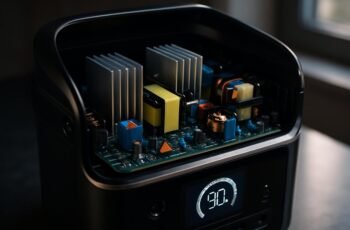
Like a captain’s compass guiding a fleet, our BMS directs safety, health, and efficiency across a power station. We trackSOC, cell health, temps, and interlocks, enforce envelopes, and harmonize multi-vendor hardware with real-time visibility. We balance charging schedules for longevity, predict faults, and guarantee safe plant-wide operation. This is a complex orchestration—and the outcome hinges on data integrity, standards, and integration. If we keep pace, the rewards—and risks—will become clearer.
Key Takeaways
- A Battery Management System (BMS) monitors and protects large-scale energy storage by tracking state of charge, health, temperature, and safety interlocks.
- It coordinates charging/discharging to extend cycle life, ensure grid stability, and prevent unsafe operating conditions.
- Core functions include protection, cooling management, and accurate SOC estimation from cell data and thermal readings.
- Real-time monitoring, data integrity, and alarm systems enable rapid, audited responses across plant controls and SCADA.
- Compliance with safety standards, interoperability protocols, and secure data handling ensures reliable, traceable operation.
Why BMS Matters for Power Stations
Battery management systems (BMS) are critical to power stations because they directly determine operational safety, reliability, and lifecycle economics of large-scale energy storage. We focus on how BMS influences overall performance, from cell balance to pack integrity, enabling predictable available capacity and reduced maintenance cost. By tracking state of health, state of charge, and thermal conditions, we anticipate failures before they affect output, preserving grid stability. We also manage degradation drivers, including battery aging, pausing unsafe operating windows, and enforcing conservative aging models to extend usable life. In practice, the BMS coordinates safety interlocks, charger/discharger limits, and monitoring thresholds that mitigate inverter harmonics, minimizing electromagnetic interference and thermal stress downstream. The result is a robust, auditable control loop that supports continuous, compliant energy delivery.
Real-Time Battery Monitoring: What the System Tracks
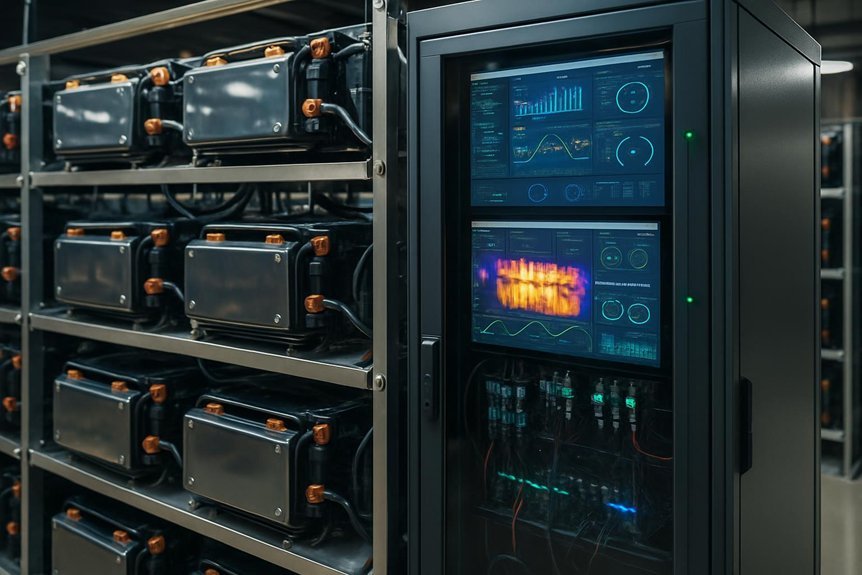
How do we track the real-time state of a large-scale battery system? We monitor a tight set of metrics that reveal health, performance, and readiness. Our real-time telemetry streams voltage, current, temperature, impedance, and state history, then flags anomalies through configured thresholds. We analyze cell balance, pack homogeneity, and aging indicators to prevent drift from design targets. We continuously verify data integrity, timestamp accuracy, and communication latency to assure timely responses. We correlate fleet-wide energy throughput with temperature maps to detect hotspots and potential degradation. We also log maintenance cadence events and standby readiness statuses to align outages and inspections with risk.
- Voltage, current, and temperature profiles across modules
- Cell imbalance and impedance trends
- Temperature hotspots and cooling outlet readings
- Data integrity, latency, and synchronization checks
- Maintenance cadence and standby readiness indicators
Core Functions of a Power-Station BMS: Protection, Cooling, and SOC
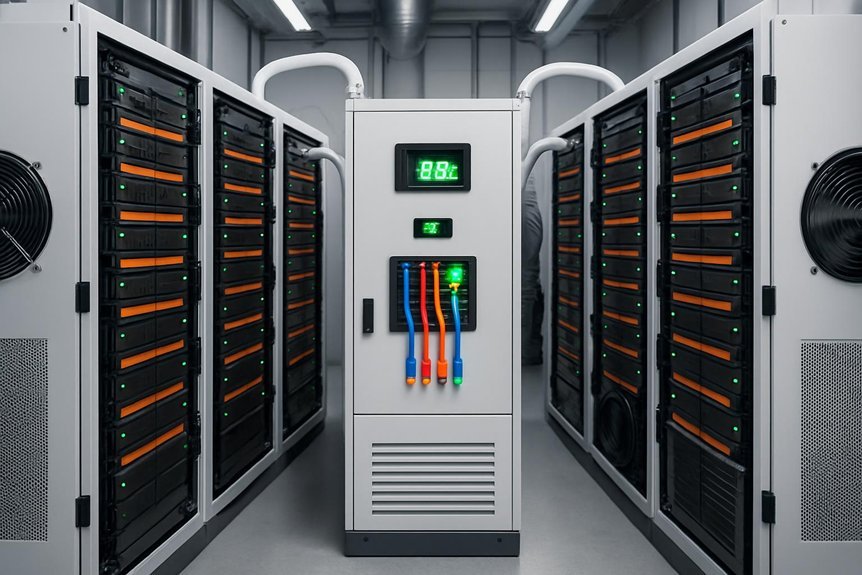
We outline how a power-station BMS enforces protection, optimizes thermal cooling, and tracks State of Charge (SOC) to maintain safety and performance. We’ll examine protection mechanisms, how cooling strategies respond to varying loads, and the accuracy and responsiveness of SOC estimation. This framing sets the stage for detailed assessment of interdependencies and performance metrics across the core functions.
Protection Mechanisms Overview
–
–
–
–
–
Thermal Cooling Management
| Element | Impact |
|---|---|
| Heat generation | Drives cooling demand |
| Airflow control | Balances cooling delivery |
| Coolant management | Sustains temperature setpoints |
| Thermal sensors | Enables precise regulation |
| System margins | Maintains safety envelope |
State Of Charge Tracking
State of Charge (SOC) tracking sits at the core of the power-station BMS’s protective and cooling functions, linking real-time energy state to safe operation and thermal management. We monitor SOC to prevent over-discharge, over-charge, and thermal excursions, ensuring reliable energy availability and safe cycling. Our method integrates cell voltages, currents, and temperature data to estimate SOC with tight accuracy, supporting actionable control decisions. We also quantify cycle lifetime impact, adjusting charging strategies to minimize degradation while meeting throughput targets. This discipline enables proactive balancing, state validation, and fault avoidance, reducing unsafe operating envelopes and extending asset life. SOC visibility guides cooling setpoints and protection thresholds, aligning thermal safety with energy reliability.
- Real-time SOC estimation aligns protection, cooling, and energy management
- Multisensor fusion improves accuracy under varying temperatures
- Battery aging informs coefficient updates and cycle-life planning
- Guard bands trigger safe transitions before critical states
- Data-driven strategies optimize charge discipline and longevity
How BMS Schedules Charging and Discharging for Longevity
How does a BMS schedule charging and discharging to maximize longevity? We design control actions around cycle life, state of health, and environment. We optimize the charging profile to minimize high-rate stress, keep state of charge within a narrow band, and align peaks with low-temperature windows. Discharging is paced to reduce cumulative aging effects, avoiding deep-depth cycles that accelerate degradation. We implement balancing cadence that spreads cell balance operations over time, reducing localized stress while preserving capacity. Our scheduling uses model-informed constraints: maximum current limits, temperature bounds, and round-trip efficiency targets. We continuously evaluate aging effects indicators, updating schedules to preserve capacity fade characteristics. The goal is predictable performance, balanced aging, and robust reliability across varying load and solar conditions.
Battery Health Diagnostics and Fault Prediction in Practice
What practical signals indicate a battery’s health, and how can we forecast faults before they manifest? We adopt data-driven prognostics to monitor aging indicators, quantify battery health, and predict failure timelines. We correlate impedance growth, capacity fade, self-discharge, and temperature excursions with degradation modes, enabling proactive maintenance. Our fault prediction framework integrates electrochemical models, state-of-health metrics, and trend analysis to flag anomalous patterns early. We emphasize repeatability, traceability, and noise mitigation to ensure robust diagnostics across cycles and environments.
- Impedance and capacity trends as degradation indicators
- Temperature and thermal runaway risk signals
- Charge/discharge efficiency and self-discharge deviations
- Anomalous voltage relaxation and recovery patterns
- Probabilistic fault timelines and maintenance windows
How BMS Communicates With Plant Controls and Other Systems
We outline how the BMS interfaces with plant controls and other systems, focusing on the BMS-Plant Interface, data exchange protocols, and system alarm integration. We describe the data paths, message formats, and timing requirements that enable coordinated control, monitoring, and fault signaling across the plant. Our aim is to establish a clear, standards-based foundation for reliable inter-system communication and prompt escalation of critical events.
BMS-Plant Interface
Effective communication between the Battery Management System (BMS) and plant controls hinges on well-defined interfaces, robust data models, and standardized protocols that minimize latency and ensure integrity.
- Clear signaling paths that map sensor inputs to controller actions in real time
- Harmonized data schemas and tagging to support cross-system interpretation
- Deterministic messaging with priority levels for critical safety and fault events
- Verified health checks and diagnostics that validate link and device availability
- Structured fault prediction integration to align BMS states with plant alarms
We emphasize a cohesive bms plant interface that supports telemetry, control commands, and state reporting without ambiguity, enabling rapid decision making and reliable operation. This approach reduces risk and improves overall plant resilience.
Data Exchange Protocols
Data exchange protocols define how the BMS communicates with plant controls and other systems, ensuring timely, reliable, and verifiable information flow. We specify data formats, message timing, and validation checks to minimize latency and misinterpretation. Our focus is on consistent data exchange, where standardized payloads and encoding schemes enable interoperability across vendor platforms. Protocol alignment is achieved through agreed command structures, status reporting, and event tagging that preserve traceability and auditability. We evaluate determinism versus flexibility, selecting protocols that support real-time monitoring, control loops, and data historization without compromising safety. Security considerations, including authentication and integrity checks, are integrated to protect critical signals. In practice, we test end-to-end paths, verify backhaul reliability, and document failures for rapid remediation and ongoing improvement.
System Alarm Integration
System alarms are the core of timely, shared situational awareness among the BMS, plant controls, and ancillary systems. We describe how signals travel, how priority is assigned, and how events trigger coordinated responses. Our goal is minimized downtime, clear escalation paths, and verifiable recovery. We emphasize deterministic messaging, robust fault isolation, and auditable alarm histories to support root-cause analysis. Alarm testing maintains readiness, while integration with plant historians and SCADA enables trend analysis and regulatory reporting. We design interfaces to prevent alarm storms, ensure safe shutdown sequencing, and preserve safety integrity. Clear nomenclature and standardized severity levels reduce misinterpretation during incidents.
Safety, Standards, and Compliance for Grid-Scale BMS
How do we ensure safety, alignment with standards, and regulatory compliance in grid-scale Battery Management Systems (BMS)? We approach this with a structured, engineering mindset. We implement formal safety standards across design, validation, and operation, ensuring that architecture supports fault tolerance, isolation, and deterministic behavior. Compliance testing verifies conformance to grid codes, electrical safety directives, and vendor-supplied safety claims, while documentation substantiates traceability and auditable processes. Lifecycle oversight governs aging, warranty, and maintenance planning, limiting degradation risk and ensuring timely retrofits. We perform risk assessment to identify failure modes, quantify impacts, and prioritize mitigation strategies. Clear change control, supplier qualification, and independent verification strengthen reliability. Together, these practices sustain safe, compliant, and predictable BMS performance within the power system.
Data, Sensors, and Integration Challenges in the Field
What makes field data and sensor streams problematic, and how do we address those frictions head-on? We’ll align data provenance with system models, insist on consistent sampling rates, and combat noise with robust filtering. Our focus is data reliability and timely ingestion, not just raw numbers. We calibrate sensors regularly, track drift, and validate measurements against reference standards. Integration across diverse equipment requires a common schema, reliable time stamps, and explicit metadata. We minimize latency through edge processing and secure channels, while preserving data integrity through redundancy. We document assumptions, quantify uncertainty, and govern changes to prevent hidden correlations from misleading decisions.
- Clear data lineage and provenance
- Regular sensor calibration routines
- Harmonized sampling and time synchronization
- Edge processing with integrity checks
- Redundant, secure data transport and storage
Measuring BMS Success: KPIs and Operational Outcomes
Measuring BMS success hinges on concrete KPIs that translate system health into actionable insights. We define KPIs around availability, cycle life, and safety events to benchmark performance across the stack. We track battery longevity projections from state-of-health models and nominal degradation curves, updating forecasts with real-time data to inform maintenance and replacement schedules. Operational outcomes focus on charge/discharge efficiency, thermal management effectiveness, and fault containment. We assess thermal uniformity through sensor arrays and thermal impedance analyses, ensuring no hot spots that accelerate aging. Data-driven decisions hinge on trending, anomaly detection, and root-cause analysis to reduce unscheduled outages. By tying analytics to control actions, we improve reliability, reduce throughput losses, and sustain long-term system resilience.
Frequently Asked Questions
How Does BMS Handle Extreme Temperature Fluctuations in Grid Storage?
We handle Extreme Temperature fluctuations in Grid Storage by active thermal management, predictive cooling/charging schedules, and redundancy; we prioritize BMS data integrity, Cyber Security, and timely BMS Upgrades to minimize Plant Downtime and optimize Costs ROI.
Can BMS Automate Cell Replacement Without Plant Downtime?
We can’t automate cell replacement without plant downtime. As we speak, we’d require maintenance scheduling and predictive aging data to coordinate swaps. If feasible, automation reduces time, but still demands controlled outages for safe, precise replacements.
What Cyber-Security Measures Protect BMS Data From Threats?
We safeguard BMS data with layered cybersecurity governance and strict access controls, analyzing threats, enforcing data integrity, and continuously auditing systems; we rapidly detect anomalies, isolate breaches, and enforce resilience to protect critical power-station operations.
How Does BMS Influence End-Of-Life Battery Recycling Decisions?
We influence recycling decisions and end-of-life planning by forecasting degradation, coordinating with DI, and classifying cells. We assess timing, safety, and economics; we prioritize recycling decision factors, minimizing risk, maximizing value, and ensuring compliant end-of-life planning.
What Are the Costs and ROI Drivers for BMS Upgrades?
We see that upgrade ROI hinges on improved reliability, reduced downtime, and extended battery life, driving a favorable cost benefit; initial capex is balanced by operational savings and smarter asset utilization, yielding compelling upgrade ROI for our system.
Conclusion
We manage BMS as the nervous system of a power station, translating chemistry into safe, schedulable, grid-ready operation. By continuously monitoring cells, temps, voltages, and state of health, we optimize cycles, prevent faults, and sustain cohesion across multi-vendor hardware. Our question is simple: can we trust real-time data to govern critical safety and economic decisions? Yes—when data integrity, standards compliance, and robust communications align, delivering reliable energy storage with measurable KPIs.