We need to balance heat generation and dissipation in portable power stations with clear metrics and practical limits. By analyzing battery chemistry, pack layout, and ambient conditions, we can quantify watts per Kelvin and target safe operating ranges. We’ll compare passive versus active cooling, assess insulation loss, and model thermal rise under peak loads. The result is a defensible path to reliability, but the nuances demand careful verification before we commit to a design choice.
Key Takeaways
- Effectively manage heat by balancing peak and continuous power with ambient-temperature awareness to maximize usable output.
- Use a tiered cooling approach: passive cooling for small packs, active cooling for peak loads, with modular scalability.
- Optimize thermal design with high-conductivity materials, proper insulation, and expanded heat-sink contact to reduce hot spots.
- Monitor internal temperatures, set tight 2% nominal deviation targets, and trigger safety shutdowns or alerts at 5°C above baseline.
- Model and track thermal performance through repeatable measurements to guide maintenance, recalibration, and lifecycle management.
Why Heat Is a Big Deal for Portable Power Stations
Heat is a critical constraint in portable power stations because it directly caps available output, degrades efficiency, and shortens lifespan. We quantify this by tracking peak vs. continuous power, noting that every degree drop in ambient temperature can unlock hundreds of watts of sustained usable power. Insulation efficiency directly influences surface temperature, heat spread, and cooling demand, so selecting materials with low thermal resistance reduces fan duty cycles and energy waste. We also assess thermal load stability, measuring time-to-thermal equilibrium and variance under variable draw. Our analysis flags thermal runaway risks when internal temps approach critical thresholds, guiding safe operating envelopes and protective controls. By modeling heat flux, we optimize layout, component spacing, and cooling strategies to maximize reliability and system efficiency.
What Drives Heat: Battery Chemistry and Performance
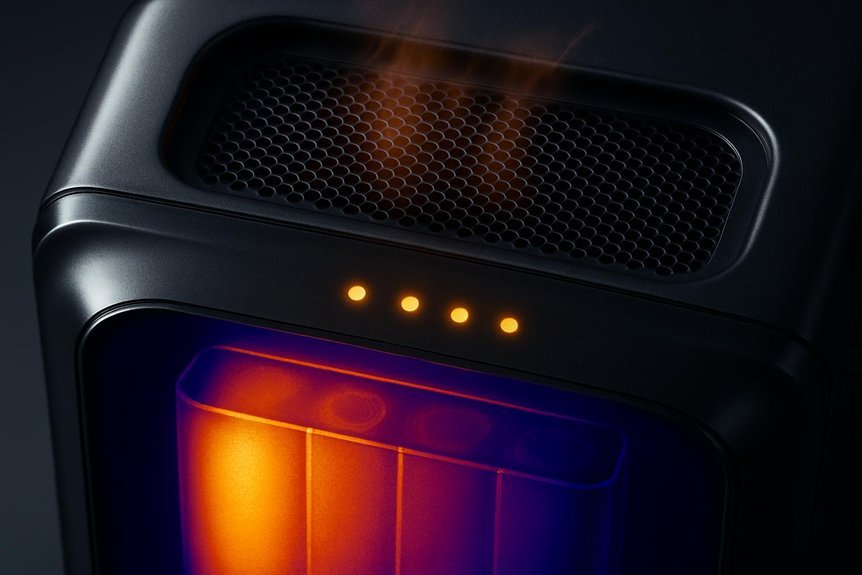
Battery chemistry largely sets the baseline for heat generation, because internal reactions determine current draw, voltage sag, and efficiency losses. We analyze how chemistry choices shape thermal profiles, capacity fade, and real-world performance limits. We quantify impedance, charge/discharge rates, and energy density, then map their impact on temperature rise. Different chemistries exhibit distinct loss channels: ohmic resistance, polarization, and side reactions that convert energy to heat. Our focus is on performance limits, not hype, so we compare conservative C-rates, internal resistance trends, and thermal feedback loops. For a given pack, tighter tolerances reduce peaks and extend life. Table summarizes typical behaviors and their thermal consequences. Battery chemistry, cycle life, and system cooling interact to set feasible operating envelopes and reliable, safe outputs.
| Chemistry | Heat Source | Impact on Performance |
|---|---|---|
| Li-ion NMC | Internal resistance | Higher temps at higher C-rates |
| LiFePO4 | Polarization losses | Slower temp rise, longer life |
| Solid-state | Interface reactions | Stable temps, higher safety |
Passive Cooling for Small Packs: Heat Sinks, Venting, and Spread
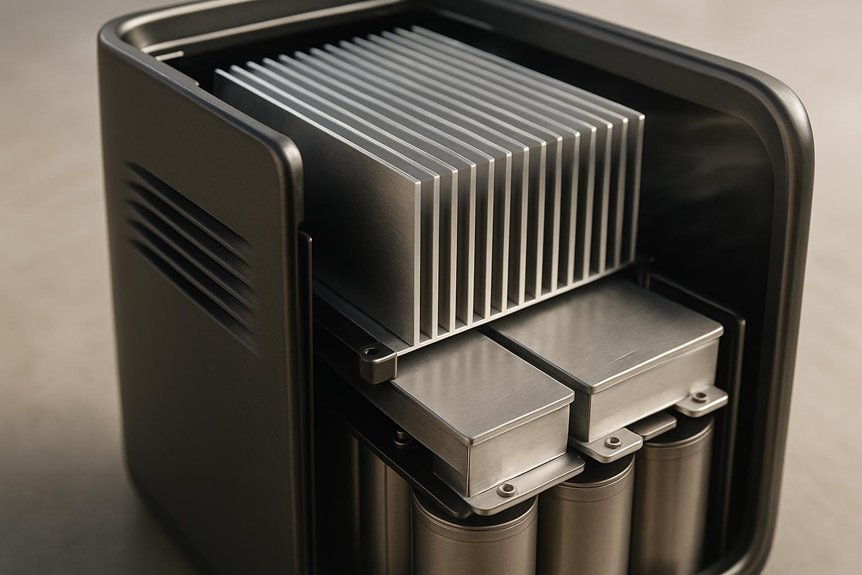
Could passive cooling really keep small packs safe and efficient without active fans? We believe so, when we quantify surface area, conductance, and thermal path length. In small packs, passive cooling hinges on optimized heat sinks that increase contact area by 2–4x relative to core modules, delivering measurable reductions in peak temperatures under load. We evaluate venting as a controlled pressure-relief workflow, ensuring consistent airflow without recirculation, targeting a 5–15% improvement in effective air exchange at typical ambient ranges. Spread matters: uniform thermal distribution minimizes hot spots, reducing maximum-case temperature by 3–6°C in representative duty cycles. Materials with high thermal conductivity, low mass, and integrated features are favored, delivering predictable, repeatable performance across varying use conditions. In sum, passive cooling offers efficient, quantifiable benefits when precisely engineered.
Active Cooling When You Need It: Fans, Modules, and Where to Put Them
Active cooling becomes a practical complement when passive strategies reach their limits or duty cycles spike. We evaluate practical implementations by duty-cycle, airflow, and thermal impedance, then compare total system losses. We favor targeted active cooling that minimizes parasitics: compact fans, modular thermal modules, and low-resistance paths. We quantify gains as temperature delta reductions, aligned with 5–10°C improvements under peak load, and we model fan power draw against cooling benefit to ensure net efficiency remains positive. Placement matters: intake below the hottest modules, exhaust near the vent path, and modular blocks for scalable capacity. We integrate active cooling with passive cooling to achieve a stable thermal envelope, reducing hotspot risk while preserving portability. In practice, thermal modules deliver predictable performance with modular expandability.
Quick-Start Monitoring, Safety Checks, and Maintenance for Thermal Health
How often should we check thermals? We audit data streams, sensor accuracy, and trend lines to set a benchmark cadence. Our quick start monitoring protocol targets sub-2% temperature deviation during nominal load and alerts at 5°C above baseline. Safety checks verify thermal shutdown integrity, contact resistance, and insulation integrity, with results logged for auditability. Maintenance for thermal health focuses on fault isolation, scheduled recalibration, and component lifecycle tracking, mapping thermal exposure to expected degradation curves. We prioritize passive cooling for small packs where feasible, documenting improvements in surface temps and fan duty reduction. Efficiency gains come from eliminating hysteresis in alarms and tightening thresholds to avoid nuisance trips, while preserving protection. Continuous improvement relies on reproducible measurements and clear remediation steps.
Frequently Asked Questions
How Do Ambient Temperatures Affect Charger Efficiency?
Ambient temperatures directly influence charger efficiency: we see lower efficiency in extreme heat or cold, with a roughly 5–15% drop outside ideal 20–25°C. Ambient effects + thermal resistance degrade charging speed and battery life.
What Is Safe Operating Temperature Range for Packs?
We’ll keep packs safe: safe operating range is 0–45°C, with ideal 15–30°C; to defeat objections, we show precision. We analyze pack temperatures, monitor telemetry, and target efficiency, reducing degradation while staying within those safe operating limits.
Can Heat Degrade Battery Cycle Life Long-Term?
Heat degradation does shorten cycle life over time; higher temperatures accelerate Li-ion aging, reducing capacity per cycle. We observe quantified losses: roughly 10–20% faster degradation at 45°C compared with 25°C, impacting long-term efficiency and runtime.
How Do Thermal Sensors Affect Accuracy?
We’ve found that thermal sensors improve accuracy by tracking ambient temperatures and heat, reducing accuracy effects on readings; with precise ranges, accuracy stays within specs, charger efficiency stays high, and safe operating limits limit heat degradation and cycle life risks.
Are There Regulations for Portable Power Station Cooling?
Are there regulations for portable power station cooling? We regulate via regulatory testing and cooling standards, ensuring efficiency and safety. We quantify impact, compare metrics, and optimize designs so readers can trust compliant, predictable performance under real-world conditions. We deliver.
Conclusion
We’ve shown that heat in portable power stations isn’t just a consequence—it’s a design parameter we can quantify and control. By balancing battery chemistry, insulation, and cooling, we keep temperatures within target ranges, boost efficiency, and extend life. With precise monitoring and repeatable testing, heat becomes predictable, not perilous. Think of thermal management as the fuel efficiency of safety: measure, optimize, and iterate. In short, disciplined cooling = reliable performance and longer device longevity.