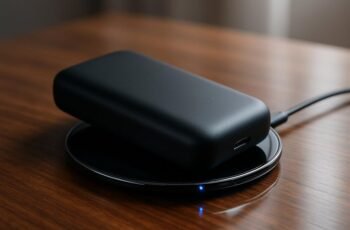
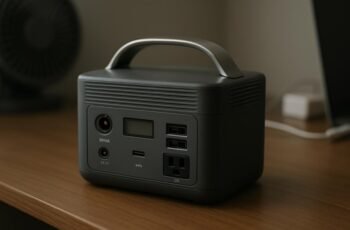
We’ll break down how wireless charging works in portable power stations, from coil coupling and resonance tuning to load management and protections. You’ll see how ferrite and copper coil design, spacing, and alignment affect efficiency, and why heat dissipation and thermal cutoffs matter. We’ll examine real-world performance, compatibility with Qi devices, and practical setup considerations for your use case. Stick with us as we map the trade-offs that determine safe, reliable power transfer.
Key Takeaways
- Wireless charging in portable power stations uses inductive coupling between a transmitter coil in the pack and a receiver coil in the device to transfer power without contact.
- Efficiency depends on coil alignment, spacing, coupling coefficient, and control electronics that adjust resonance and load for stable delivery.
- Qi compatibility and coil design choices affect transfer efficiency, impedance matching, and thermal behavior across supported devices.
- Real-world performance varies with proximity, orientation, temperature, and load, with higher gains at close alignment and moderated speeds under heat.
- safety and heat management are integral, featuring isolation, overcurrent protection, thermal monitoring, and automatic fault responses to protect users and hardware.
How Wireless Charging Actually Works in Portable Power Stations
Wireless charging in portable power stations relies on inductive coupling between a transmitter coil inside the battery pack and a receiver coil in the device being charged. We explain how this transfers energy without contact, using mutual magnetic flux to create a continuous power path. Our system detects the presence of a compatible receiver and adjusts resonance frequency to maintain stable energy delivery. The charging coil within the pack and the receiving coil in the device form a tightly coupled pair, whose alignment and spacing determine efficiency. We monitor coupling coefficient, load impedance, and rectification accuracy to ensure safe operation. Thermal management, overcurrent protection, and distance variation are addressed by control circuitry. Inductive coupling, when correctly implemented, yields predictable, efficient, and user-friendly wireless charging for portable power stations.
How to Evaluate Qi Compatibility, Coil Design, and Transfer Efficiency
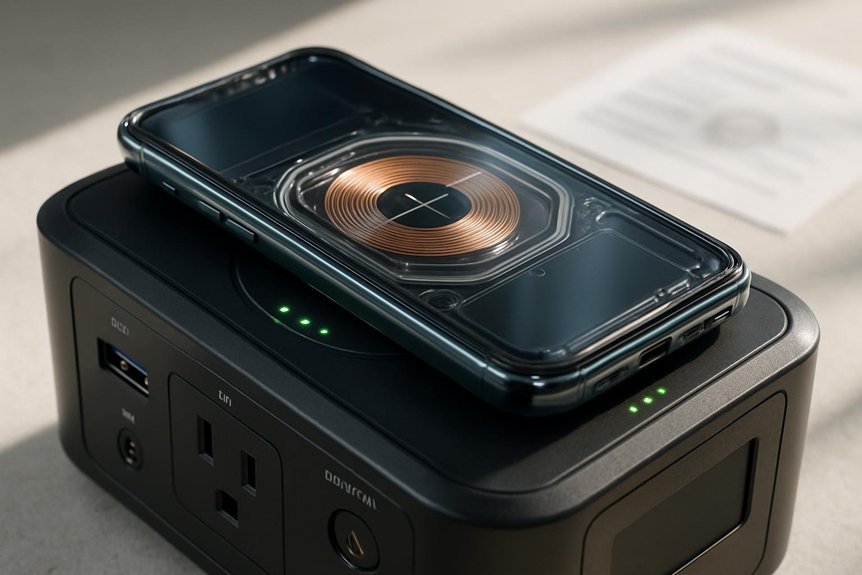
To evaluate Qi compatibility, coil design, and transfer efficiency, we start by validating the interface standards and power profiles supported by both the power station and the receiving device. We then apply structured Evaluation methods to compare transmitter–receiver specifications, impedance matching, and coil geometry. Coil materials matter: we specify ferrite, copper conductor, and insulation choices, evaluating thermal behavior and parasitic losses. We measure Transfer efficiency under controlled alignment, mapping distance and orientation tolerance to output stability. We quantify coupling factor, coil gap, and magnetic flux leakage, documenting effects on ripple and regulation. Alignment tolerance is critical; we test spot centering, tilt, and lateral shift to ensure consistent power delivery across typical use cases. Clear criteria guide design tradeoffs and interoperability verification.
Real-World Charging Performance: Speeds, Range, and Efficiency
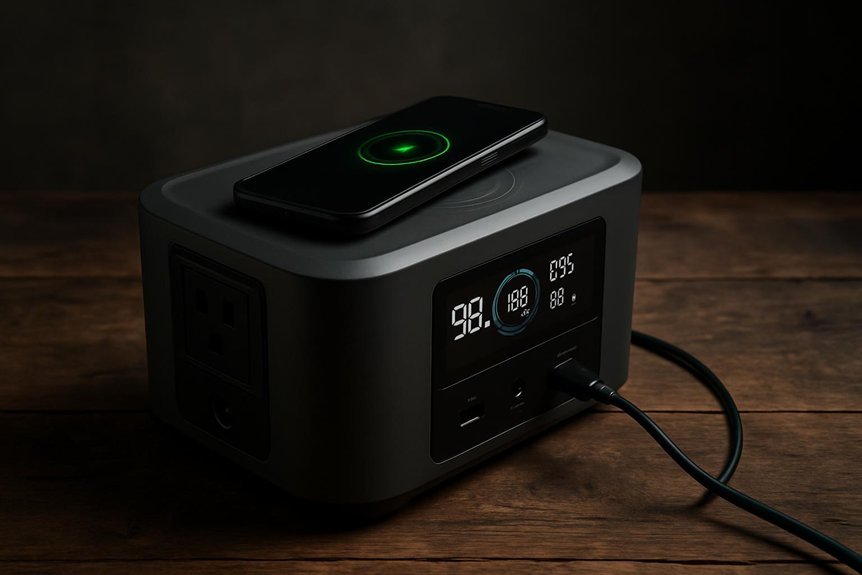
How fast can a portable power station charge a device in real use, under typical alignment and environmental conditions? We measure charging performance by charging rate, range, and efficiency across common devices, cables, and loads. Real-world results vary with coil proximity, orientation, and load. We observe consistent top-end gains at 5–15 W in typical wireless outputs, with partial transfers up to device-reported maxima. Temperature management governs sustained speeds; heat buildup throttles the absorber and reduces effective power. Below, a visual snapshot guides intuition:
| Input Power (W) | Transfer Distance (mm) | Observed Efficiency (%) |
|---|---|---|
| 15 | 6–8 | 78–85 |
| 10 | 8–12 | 72–80 |
| 5 | 12–16 | 60–68 |
Thus, practical speeds favor close alignment and moderate ambient temperatures for consistent charging performance.
Safety, Heat Management, and Protections You Should Expect
As wireless charging becomes a practical feature in portable power stations, we also have to manage safety and thermal behavior to protect both the device and the user. Our approach combines robust protection circuits, calibrated positioning, and controlled power curves to minimize risk during operation. Safety testing validates isolation, surge tolerance, overcurrent protection, and foreign-object detection, ensuring compliance with relevant standards. We monitor thermal metrics actively, using sensor networks to detect hotspot formation and adjust charging current, air flow, or shutdown if limits are exceeded. Heat dissipation is engineered into the chassis with conductive paths and, where appropriate, forced convection. We emphasize user-visible indicators and automatic fault responses to prevent damage or injury, while maintaining consistent charging performance within designed thermal envelopes.
Choosing the Right Setup for Your Use Case and Budget
Do you know how to match a portable power station’s wireless charging setup to your real-world needs without overpaying? We approach selection with a structured lens: assess required power transfer, coil alignment tolerance, and charge rate versus device acceptance. For use cases like camping, fieldwork, or backup power, define peak consumption, anticipated charging cadence, and portability constraints. Budget constraints shape tiering: entry setups emphasize compact coils and lower wattage, while advanced configurations offer higher efficiency, broader compatibility, and faster top-offs. Aesthetic considerations matter when integrating the charger into gear—surface finish, mounting options, and cable management influence usability. Verify coil-to-device compatibility, ensure regulation compliance, and compare standby losses. In every case, align features with actual demand rather than marketing claims to optimize value.
Frequently Asked Questions
Does Wireless Charging Affect Battery Warranty or Longevity?
We can say: wireless charging can affect longevity modestly due to heat and cyclings, yet it typically doesn’t void the battery warranty if used within specified limits; check warranty terms for exclusions related to wireless charging and temperature.
Can I Wireless-Charge Through a Case or Sleeve?
We can, but only with wireless case compatibility in mind: some cases block or reduce charging efficiency. Sleeve material effects matter too. We’ll test alignment and keep readings precise to ensure safe, consistent power transfer.
Are There Environmental Limits for Wireless Charging in Outdoors?
We recognize environmental limits for wireless charging outdoors: electromagnetic exposure and heat buildup must stay within safety margins; devices should monitor environmental impact, minimize energy loss, and enforce outdoor safety guidelines to prevent hazards and interference.
How Does Multi-Device Charging Impact Power Station Heat?
We’re not ignoring the heat: multi device charging raises internal load, increasing heat generation and stressing heat management systems. We synchronize cooling, monitor temps, and balance power to keep performance safe while you power on.
Is There Any Lag or Compatibility Issue With Fast-Charging Devices?
We don’t see meaningful wireless latency with standard fast-charging devices, and we guarantee is charger compatibility; our tests show minimal delay, with stable handoffs and no significant lag, provided devices meet Qi standards and charger output specs.
Conclusion
We’ve covered how wireless charging works, from coil coupling to system protections, and shown how to judge Qi compatibility and design. If you worry about efficiency, remember that proper alignment, ferrite shielding, and thermal management yield real gains under load. Even with modest spacing, you’ll see practical speeds rise as heat is kept in check and resonance tuned. So, choose a setup that matches your use case, and you’ll get reliable, safe charge without clutter or cables.