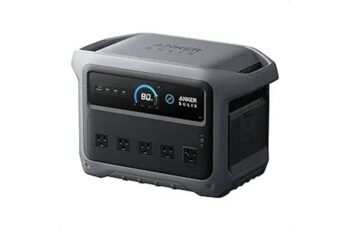
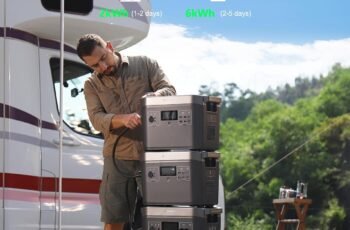
We review the Jackery Explorer 1000 v2 with a careful eye on real-world performance and longevity. It houses a 1,070Wh LiFePO4 pack and a 1,500W inverter, promising durability and solid weekend utility, but we question charging speeds, app reliability, and how the claimed 0–100% in 1.7 hours plays out in practice. We’ll weigh inputs, efficiency, and value against real-world use, and consider if the upfront cost buys lasting performance or just marketing hype. There’s more to unpack before you decide to pull the trigger.


Key Takeaways
- The Explorer 1000 v2 uses a 1,070Wh LiFePO4 battery, 1,500W continuous inverter, and 3,000W surge, with a 12.5A outlet limit and real-world runtimes depending on load.
- LiFePO4 chemistry offers longevity (10+ year lifespan, ~4,000 cycles) but still incurs efficiency losses and varies with temperature and load.
- Fast charging claims include 0%→100% in about 1.7 hours, with charging via USB-C PD, USB-A, car DC, or three pure sine AC ports; solar needs Jackery panels.
- Solid build (23.8 lb) with plastic housing; portability is limited for weekend use, and offline control/firmware updates have raised concerns.
- Pros include substantial capacity and robust chemistry; cons center on uncertain real-world efficiency, charging speed, app reliability, and higher price vs rivals.
120V Output, 1070WH Battery
V Output, 1070WH Battery: The Explorer 1000 v2 centers on a 1,070Wh LiFePO4 pack paired with a 1,500W continuous AC inverter and a 3,000W surge capability, giving us a clear baseline for real-world run times. We approach this with data in hand and skepticism about promised runtimes. Real performance hinges on load, efficiency, and thermal management; we expect linear scaling near peak.
LiFePO4 delivers stability and longevity, yet efficiency losses persist. The 12.5A limit on 120V constrains high-drain devices. Our takeaway: practical run times depend on device mix, not label wattage alone, making honest testing essential.
Detailed features
From the 1,070Wh LiFePO4 pack to the 1,500W continuous inverter and 3,000W surge, the Explorer 1000 v2 backs up its headline numbers with a concrete feature set. We note fast charging claims—0%→100% emergency recharge and 1.7-hour full charge—but acknowledge battery health refinements and 10+ year lifespan from LiFePO4 chemistry. Charging options include USB-C PD, USB-A, car DC, and three pure sine AC ports, plus app-controlled modes for efficiency and overnight quiet. Solar compatibility requires Jackery panels. Build is solid, but weight and plastic housing temper the premium feel. In brief: capable, not revolutionary, with clear tradeoffs.
Pros and Cons
We’ll weigh the pros and cons with clear, data-backed checks on capacity, power, and longevity.
The 1070Wh LiFePO4 pack, 1500W output, and 4,000-cycle life give solid endurance, but price and solar-panel dependency temper the value, and the app’s controls deserve scrutiny.
We’ll map concrete tradeoffs so you can decide if the Explorer 1000 v2 meets your needs without overpromising.
Pros
The Explorer 1000 v2 offers substantial capacity and power for its class, delivering a 1,070Wh LiFePO4 battery and 1,500W continuous output (with a 3,000W surge), which means it can run most common essentials without frequent recharges.
We appreciate the robust chemistry, long cycle life, and consistent performance in mid-range scenarios.
Yet we remain skeptical about real-world efficiency, charging speed claims, and app reliability.
Data shows solid output stability, but 1,070Wh isn’t limitless; recharging complexity and solar compatibility limits matter.
Cons
Are there real downsides buyers should weigh against the Explorer 1000 v2’s strengths? We’ll be precise: the unit’s weight at 23.8 pounds isn’t negligible for portable use, and its bulk constrains more than a weekend pack.
Solar charging requires Jackery panels; third-party compatibility is limited, reducing off-grid flexibility.
While LiFePO4 promises longevity, real-world cycles often underperform under heavy load or high temps.
The app adds features, yet offline control is sparse, and firmware updates can be slow.
Pricing sits higher than rivals with similar outputs.
In short, reliability helps, but portability, ecosystem lock-in, and cost invite scrutiny.
Concluding thoughts
Could this power station genuinely meet modern backup needs, or are its limits sharper than its claims suggest? We assess the Explorer 1000 v2 with 1,070Wh LiFePO4, 1,500W output, and 3,000W surge. It’s capable for essential loads, yet not limitless: charging speeds hinge on 100W USB-C and rapid 0→100% app modes, while solar compatibility requires Jackery panels. Long-term life claims—4,000 cycles, >10 years—fit LiFePO4 tech, but real-world cycles vary. Weight and portability help off-grid tasks, but the unit’s economy rests on usage discipline and device mix. In summary, solid backup for moderate needs; not a universal power store.
Frequently Asked Questions
Can It Power a Full-Size Refrigerator on Battery Only?
Yes, it can power a fridge, but only briefly and under strict limits. We’d expect roughly a 1,000–1,500W load, with an initial surge; overall runtime depends on fridge size, startup draws, and continuous duty cycle. Real-world viability remains limited.
How Long Does It Take to Fully Recharge via Solar?
Solar charging time isn’t fixed; it depends on panel power, sun, and conditions. With a Jackery solar panel, expect hours-to-days, not a guaranteed 0–100% in a set window, and plan for partial charging under average sun.
Is 30 dB Overnight Mode Effective for 24/7 Use?
Yes, 30 dB overnight mode helps, but we’d verify ongoing loads. We’d monitor for predictive cooling, battery health, and app reports; long-term 24/7 use requires prudent usage, occasional rest periods, and conservative power budgeting.
Can I Replace the Lifepo4 Battery Myself?
No, we don’t recommend replacing the LiFePO4 battery ourselves. The pack is integrated and non-user-serviceable; improper handling risks fire or damage. Use authorized service or Jackery support for replacement; warranty and safety considerations apply—follow official procedures.
Does the App Support Control Outside the US?
Yes, we can confirm the app’s region limitations vary by firmware; some users abroad report limited features or need VPN workarounds, while others access full controls. We recommend checking your unit’s firmware region before relying on it.