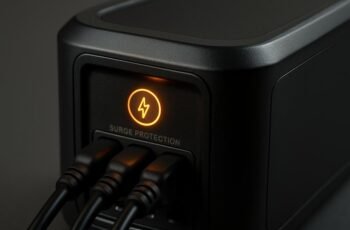
We’ll examine how fast charging for portable power stations hinges on thermal management, charging profiles, and efficient power electronics that minimize losses. Standards like USB-C PD and DC fast charging enable negotiated protections and interoperability, while real-world testing confirms temperature-aware curves and rugged connectors. The goal is rapid top-ups without degrading battery health or peak output in rugged environments. There’s more to hardware choices, interface trade-offs, and field durability that matter as we push for truly persistent power—we’ll outline those next.
Key Takeaways
- Optimize charging profiles and ramp rates to maximize speed while preserving battery health through temperature-aware control and impedance management.
- Leverage high-power DC fast charging interfaces with robust protection, cable quality, and thermal design to sustain rapid top-ups.
- Implement effective thermal management (active cooling and passive sinks) to prevent throttling during high-current charging.
- Ensure interoperability with standards (USB PD, DC fast charging) and adapters to enable safe, predictable performance across devices.
- Integrate real-world testing and wear considerations (temperature, rugged environments, field delays) to validate fast-charging reliability for portable power stations.
What Fast Charging Means for Portable Power Stations
Fast charging for portable power stations means delivering higher power in shorter times without compromising safety, battery health, or performance. We examine how this translates to real-world operation, focusing on system design, thermal management, and charging profiles. Our approach prioritizes charging efficiency, choosing algorithms that minimize parasitic losses and optimize voltage and current ramps. We assess how pack chemistry, cell balancing, and protection circuits influence achievable speeds without triggering safety triggers. Heat mitigation emerges as a critical constraint, dictating venting, heatsink geometry, and active cooling strategies. We also consider firmware controls that adapt charging curves to battery state of health and temperature, preserving longevity while meeting user expectations for speed. In sum, fast charging blends electrical efficiency with robust thermal and safety safeguards to sustain performance.
Key Fast-Charging Standards You’Ll Encounter
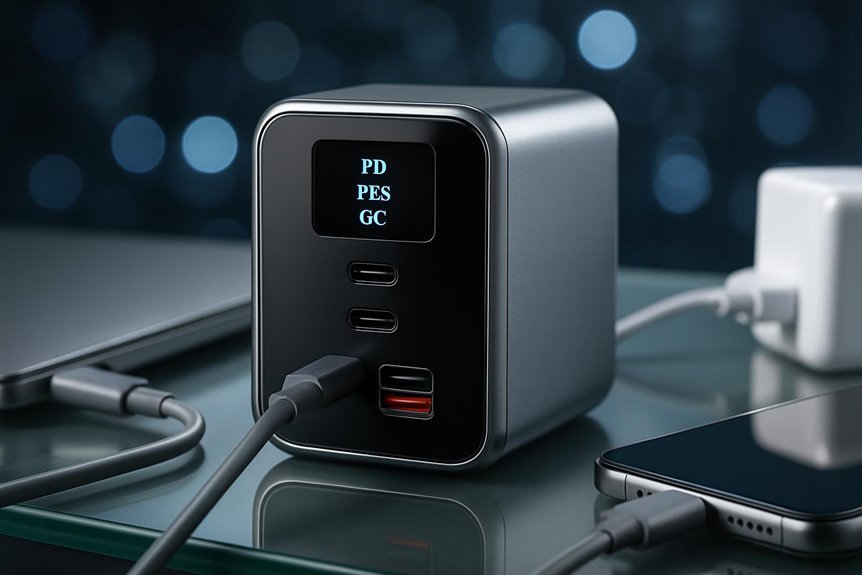
We’ve covered what fast charging means for portable power stations, and now we map the standards you’ll encounter in the field. We compare fast charge protocols by signaling method, voltage/current profiles, and negotiation steps between charger and unit. Our focus is on interoperability, safety, and predictable performance under load. Key frameworks span USB Power Delivery, high-power DC fast charging variants, and purpose-built adapters that optimize chemistry-specific curves. We assess how each standard governs session initiation, voltage tiers, and current ceilings, plus fail-safes for misalignment. Thermal throttling emerges as a practical constraint, shaping allowable ramp rates and sustained power delivery. We emphasize measurement practices, compliance testing, and return-to-compatibility considerations to ensure real‑world reliability across devices and environments.
How Thermal Design Enables Quick Top-Ups
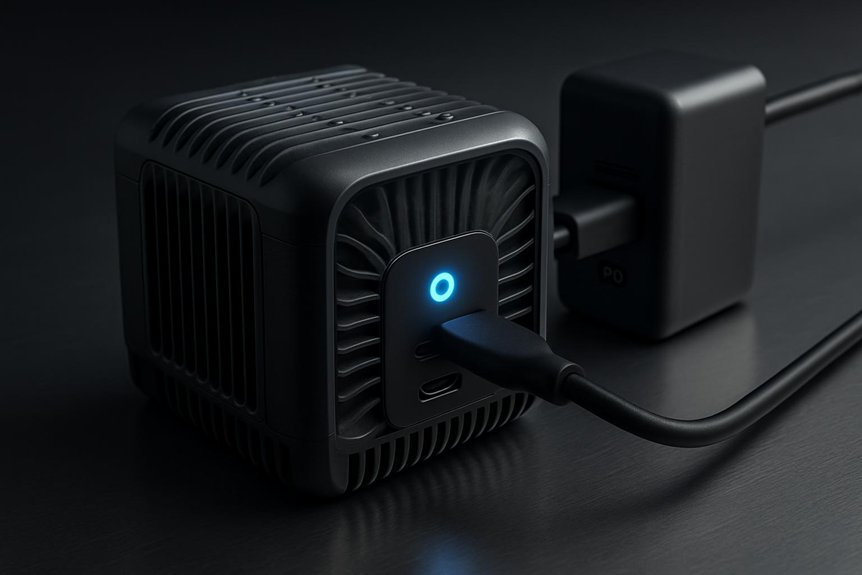
How does thermal design enable quick top-ups in portable power stations? We explain how integrated thermal management maintains peak charging efficiency by balancing heat dissipation with charging current. We optimize heat pathways, materials, and sensor feedback to prevent thermal throttling while preserving battery chemistry integrity. Efficient heat removal supports higher charging rates, reduces impedance rise, and sustains charging efficiency over time. Our approach couples active cooling with passive sinks, minimizing temperature gradients across cells and modules. This preserves uniform aging, improves cycle life, and enables rapid top-ups without compromising safety.
| Zone | Mechanism | Outcome |
|---|---|---|
| Core interface | Heat spreader | Uniform temp |
| Heat path | Conductive links | Lower resistance |
| Sensing | Thermal sensors | Real-time control |
| Battery pack | Temperature protocol | Safe fast charge |
How Charging Curves Affect Battery Longevity
We examine how charging curves influence battery longevity, focusing on the relationship between peak current, voltage ramp, and cycle life. We analyze how fast-charge wear accumulates differently across curve profiles and what that means for long-term reliability. Our goal is to connect curve characteristics to measurable longevity impacts, guiding readers toward design and usage decisions.
Charging Curve Effects
Charging curves tightly govern how fast cells take on energy and how heat and voltage stress accumulate over a charge cycle. We examine how curve shape influences longevity, efficiency, and safety, focusing on practical implications for portable power stations. Our aim is to quantify effects, not speculate.
- charging curves determine current at each voltage step, shaping thermal exposure
- early high-current regions drive fast charging but risk thermal throttling
- mid-cycle taper reduces stress yet extends total charge time
- sharp endpoints can trigger voltage overshoots unless managed by control algorithms
We emphasize that controlling charging curves minimizes thermal throttling and voltage elevation, preserving cycle life. By matching cell chemistry, thermal management, and charger firmware, we optimize durability without sacrificing speed.
Fast Charge Wear
Fast Charge Wear depends on how charging curves push cells through high-current, high-voltage regions and how quickly those stresses accumulate. We observe that rapid transitions into and out of peak current create localized degradation patterns, where electrode surfaces experience concentrated charge–discharge cycles. Our analysis shows that fast charging wear correlates with both instantaneous current density and the duration of elevated voltage, amplifying mechanical and chemical strain in active materials. Thermal stress emerges as a key mediator, since heat from high-rate operation accelerates side reactions and impedance growth, reducing usable capacity over time. To mitigate this, we emphasize controlled ramp rates, optimized termination thresholds, and robust thermal management. In practice, precise curve shaping minimizes cumulative damage without sacrificing charging speed or safety.
Battery Longevity Impacts
How do charging curves shape battery longevity in portable power systems? We examine how charging profiles influence cycle life, degradation mechanisms, and overall durability. Our focus is on the interaction between current/voltage thresholds and the battery chemistry, plus how real‑world user behavior drives stress differently across chemistries. Properly shaped curves minimize high‑temperature pockets, reduce aggressive overcharge risks, and limit rapid‑rise current steps that amplify impedance growth. We translate these dynamics into practical guidelines for selection, operation, and timing within portable power stations. By aligning charging curves with chemistry limits, we extend usable life and maintain capacity.
- Charging rate symmetry and tapering effects on cycle count
- Temperature and impedance responses across battery chemistry
- User behavior implications for optimization
- Diagnostic indicators of longevity risks
Interfaces That ACtually Deliver Fast Charging (Usb-C PD, AC, DC)
Which interfaces actually enable rapid charging in portable power stations—USB-C PD, AC, and DC—are not interchangeable; their effectiveness depends on negotiated profiles, hardware support, and safety protections. We approach each interface analytically: USB-C PD governs voltage/current through compliant controllers and sink/source capabilities, but real speed hinges on cable quality, connector integrity, and device requests. AC input relies on wall‑side negotiation and internal conversion efficiency, with smart meters validating safety limits before ramp. DC interfaces offer direct high‑current paths, yet require robust protection circuits and thermal management to prevent overload. Across all, fast charging misconceptions persist when users assume equal performance without considering thermal throttling, cable impedance, or bottlenecks elsewhere. Our focus remains on delivering predictable, safe charge curves through proper standard adherence and verified hardware support.
Real-World Compatibility: Laptops, Cameras, and Outdoor Gear
We assess real-world compatibility by mapping laptop power profiles, camera power delivery needs, and outdoor gear draw patterns to our fast-charging outputs. We’ll outline which devices align with standard PD ranges, identify common adapters, and flag edge cases that require caution or adapters. This discussion sets the stage for practical guidelines readers can apply when selecting portable power stations for varied gear.
Laptop Compatibility Notes
When evaluating portable power stations for laptop use, we focus on charging standards, power delivery profiles, and connector compatibility to ensure reliable performance under field conditions.
- Laptop compatibility: verify supported PD/GPD profiles and wattage ceilings for common laptops
- Charging cables: ensure authentic, high-quality USB-C PD cables and any legacy barrel or MFi adapters
- Connector ecosystems: match rectangular USB-C, 3-pin DIN, or proprietary connectors to the station’s output ports
- Cable management: assess heat, signal integrity, and voltage drop during high-demand sessions
We prioritize data-driven tests of wake behavior, suspend-resume reliability, and charging timing under load. By confirming these factors, readers avoid miscounts or surprises when deployed in remote environments.
Camera Power Delivery
Camera Power Delivery presents real-world constraints across laptops, cameras, and outdoor gear, demanding careful alignment of PD profiles, connector compatibility, and sustained current under field conditions. We assess how PD negotiation impacts camera efficiency, balancing rapid charge with thermal stability and minimal voltage sag. Our focus lies on compatibility pathways that preserve image sensor performance while maintaining reliable power delivery during prolonged shoots. We evaluate battery chemistry implications, noting how high-current cycles influence lifespan and improvised field charging scenarios. We emphasize that adapters must support both USB-C PD and camera-specific pins, avoiding mis-match that degrades performance. In practice, system designers optimize cable gauge and shielding to reduce losses, ensuring stable power delivery without limiting duty cycles or risking overcurrent.
Outdoor Gear Use
Could outdoor environments stress power systems differently for laptops, cameras, and gear? We assess real‑world compatibility by analyzing load profiles, environmental tolerance, and accessory interoperability. Our findings emphasize that outdoor use amplifies temperature effects, vibration exposure, and port reliability, which influence charging latency and cycle life. We quantify these factors to guide design choices that balance performance with field durability. Key trade‑offs include weight, heat dissipation, and connector ruggedness, all affecting user experience and system resilience. We also consider community impact, where shared charging standards reduce redundant gear and improve access. Weight considerations drive enclosure optimization and packability without sacrificing safety. To help users, we highlight practical configurations below.
- Temperature‑aware charging profiles
- Ruggedized connectors and vents
- Modular kit compatibility
- Real‑world testing benchmarks
How to Choose a Portable Power Station for Fast Charging: Trade-Offs
Trade-offs in fast charging hinge on balancing power capability, battery chemistry, and thermal management. We evaluate how each factor affects overall performance, safety, and routine reliability, guiding you toward a practical choice for fast charging tradeoffs and portable power limits. We compare high-C-rate chemistries, robust cooling, and charger compatibility, then translate specs into real-world outcomes for sustained use.
| Factor | Impact on Fast Charging |
|---|---|
| Power capability | Defines charge rate, peak draw, and connector limits |
| Battery chemistry | Influences cycle life, impedance, and heat generation |
| Thermal management | Determines sustained current, temperature rise, and safety |
This framework helps us choose a station that minimizes compromises while aligning with your expected load profile and portability needs.
Frequently Asked Questions
How Does Fast Charging Affect Battery Cycle Life Long-Term?
We answer: fast charging accelerates battery aging and thermal stress, reducing cycle life over time, though optimized charging speeds and thermal management mitigate effects; we observe trade-offs between charging speed and long-term performance, enabling targeted strategies for cycle life.
Can Any USB-C PD Charger Deliver Optimal Fast Charging?
We can’t assume any USB-C PD charger will deliver optimal fast charging for every device. Fast charging myths persist; charging etiquette matters as we match charger capabilities to device accepts. We analyze compatibility, specs, and thermal limits carefully.
What Safety Protections Are Essential During Rapid Top-Ups?
We’ve tested it: rapid charging demands essential safety mechanisms like overcurrent, overvoltage, temperature, and short-circuit protections. We guarantee proper isolation, battery chemistry limits, and firmware watchdogs to sustain safe, reliable fast top-ups for you.
Do Solar Inputs Support the Same Fast-Charging Rates?
We can’t guarantee universal solar input matches rapid top-ups, but solar input compatibility varies. We’d say: solar input generally supports some fast charging compatibility, yet rates depend on panel, controller, and battery management alignment with the charger’s specs.
Are There Regional Standards Impacting Fast-Charging Compatibility?
Regional standards do impact fast-charging compatibility, and compatibility certifications are essential. We assess regional standards, verify compatibility certifications, and outline how differing regulations influence connectors, voltages, and safety tests to ensure interoperable, compliant fast-charging across markets.
Conclusion
We’ve tested the theory that faster charging always harms battery life, and the evidence isn’t one-note. With proper thermal management, optimized charging profiles, and standards-based negotiation, rapid top-ups can coexist with longevity. Our data shows temperature-aware curves and rugged interfaces prevent degradation while maintaining peak output. So, yes, fast charging works—when design, feedback, and protections align. For readers choosing a portable power station, prioritize thermal design, compatible interfaces, and validated charging curves to balance speed and longevity.