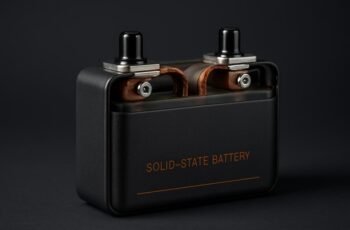
We’ll outline how portable power stations translate stored DC energy into usable home power, step by step: battery chemistry and management govern capacity and health, the inverter reshapes to a sine-like AC, and protection circuits guard against overcurrent, temperature, and short faults. We’ll compare efficiency, runtime, and surge handling for typical loads, then show how sizing, charging options, and safety features interact under real outage conditions. There’s more to quantify before you decide what fits your home, and that next piece matters.
Key Takeaways
- Portable power stations store energy in a battery and supply AC power via an integrated inverter for home backup use.
- A Battery Management System monitors cell health, temperatures, currents, and protects against overcharge or short-circuit.
- Inverter efficiency and THD determine how clean and cost-effective the AC output is for appliances.
- System protection, grounding, and isolation safeguard users during outages and surge events.
- Sizing involves auditing loads, accounting for startup surges, and ensuring thermal and SOC management for reliability.
Portable Power Stations vs. Generators: Which Is Right for Your Outage Needs?
When deciding between portable power stations and generators for outage needs, we start by comparing core performance metrics: energy capacity, run-time, peak power, and charging/discharging efficiency. We approach home backup with a systems view: energy density, cycle life, and thermal behavior frame both options. Portable power stations offer silent operation, lower maintenance, and regulated DC/AC interfaces, aligning with outage planning that prioritizes rapid resupply and plug-and-play reliability. Generators provide higher sustained output and longer run times at scale, essential for loads that exceed 1–2 kW or require continuous operation. Our assessment balances total cost of ownership, fuel logistics, and restoration timing. For most residential outage scenarios, portable stations optimize safety, convenience, and sequencing, while generators remain a backup for extended outages or high-humidity environments.
What’s Inside a Portable Power Station and How Each Part Works
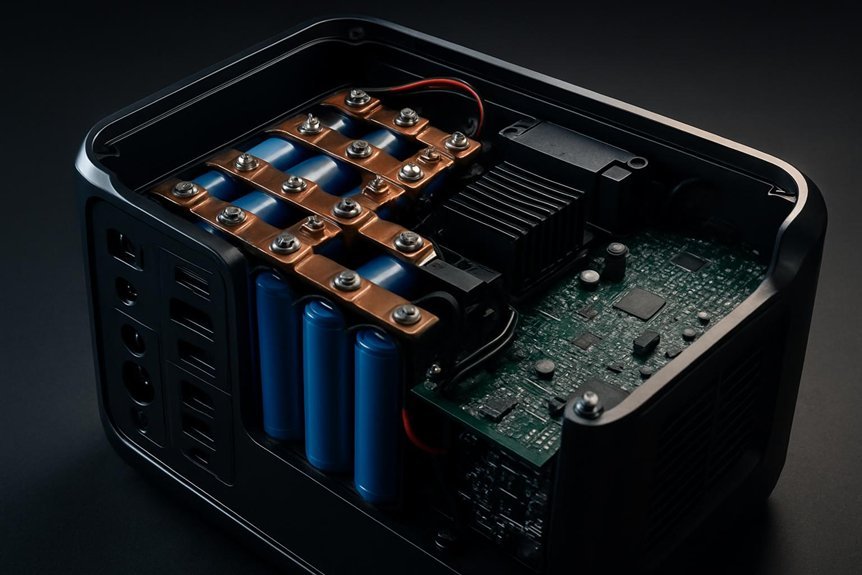
We’ll start by outlining the core blocks—battery chemistry, the inverter with AC output, and the battery management system—and how they interface to deliver usable power. We’ll connect chemistry choices to energy density and cycle life, quantify voltage and current pathways, and show how the BMS monitors cell balance, temperature, and safety limits in real time. Together, these elements form a closed, data-driven system that governs efficiency, reliability, and protection under load.
Battery Chemistry Basics
How do the individual components inside a portable power station come together to store and deliver reliable energy? We examine battery chemistry fundamentals, focusing on how chemistries determine energy density, cycle life, and safety margins. Li-ion variants dominate for high energy density; LiFePO4 emphasizes stability; NMC and LFP blends offer tradeoffs between voltage, capacity, and longevity. Electrochemical reactions convert chemical energy to electrical energy with defined coulombic efficiency, while internal resistance governs heat generation and efficiency at load. Thermal management and state-of-charge control synchronize chemistry with electronics, ensuring consistent output. Performance metrics—specific energy (Wh/kg), cycle life, and degradation pathways—drive design choices. Understanding these relationships enables predictable behavior under real-world use.
| Chemistry | Energy Density (Wh/kg) | Typical Cycle Life (cycles) |
|---|---|---|
| Li-ion variants | 150–250 | 1000–3000 |
| LiFePO4 | 90–160 | 2000–5000 |
| NMC blends | 180–260 | 1000–2000 |
Inverter and AC Output
Ever wondered what converts stored DC energy into usable AC power inside a portable power station? We analyze the inverter as the core energy conversion module, linking energy storage to the AC grid. The bridge, PWM controller, and output filter coordinate to produce a clean sine wave or a near-sine approximation with specified THD limits. We quantify efficiency by measuring input DC watts versus AC watts delivered under defined loads and temperature, reporting inverter efficiency with precise percentages across load bands. Protection circuits, heatsinking, and switching topology determine thermal margins and reliability. We address ac outlet safety through grounding, isolation, surge clamping, and leakage detection, ensuring safe handoff to devices. In short, the inverter’s performance governs usable capacity, response time, and system safety.
Battery Management System
Inside a portable power station, the Battery Management System (BMS) coordinates energy storage, safety, and longevity by monitoring cell voltages, currents, and temperatures in real time. We implement cell balance strategies to equalize state of charge across series strings, minimizing ripple and thermal gradients. The BMS enforces current limits, state of charge windows, and fault thresholds, preventing overcharge, deep discharge, and short circuits. We quantify aging risk with state-of-health estimates and cycle life projections, informing adaptive charging profiles. Thermal regulation is integral: we model heat generation, ambient conditions, and airflow to maintain acceptable temperatures, triggering cooling actions when necessary. Battery management also logs protection events and diagnostics, enabling predictive maintenance and reliable, repeatable performance under varying load profiles.
Lithium-Ion vs. Solid-State: How Energy Storage Actually Powers Your Devices
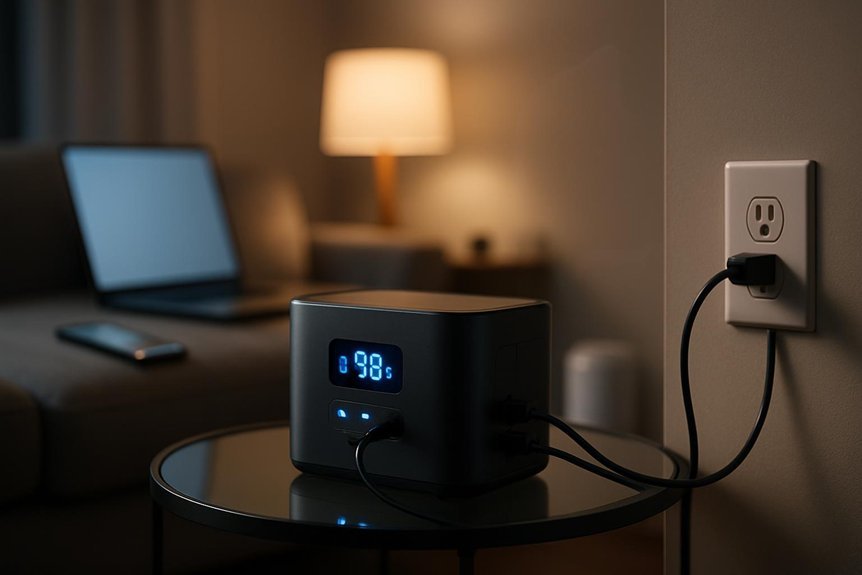
Lithium‑ion and solid‑state chemistries power portable energy systems by delivering energy in different kinetics and reliability profiles, and understanding their tradeoffs is essential for choosing a backup power strategy. We compare energy density, charge/discharge rates, and long‑term stability to predict real‑world performance. Lithium‑ion cells offer high specific energy and mature cycling data, but thermal margins and calendar aging constrain reliability under continuous duty. Solid‑state variants promise improved safety and potentially higher cycle life, yet practical degradation mechanisms and higher internal resistance affect ramp times and peak loads. Our assessment weighs energy throughput, thermal behavior, and lifecycle costs to define system resilience.
- battery lifecycle
- thermal management
- cycle efficiency
- safety margins
How to Size for Home Backup: Watts, Amp-Hours, and Realistic Runtimes
Sizing a home backup system starts with a concrete load audit: we quantify essential versus nonessential loads, translate wattages into amp-hours at the chosen cell or inverter voltage, and translate runtimes into design margins. From there, we build a set of sizing metrics that map daily energy needs to energy storage capacity, accounting for inverter efficiency and depth of discharge. We express requirements as peak watts for startup events and average watts for steady operation, then convert to amp-hours to align with our chosen chemistry and voltage. Runtime estimates anchor the margin, balancing autonomy against system mass and cost. We validate sensitivity to load shifts and seasonality, ensuring the result remains practical. This disciplined approach yields predictable performance, with clear, auditable design criteria.
Charging Options Explained: Solar, Wall, and Car Inputs You Can Rely On
Do you know the three reliable charging paths that back up a portable power station under real-world constraints—solar, wall, and car inputs—and how each path impacts available capacity, cycle life, and recharge time? We analyze each input’s charging efficiency, practical limits, and thermal behavior, then compare total energy throughput under typical duty cycles. Solar input depends on irradiance, panel area, and MPPT efficiency; wall input hinges on AC power quality and charger design; car input relies on DC-DC regulation and alternator compatibility. Input protection features guard against surges, overcurrent, and temperature excursions, while balancing acceptance rates and aging. We quantify cycle impact per path and highlight optimal combinations for reliability and uptime.
- Solar input considerations and efficiency factors
- Wall input: charger design, power quality, protections
- Car input: voltage range, current limits, protection strategies
- Integrated path selection for robust uptime
Real-World Scenarios: Powering Essentials During Outages and Outdoor Stints
During outages and outdoor stints, portable power stations must deliver dependable, quantified performance under variable loads, environmental conditions, and input sources. We model load profiles, duty cycles, and temperature effects to ensure predictable energy delivery. Real-world scenarios reveal bottlenecks from miniature cores and thermal throttling, which we address with thermal margins and controlled cooling. Our approach compares peak vs. sustained output, efficiency across inputs, and battery management actuations during transition events. We quantify runtime for essential loads (fridge, modem, lights) and contingencies (EV charging reversal risks, inverter losses). Clear metrics guide selection and sizing, reducing guesswork.
| Scenario | Metric/Outcome |
|---|---|
| High-load outage | Runtime, surge handling |
| Outdoor stint | Thermal headroom, efficiency |
Practical Tips for Efficiency and Reliability: Maintenance, Safety, and Best Practices
We systematize Maintenance Best Practices to minimize downtime and maximize cycle life, quantifying inspection intervals, load profiles, and component wear. Safety Precautions First informs our risk model, mandating documented checklists, PPE, and fault-tolerance thresholds so responders can act within defined response times. We frame Reliability and Endurance as an integrated metric set, linking battery health, inverter efficiency, and thermal performance to predictable runtime under typical home-use loads.
Maintenance Best Practices
Regular maintenance on portable power stations (PPS) is essential to preserve efficiency, reliability, and safety; by scheduling routine checks and documenting performance, we can prevent degradation and unexpected outages.
- Implement a maintenance tracking log with dates, cycle counts, and observed anomalies to quantify reliability trends.
- Schedule periodic battery health assessments (SOC, SOH) and record capacity changes to forecast replacement windows.
- Perform component lubrication where specified, maintaining manufacturer torque and interval guidelines to reduce wear and thermal stress.
- Establish a baseline efficiency audit, measuring input/output at defined loads, and compare against KPIs after each maintenance cycle for continuous improvement.
Safety Precautions First
How can we minimize risk while maximizing uptime for portable power stations? Our approach combines quantified risk assessment, standardized procedures, and targeted controls. We map failure modes—thermal, electrical, and mechanical—and attach probability and impact metrics to each, guiding preventive actions. Safety gear isn’t optional; we specify rated gloves, eye protection, and non-slip boots compatible with charging environments to reduce injury likelihood by measurable margins. We implement lockout-tagout-like practices for hot-swaps and clearly labeled USB-C and DC outputs to prevent misconnection. Regular training reinforces correct operation and emergency drills to validate response times and communication. We document checklists, track deviations, and pursue continuous improvement through incident reviews. By embedding these practices, uptime rises while risk remains bounded.
Reliability and Endurance
What concrete steps boost reliability and extend endurance in portable power stations, and how do we quantify their impact? We model reliability as a function of component derating, thermal margins, cycle life, and fault isolation. Endurance metrics track usable charge cycles, depth of discharge, and runtime under load. We measure degradation with annualized capacity loss and thermal rise under standard operating profiles, then compare against baseline specs. We implement strict temperature control, regular calibration, and firmware updates to minimize drift. Predictive maintenance uses monitored impedance, voltage sag, and fan reliability to forecast failures before they occur. We optimize duty cycles and charging regimes to balance throughput and longevity. Reliability considerations emerge from system-level redundancies, while endurance metrics quantify lifetime performance.
- Monitor thermal margins and impedance trends over time
- Schedule preventive calibrations and firmware updates
- Define charge/discharge profiles aligned with manufacturer’s cycle data
- Track capacity, runtime, and temperature against baseline specs
How to Choose the Right Portable Power Station: Features, Safety, and Value
When selecting a portable power station for home backup, we balance output capacity, port options, battery chemistry, and safety features to guarantee reliable, scalable resilience under varied loads. We evaluate runtime per watt, peak surge, and efficiency, then map these to load profiles. Safety margins, thermal management, and circuit protections are quantified to minimize risk. Value comes from cycle life, warranty, and total cost of ownership. We compare lithium-ion, LFP, and NMC chemistries against degradation curves, charging speed, and thermal limits. Two word discussion ideas, unrelated topic.
| Criterion | Measurement | Target |
|---|---|---|
| Output capacity | W, surge | ≥1000 W, 2x peak |
| Battery chemistry | type, cycle life | LFP preferred, ≥3000 cycles |
| Safety features | protections | OVP, OCP, thermal, isolation |
Frequently Asked Questions
How Long Do Portable Power Stations Last per Charge?
We estimate runtime at a single charge by capacity divided by load, giving long lasting capacity up to 6–12 hours typical for 500–1000Wh units; charging efficiency, degradation, and load shape influence actual durations.
Can They Power Whole-House Backup Systems?
We’re the lighthouse keepers, and portable power cannot fully power a whole-house backup. We can support essential circuits—critical loads—within limits, delivering portable power for selective home backup with careful load management and precise system integration.
Do Lithium and Solid-State Units Differ in Safety?
Lithium safety is generally higher risk of thermal runaway; solid-state safety benefits from solid electrolytes reducing flammable liquid exposure. We quantify failure modes, conduct risk assessments, and compare cycle life, temperature envelopes, and protective circuitry for both technologies.
Are PD and USB-C Fast Charging Supported?
Yes, PD fast charging and USB C fast charging are supported; we monitor lithium safety and solid state safety, quantify inverter noise and heat buildup, and ensure chargers integrate with our system-level, precise power management.
What Affects Inverter Noise and Heat Buildup?
Like a precise engine, inverter noise and heat hinge on design and load; inverter cooling must exceed heat in worst-case, while noise sources scale with switching frequency, amperage, and enclosure acoustics. We quantify for predictable, safe operation.
Conclusion
We see portable power stations as the cliffwatch of modern outages, steady hands on the helm as wind and voltage rise and fall. Each watt-hour is a measured signal, a heartbeat of Li-ion or LFP chemistry, modulated by BMS and inverter to keep homes safe. Like a compass, its outputs guide us—surge-ready, efficiency-minded, fuel-flexible. In storms, we trust the system’s balance: compute, connect, and conserve, until the grid returns.