Much like the silent current flowing beneath the surface of a river, the differences in runtime between AC and DC outputs often go unnoticed until their impact becomes critical. These variations hinge on factors like voltage stability and conversion efficiency, which directly influence device longevity and energy consumption. Understanding these nuances is essential for optimizing power systems, especially in portable or high-demand applications. Let’s explore how these fundamental differences shape performance and determine the best choices for specific needs.
Key Takeaways
- DC provides more stable voltage, resulting in longer runtime for batteries and portable devices.
- AC systems experience energy losses due to conversion processes, reducing overall runtime efficiency.
- DC’s unidirectional flow minimizes energy dissipation, extending device operational periods.
- AC power distribution involves multiple conversion steps, which can decrease runtime due to efficiency losses.
- Applications requiring sustained power, like backup systems, benefit more from DC’s longer and more stable runtime.
How Do AC and DC Power Differ in Runtime Duration?
How do AC and DC power differ in runtime duration? The main distinction lies in their electrical characteristics and how they deliver energy. Alternating current (AC) fluctuates periodically, which can lead to efficiency losses over long distances, potentially reducing runtime in power transmission. Conversely, direct current (DC) maintains a constant voltage, offering more predictable and stable energy delivery. This stability often results in longer runtime for batteries and portable devices powered by DC, especially when energy conservation is critical. Additionally, DC’s steady flow minimizes energy losses in specific applications, extending operational periods. While AC is typically used for large-scale power distribution, DC’s consistent output provides advantages in applications where runtime and energy efficiency are paramount.
Factors That Influence AC and DC Runtime Performance
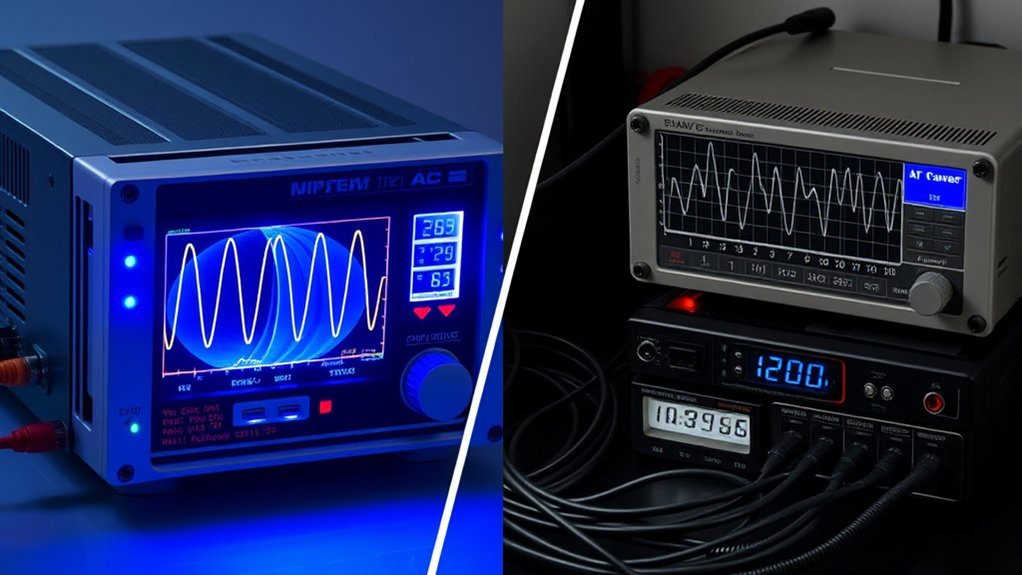
Several factors profoundly influence the runtime performance of both AC and DC power systems, with the efficiency of energy transfer and the characteristics of the load playing crucial roles. Voltage stability is critical; fluctuations can lead to power loss or system failure, reducing runtime. Stable voltage ensures consistent energy delivery, maximizing efficiency. Load management also considerably impacts performance; proper distribution and regulation of load prevent overloads and minimize energy waste. High load variability can cause inefficiencies, shortening runtime. Additionally, wiring quality, system design, and the capacity of power sources influence how effectively energy is conserved over time. Understanding these factors helps optimize system performance, ensuring reliable operation and extended runtime for both AC and DC configurations.
Comparing Battery Life and Efficiency: AC vs DC
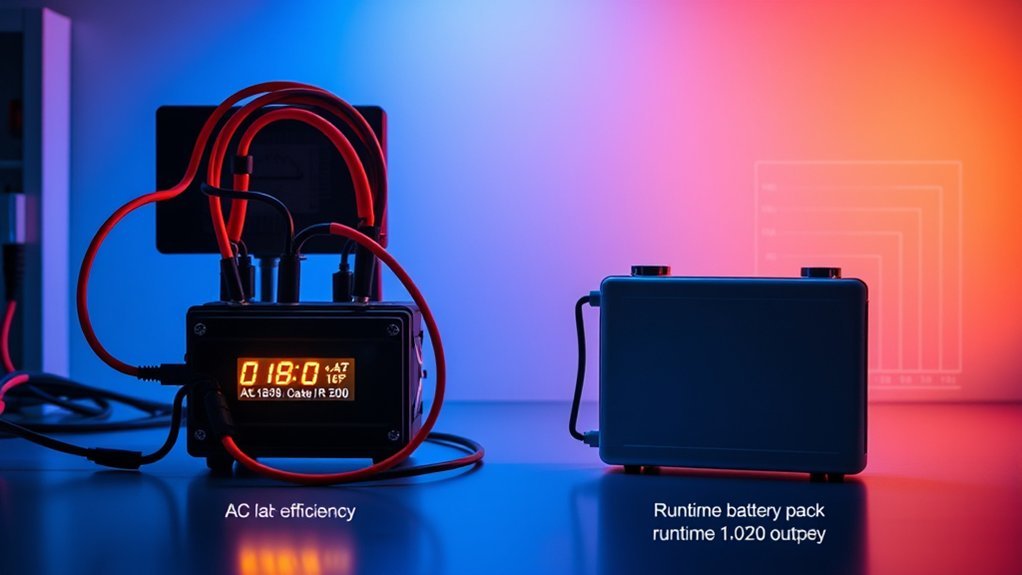
When comparing battery life and efficiency between AC and DC systems, it’s essential to recognize that DC power typically offers higher overall efficiency due to its direct, unidirectional flow, which minimizes energy losses during transmission. DC systems generally provide better voltage stability, reducing fluctuations that can cause additional power conversion losses. Since DC power requires less conversion, it preserves energy more effectively, extending battery life. In contrast, AC systems depend heavily on power conversion processes, such as rectification and inversion, which introduce additional inefficiencies and increase energy dissipation. These conversion steps not only reduce overall efficiency but can also impact voltage stability, leading to increased stress on power sources. Consequently, DC configurations tend to deliver longer runtimes, especially in applications where minimizing power loss during transmission and maintaining stable voltage levels are critical.
Practical Applications: When Does Runtime Matter Most?
In practical scenarios, the importance of runtime varies considerably based on application demands and operational priorities. For example, in emergency backup systems, extended runtime guarantees continuous power, making battery technology and efficient power conversion critical. Similarly, portable devices, such as medical equipment or field sensors, require sustained operation to prevent data loss or malfunction. In these cases, the choice between AC and DC output directly impacts runtime, with DC often offering better efficiency due to reduced power conversion losses. Additionally, renewable energy systems rely on prolonged runtime to maximize energy utilization, emphasizing ideal battery technology. Understanding when runtime is most critical helps us select the appropriate power systems and design solutions that meet specific operational needs, ensuring reliability and efficiency in real-world applications.
Tips to Maximize Power Output for AC and DC Devices
To maximize power output for both AC and DC devices, optimizing the entire power delivery chain, starting from source selection to load management, is vital. Guaranteeing power stability through consistent voltage regulation minimizes fluctuations that can impair device performance. Proper voltage regulation maintains a steady voltage level, preventing overvoltage or undervoltage conditions that reduce efficiency and lifespan. For AC systems, using quality transformers, filters, and regulators ensures minimal power loss and stable delivery. In DC systems, implementing high-quality regulators and filtering components reduces noise and voltage dips. Additionally, managing load distribution prevents overloading any single component, which can cause voltage instability. By focusing on these aspects, we improve overall power stability, maximize output efficiency, and extend device operational longevity.
Frequently Asked Questions
How Does Temperature Affect AC and DC Runtime?
Temperature impacts both AC and DC runtime by affecting battery chemistry and power efficiency; higher temperatures can degrade batteries, reducing runtime, while lower temperatures may hinder chemical reactions, also decreasing overall efficiency and operational duration.
Can Inverter Quality Impact AC and DC Device Durations?
Surprisingly, inverter quality notably impacts device durations through inverter efficiency and power quality; high-quality inverters optimize energy transfer, reducing losses, and ensuring consistent power, ultimately extending both AC and DC device runtimes effectively.
What Safety Concerns Influence Runtime in AC Vs DC Systems?
We recognize that battery degradation and power surges pose safety concerns influencing runtime in AC versus DC systems; these factors can cause system instability, reduce efficiency, and necessitate protective measures to guarantee safe, reliable operation during extended use.
How Do Load Fluctuations Alter AC and DC Runtime Stability?
Load fluctuations impact both AC and DC runtime stability through voltage regulation challenges and frequency stability issues, causing variations in power delivery. We observe that AC systems tend to experience more fluctuation-related instability, whereas DC systems maintain steadier runtime under similar conditions.
Are There Environmental Factors That Affect AC and DC Power Longevity?
Environmental factors like temperature, humidity, and electromagnetic interference impact power longevity by affecting voltage stability and power grid performance, causing fluctuations that can accelerate wear in AC and DC systems, ultimately reducing their operational lifespan.
Conclusion
Understanding the nuances between AC and DC power reveals more than just runtime differences; it hints at the future of energy efficiency. As technology advances, the choice between AC and DC becomes increasingly critical in optimizing device longevity and performance. Are we truly harnessing the full potential of these systems? The answer lies in ongoing innovations and deeper insights—because sometimes, the key to longer-lasting power isn’t just about the current, but what’s on the horizon.