We’re practical about power, and—what a coincidence—we’re often asked to balance weight, efficiency, and lifecycle costs in one system. We frame Hybrid Gas–Battery portable power as an optimized bridge: batteries smooth transients while a gas generator recharges on the fly, with smart control aligning fuel use, emissions, and duty cycles. We’ll outline core components, sizing, and management strategies to keep you productive, quiet, and ready for field conditions, but the specifics that matter most may surprise you.
Key Takeaways
- Hybrid gas–battery portable power systems combine a gas engine or turbine with a rechargeable battery to deliver energy on demand.
- The battery buffers transients and supports rapid response during high-demand episodes, while the engine replenishes energy for extended runtime.
- Core architecture includes gas engine, electric motor, battery pack, power electronics, and a control unit with modular interfaces.
- Key design goals emphasize fuel efficiency, reduced emissions, thermal management, noise control, and safety across varying field loads.
- Use-case orientations include camping versatility, construction-site reliability, and emergency power readiness with scalable, fault-tolerant operation.
What Problem Hybrid Gas–Battery Power Systems Solve for Outdoor Power Needs
Hybrid gas–battery power systems address a core mismatch in outdoor power needs: the demand for high energy density, quick recharging, and reliable runtime across variable terrains and durations. We frame the problem systemically: operations require sustained power, minimal downtime, and adaptable duty cycles. By combining internal combustion generation with electric energy storage, we optimize energy flow, reduce weight per usable kilowatt, and tailor runtime to mission profiles. Our approach assesses tradeoffs among energy density, recharge time, and thermal management, guided by interdisciplinary methods from thermodynamics, control theory, and lifecycle analysis. We prioritize environmental impact and regulatory compliance, integrating emissions, noise, and safety constraints into design criteria. The resulting solution improves reliability, lowers total cost of ownership, and supports scalable performance across diverse outdoor contexts.
What Hybrid Gas–Battery Portable Power Systems Are and How They Work

What exactly are hybrid gas–battery portable power systems, and how do they function in practice? We’ll explain the hybrid concept by framing how a gas engine or turbine augments a rechargeable battery, delivering energy on demand while maintaining efficiency. Our approach highlights system boundaries, control strategies, and performance tradeoffs, ensuring reproducible results across contexts. In operation, electrical power is drawn from the battery for high-demand episodes, with the furnace or engine replenishing it during steady loads, improving runtime and resilience. The method remains optimization-focused: minimize fuel use per delivered watt, reduce emissions, and manage thermal loads.
| Mode | Source | Effectiveness |
|---|---|---|
| — | — | — |
| Battery-first | Onboard fuel | Fast response |
| Boost recharge | Engine duty | Extended runtime |
| Hybrid control | Smart logic | Stable output |
Core Components and How They Connect in a System
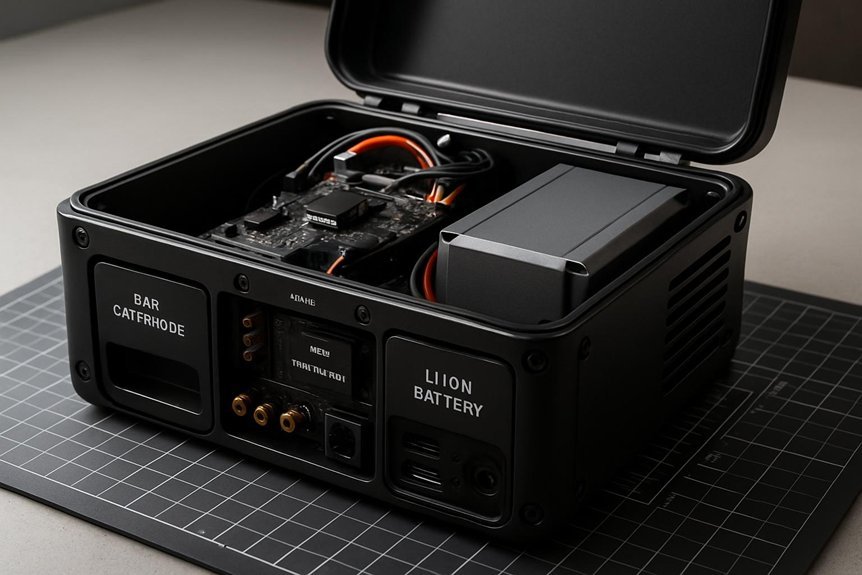
We’ll outline the core components, show how each connects within a system, and frame the data flows for optimization. We’ll compare mechanical, electrical, and control interfaces to reveal efficient connection methods and interoperability. We’ll then discuss how power flow management integrates these elements to balance performance, reliability, and safety.
Core Components Overview
How do the core components of a hybrid gas-battery portable power system fit together to deliver reliable, efficient energy? We map the system mainstays—gas engine, electric motor, battery pack, power electronics, and control unit—into an integrated loop. Each component has a defined role: the gas engine supplies high-energy bursts and long-endurance runtime, the battery buffers transients, and the motor converts electrical power to mechanical work. Power electronics synchronize voltage, current, and speed, while the control unit optimizes operation across modes. We assess interfaces for thermal management and safety margins, ensuring minimal losses and predictable performance. Our focus on battery chemistry and fuel efficiency guides material choices, cooling strategies, and energy management algorithms, delivering a balanced, adaptable platform suitable for varying load profiles and mission requirements.
System Connection Methods
System connection methods bind the core components—gas engine, electric motor, battery pack, power electronics, and control unit—into a cohesive, optimized loop. We frame interfaces as interoperable modules, specifying standardized power interfaces, communication protocols, and mechanical couplings that minimize parasitics and delay. Our approach emphasizes modularity, robust tolerancing, and fault isolation, enabling rapid iteration across gas-battery topologies. We map the system connection to functional roles: energy reservoir, propulsion actuation, power conversion, and control orchestration, ensuring minimal energy losses and predictable thermal paths. We prioritize scalable cabling, compact packaging, and EMI/EMC considerations to preserve signal integrity. By defining clear interfaces and acceptance criteria, we reduce integration risk, improve reliability, and support cross-disciplinary optimization for overall system performance.
Power Flow Management
Power flow management in this hybrid system hinges on a clear sequencing of generation, storage, conversion, and propulsion demands, with tight coordination between gas engine output, battery state, and power electronics. We present an architecture-driven view: sensed loads drive optimization, which allocates gas and battery contributions, then routes energy through power electronics to the propulsion interface. State estimation, predictive control, and fast-acting converters minimize waste and maximize efficiency under variable conditions. Interdisciplinary inputs—thermodynamics, battery chemistry, electronics, and control theory—shape policies for charge/discharge cycles, engine ramp rates, and fault tolerance. We trace history trends and acknowledge theoretical debates that inform model choice, reliability margins, and tradeoffs. This systematic perspective guides practical design, resilience, and scalable operation in fielded portable systems.
Use Cases: Camping, Construction Sites, and Emergency Power
We’re examining how our hybrid power system delivers Camping Power Versatility, Construction Site Reliability, and Emergency Power Readiness across real-world scenarios. By aligning fuel flexibility, battery buffering, and intelligent switching, we optimize performance for outdoor use, rugged jobsites, and outage resilience. This interdisciplinary view helps us prioritize efficiency, safety, and uptime for readers planning flexible power solutions.
Camping Power Versatility
How can portable hybrids adapt to real-world campsites, construction sites, and emergencies with minimal fuss and maximal reliability? We answer by optimizing modular power, balancing gas and battery roles, and streamlining setup for outdoor charging efficiency. We coordinate energy sources, load profiles, and weather considerations to minimize downtime and maximize reliability across sites. Our approach integrates lifecycle analytics, rapid-start generation, and silent hybrid operation for quiet, safe use in tents or job sites. We emphasize fuel logistics, contingency runtimes, and scalable a/c or dc outputs to support essential gear without overprovisioning. This systematic, interdisciplinary method yields robust, repeatable results.
| Column 1 | Column 2 |
|---|---|
| Streamlined setup | Real-time load matching |
| Silent operation | Rapid-transition controls |
| Outdoor charging | Fuel logistics optimization |
| Modular scalability | Cross-site consistency |
Construction Site Reliability
Construction sites demand dependable, modular power that adapts to varied tasks and harsh conditions, so we apply a systematic, interdisciplinary approach to optimize uptime across camping, on-site use, and emergencies. We coordinate power sources, storage, and control systems for reliable performance, emphasizing redundancy where feasible. Data logging informs maintenance cycles, usage patterns, and fault detection, enabling rapid issue isolation and reduced downtime. Cross compatibility across components—gas generators, batteries, inverters, and connectors—ensures seamless integration and simplifies field upgrades. We quantify reliability through mean time between failures, cycle life, and throughput consistency, adjusting configurations to task profiles. By documenting tests, simulations, and field feedback, we sustain optimization loops that elevate site readiness while minimizing size, weight, and fuel use.
Emergency Power Readiness
In emergency power readiness, we align camping, construction sites, and contingency scenarios under a unified, data-driven framework to ensure rapid, reliable power recovery when it’s most needed. Wemodel hybrid endurance and fuel variability to balance performance, safety, and cost, delivering actionable thresholds for seamless transitions between modes. Our approach integrates sensing, forecasting, and redundancy to minimize downtime across use cases, from remote campsites to busy job sites, while preserving sustainability goals. By benchmarking components and workflows, we optimize charge-discharge cycles, logistics, and maintenance intervals, clarifying responsibilities and response times. This interdisciplinary lens enables robust decision-making under uncertainty, supporting rapid reconfiguration and recovery.
- Establish readiness metrics and response timelines
- Align fuel, battery, and generator capabilities with site demands
- Schedule proactive maintenance and reliability testing
How to Choose the Right System: Capacity, Weight, Runtime, and Efficiency
What matters most when selecting a hybrid gas-battery system is understanding how capacity, weight, runtime, and efficiency interact to meet your specific load profile. We approach this systematically, weighing trade-offs across disciplines: energy density, thermal management with variable cooling, power quality, and lifecycle costs. We quantify capacity against peak and average draw, then map weight to transportability and inertia. Runtime is forecast from load duration curves, while efficiency governs fuel use and battery aging. We compare systems by modularity, warranties, and warranty terms to manage risk and serviceability. Optimization proceeds through scenario analysis, sensitivity tests, and Monte Carlo propulsion of uncertainties. Informed decisions balance capital, operating expenses, and reliability, ensuring the selected hybrid delivers predictable performance under real-world duty cycles.
Managing Noise, Emissions, and Safety Considerations
We start by acknowledging that noise, emissions, and safety are integral constraints across all hybrid gas-battery configurations. Our approach blends engineering rigor, safety standards, and environmental stewardship to optimize performance without compromising reliability or user experience. We focus on systematic trade-offs, interdisciplinary methods, and practical metrics, ensuring clear pathways for implementation. Key levers include targeted noise reduction strategies, scrubber design considerations, and robust containment practices that minimize spill and leak risks. By iterating on architectures, we quantify impacts and converge on solutions that balance weight, cost, and efficiency.
- Noise reduction techniques and placement optimization
- Scrubber design integration with exhaust and cooling loops
- Safety protocols, diagnostics, and fail-safes for hybrid operation
Smart Power Management: Charging, Fueling, and Mode Transfer
How can we orchestrate charging, fueling, and mode transfer to maximize efficiency while guaranteeing safety and responsiveness across hybrid gas-battery systems? We approach this with a structured, interdisciplinary framework. We define objective functions that balance charging strategies, fuel efficiency, system latency, and thermal limits. Our strategy aligns battery state-of-charge targets with generator ramping profiles, ensuring seamless transitions between electric and combustion modes. We implement predictive control that leverages real-time telemetry, weather, and load forecasts to precondition components and minimize idle losses. Redundancy and fault-tolerant sequencing preserve responsiveness under variability. We evaluate trade-offs through sensitivity analyses, establishing robust policies that adapt to runtime constraints. This disciplined orchestration yields reliable performance gains while maintaining safety, efficiency, and control transparency for operators.
Maintenance, Durability, and Reliability in the Field
- Implement proactive durability testing schedules informed by duty cycle analytics.
- Deploy ruggedization and modular designs that simplify on-site field maintenance.
- Establish rapid recovery playbooks with remote support and spare-part alignment.
Budgeting and Getting the Most Value Over Time
What’s the most cost-effective path to sustaining a hybrid gas-battery system over its lifecycle, without sacrificing performance or reliability? We align budgeting with design targets, deploying a disciplined, multidisciplinary framework. We map total cost of ownership, balancing upfront capital with ongoing operating expenses, fuel, maintenance, and end-of-life replacement. We prioritize modular components, standardized interfaces, and scalable capacity to reduce sunk costs and downtime. By establishing budgeting nuances, we quantify risk-adjusted returns for different usage scenarios, charging regimes, and environmental conditions. We implement value tracking across procurement, operation, and amortization, using transparent metrics that inform continuous improvement. This approach embeds optimization: choose components that maximize reliability per dollar, schedule maintenance to extend life, and re-evaluate assumptions as usage evolves. Informed decisions sustain performance and maximize long-term value.
Frequently Asked Questions
How Long Does a Hybrid System Take to Recharge Fully?
We standardize on a recharge window of several hours, depending on state-of-charge and power source. We evaluate reliability tradeoffs and charging speed across chemistries, cycles, and temperatures, optimizing integration for safety, efficiency, and user expectations.
Can You Mix Different Battery Chemistries in One System?
Yes, we don’t recommend mixing chemistries due to charging compatibility risks. We optimize safety and performance by using compatible hybrid chemistry modules, standardizing chargers, and coordinating management systems across components for reliable, efficient operation.
What Is the Expected Lifespan of the Generator Component?
The generator lifespan typically ranges 5–15 years with use, and recharge duration depends on load and charging method; we optimize by balancing duty cycles, maintenance, and fuel efficiency to maximize overall system reliability and performance for you.
Are There Portable Options With Solar Charging Compatibility?
Yes, we offer portable options with solar compatibility; they optimize charging efficiency, weight, and runtime, coordinating solar input with battery management, generator support, and load profiles for systematic, interdisciplinary efficiency gains.
How Easy Is It to Upgrade the Battery Capacity Later?
We’ve found the upgrade path is straightforward when first checking compatibility considerations; we stride through components together, coincidentally noting compatible chemistries, connectors, and BMS limits, then plan scalable capacity steps, optimizing weight, safety, and performance for you.
Conclusion
We’ve seen how hybrid gas–battery power systems synergize energy buffers with rapid replenishment, turning intermittent outdoor demands into steady performance. As we map capacity, weight, and efficiency, coincidences emerge—a peak load mirrors a fuel injection cadence, a quiet night coincides with optimized idle control. By integrating smart management, modular components, and rugged durability, we optimize lifecycle cost and reliability. Together, we choose, tune, and trust these systems to sustain action, anywhere, anytime.