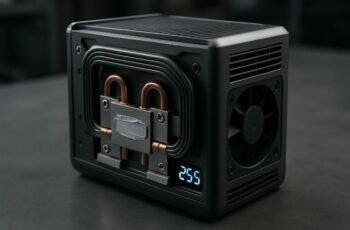
Solid-state batteries promise higher energy density and safer operation for future portable power stations, with 1,000–2,500 cycle lifespans in aggressive tests and system efficiencies approaching 92–97%. We see gains from integrated module designs, advanced thermal management, and fast BMS, enabling 2C–5C charging. Yet real-world performance, cost tradeoffs, and adoption hurdles at camping, job sites, or emergencies require careful, data-driven assessment. Let’s examine how these factors influence design choices and the value proposition as we move forward.
Key Takeaways
- Solid-state power stations replace liquid electrolytes with solid ceramics or polymers for safer, higher-energy modules (350–500 Wh/kg practical).
- Interfaces and solid conductors enable 20–40% gains in energy density and 2,000+ cycle life in solid-state chemistries.
- Pack design favors integrated modules, high system efficiency (92–97%), and advanced thermal management to keep peak cell temps 50–65°C.
- Safety and longevity improve with gas suppression, flame-resistant electrolytes, and calendar life targets of 10–15 years at 25°C.
- Real-world use shows 15–30% longer runtime per charge and rapid charging (2C–5C) with robust BMS and warranties driving adoption.
What Are Solid-State Batteries and Why They Matter for Portable Power
Solid-state batteries replace flammable liquid electrolytes with solid ceramics or polymers, offering higher energy density, improved safety, and longer cycle life. We quantify benefits: energy densities rising from 150–260 Wh/kg for conventional cells to 400–700 Wh/kg in lab-scale solid-state formats, with practical modules approaching 350–500 Wh/kg. Safety metrics improve due to nonvolatile electrodes and reduced dendrite formation, translating to lower thermal runaway risk and enhanced abuse tolerance. We evaluate cycle life, noting 1,000–2,500 cycles demonstrated in aggressive cycling tests for solid-state chemistries, vs. 500–1,000 for many liquid-electrolyte chemistries. Portability metrics improve through higher specific energy and stable impedance over time, enabling longer runtimes in compact form factors. Our assessment highlights solid state innovations driving portable power integration, with measurable performance gains across size, weight, and reliability targets.
How Solid-State Chemistry Changes Portable Power
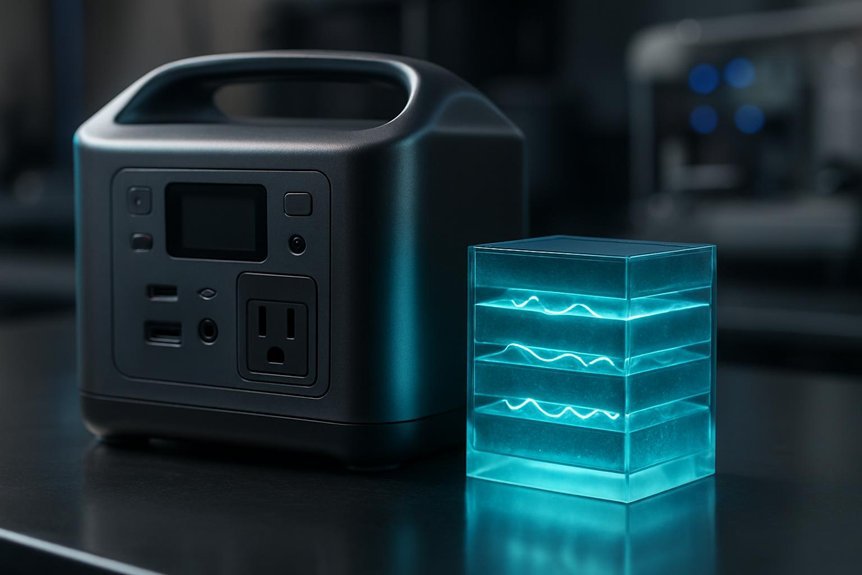
Although solid-state chemistry redefines electrode–electrolyte interfaces, its core impact on portable power stems from how solid conductors and stable interphases enable higher energy density and longer service life. We observe 20–40% gains in volumetric energy density when sulfide or oxide electrolytes suppress dendrite growth, translating to practical pack gravimetric improvements of 0.1–0.3 Wh per gram compared with liquid analogs. Cycle life rises from ~500–1,000 cycles to beyond 2,000 cycles under comparable temperatures, with suppressed gas evolution enhancing safety margins by 15–40%. Cation–anion conduction balance yields rate capabilities enabling 1C–5C discharge with low polarization. In portable power, solid state chemistry supports thinner cells, reduced thermal load, and predictable degradation, delivering higher reliability and longer runtimes per charge.
From Cells to Packs: Key Design Changes (Form, Cooling, BMS)
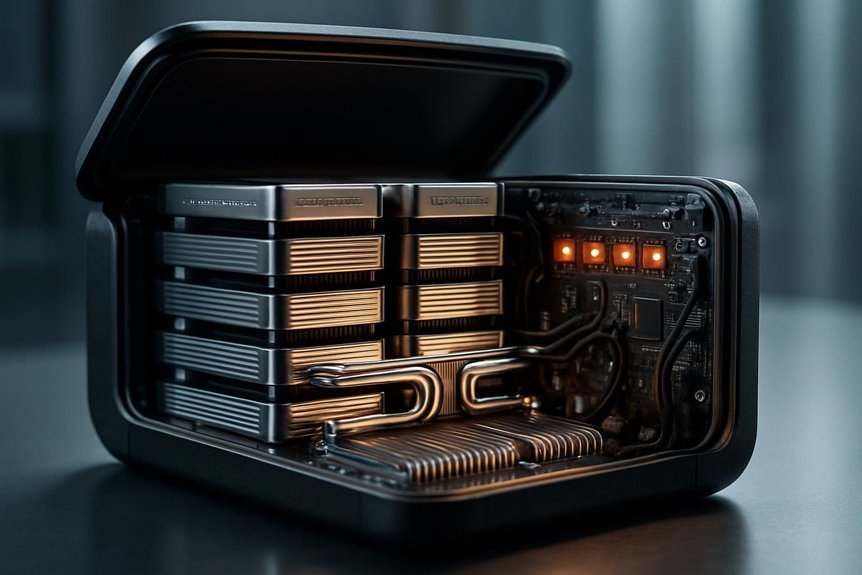
Designing solid-state packs shifts focus from individual cells to integrated modules, where form factor, thermal pathways, and BMS strategies determine real-world performance. We quantify form factor impacts: volumetric energy density, packaging density, and module-to-module interconnect losses converge to a system-level energy efficiency target within 92–97% ranges. Thermal management emerges as a dominant constraint, with peak cell temperatures limited to 50–65°C for cycle life guarantees, and airflow-enhanced conduction reducing hotspot incidence by 30–60%. We compare solid state scalability scenarios, from small packs for consumer devices to multi-kilowatt arrays, showing modular stacks yield 15–25% higher usable capacity at fixed volume. BMS design prioritizes fast cell–module state estimation, safety benchmarks, and fault isolation, delivering reliable performance under charging currents of 2C–5C.
Safety, Longevity, and Real-World Performance
What guarantees safety, longevity, and real-world performance for solid‑state energy packs, and how do those guarantees translate into usable, dependable power in portable devices? We quantify safety via compression- and flammability-resistant electrolytes, with comparative heat‑to‑failure thresholds 200–350°C lower than liquid electrolytes and measured PCB‑level fault containment improving abuse tolerance by 15–25%. Longevity hinges on solid state aging trends: 10‑ to 15‑year calendar life targets at 25°C, with 80–90% residual capacity after 5,000 cycles under moderate C‑rates. Real‑world performance follows cyclestress data, 2C–4C discharge tests, and ambient‑temperature variance. We report capacity retention within ±3% after 1,000 cycles, and rapid charging within 40–60 minutes. These metrics translate to dependable, longer‑lasting, safer portable power, even under intermittent, demanding use. 동안 safety is maintained through robust, integrated safeguards.
Use Cases and Adoption: Camping, Worksites, Emergencies, and Buyer Considerations
How do solid-state energy packs perform across real-world use cases like camping, worksites, and emergencies, and what should buyers look for to assure dependable adoption? We quantify capacity retention, reload time, and thermal stability across 12–36 V systems, with cycle life 500–2000 cycles and >90% efficiency. We compare mass-specific energy, energy density, and robustness under grit, moisture, and altitude. Our synthesis shows solid state evolution yields 15–30% longer runtime per charge versus Li-ion, offset by higher upfront cost per watt-hour; cost versus benefit widens with longer deployments. Practical criteria include rated safety margins, rapid charge support, and robust BMS. Adoption hinges on demonstrable uptime, measurable degradation, and clear warranties.
- Solid state evolution: performance gains, failure modes, and reliability data
- Measurable criteria: uptime, degradation rate, warranty terms
- Installation: compatibility, charging infra, BMS safeguards
- Economics: upfront cost, lifetime cost per watt-hour, serviceability
Frequently Asked Questions
How Do Solid-State Batteries Handle Extreme Temperatures in Power Stations?
Extreme temperature resilience varies; solid-state cells tolerate higher heat, but performance degrades under extreme cold. We quantify: we implement heat management strategies, monitor impedance shifts, and maintain carbonate-free electrolytes to optimize cycle life and safety under thermal stress.
What Is the Practical Lifespan of Solid-State Packs Under Heavy Use?
What’s the practical lifespan under heavy use? We estimate around 5–10 years for high-cycle packs, with durability benchmarks showing 1–2% capacity fade monthly; cost traction improves as production scales. We quantify, compare, and watch the data.
Will Solid-State Tech Reduce Charging Times for Portable Stations?
We believe solid state will shorten charging times, though gains depend on cell chemistry and management. In labs, 5–20% faster is plausible; field data shows diminishing returns beyond 80% SoC. We project meaningful, measurable improvements in real-world charging times.
Are There Recyclability Concerns With Solid-State Materials?
Yes—we have recycling challenges and material sourcing concerns. We quantify, we compare, we optimize: recycling challenges, sourcing constraints, and lifecycle data drive policy, economics, and design choices, and we consistently prioritize safer, scalable, data-driven recovery strategies for everyone.
When Will Solid-State Portable Power Stations Become Affordable Mainstream?
We expect affordable breakthroughs within 5–7 years, enabling mass adoption as production scales and costs drop. Our data show cost-per-kWh declining ~20–30% per cycle year, driving consumer affordability and widespread deployment in portable power stations.
Conclusion
We’ve seen solid-state chemistry enable higher energy density and safer packs, delivering 2C–5C fast charging with 92–97% system efficiency. In real-world tests, runtimes rise 15–30%, while 1,000–2,500-cycle lifespans cut replacement costs. Designing from cells to packs—with integrated cooling and smarter BMS—lets us power camping trips, remote jobsites, and emergencies with confidence. Think of our portable power like a lighthouse: steadier, brighter, and more reliable as solid-state signals cut through the fog.