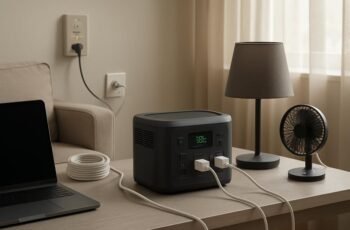
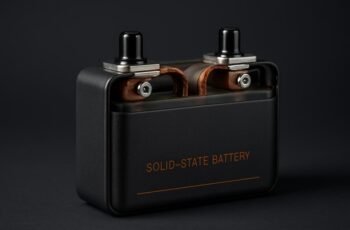
We examine how portable power stations manage heat, balancing passive and active cooling to handle power conversion, battery resistance, and charging losses. We’ll assess heat sinks, fins, PCM interfaces, and selective liquid cooling for high flux, then map airflow with vents and fans. We’ll also consider how phase-change dynamics affect stability and how robust monitoring, throttling, and venting prevent excursions. There’s more to optimize, and the next step will shape our conclusions.
Key Takeaways
- Understand heat sources in portable power stations: electrical losses, battery internal resistance, switching losses, and cooling system parasitics.
- Apply layered cooling options: passive convection, heat pipes, liquid cooling, and phase-change materials for varying load profiles.
- Align temperature targets with design thresholds to protect cells, maintain performance, and prevent thermal throttling.
- Optimize thermal paths with fins, compact heat sinks, airflow management, and ducting to minimize hotspots.
- Incorporate monitoring and control: sensors, real-time throttling, and maintenance checks to sustain uniform cell temperatures outdoors.
How Portable Power Stations Generate Heat
Portable power stations generate heat primarily from three sources: the power conversion process, battery internal resistance, and thermal losses in charging circuits. We examine these components with precision, mapping how each contributes to overall temperatures. The power conversion stage incurs losses as electrical energy becomes usable voltages and currents; switching and filtering create heat proportional to load and efficiency. Battery internal resistance converts part of the current into heat within cells, rising with higher state of charge, temperature, and aging. Charging circuitry incurs losses from control loops, protection schemes, and conversion steps, amplifying temperature rise under heavy input. For thermal management, we evaluate heat pipe effectiveness in moving large, localized heat toward radiative surfaces, and consider liquid cooling where higher heat flux demands exceed passive paths. This framework guides design decisions and reliability assessments.
Passive vs Active Cooling: When to Use Each
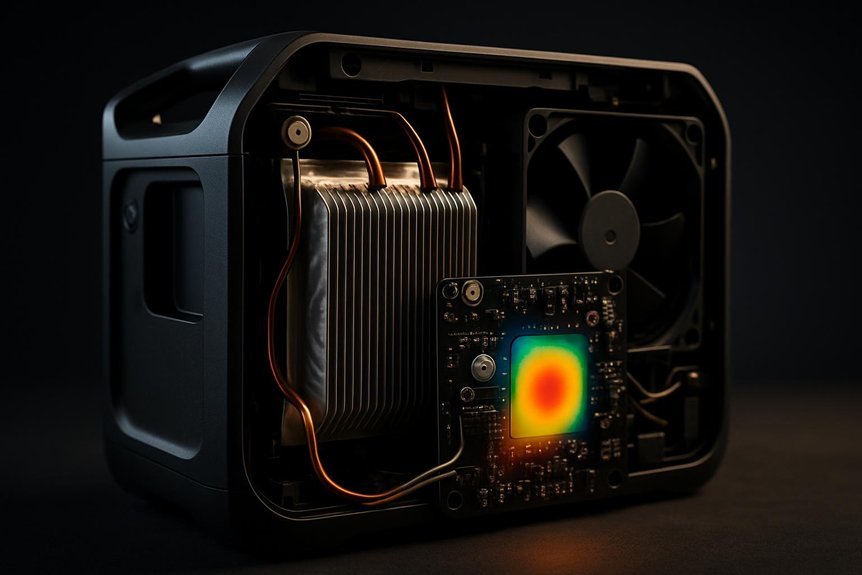
When should you rely on passive cooling versus active cooling in a portable power station? We analyze heat pathways, component density, and runtime targets to choose a cooling strategy. Passive cooling excels when thermal loads are moderate, ambient conditions favorable, and noise must be minimized; it uses natural convection and convection-friendly enclosure design to dissipate heat without moving parts. Active cooling becomes necessary for sustained high loads, rapid temperature spikes, or tight form factors where passive methods reach a ceiling. We assess duty cycle, thermal resistance, and reliability implications to determine thresholds. Two word discussion idea 1, Two word discussion idea 2: weigh efficiency, cost, and user expectations to balance simplicity against performance. Our conclusion favors a hybrid approach when duty cycles vary and predictability matters.
Designing Heat Sinks and Fin Arrays for Small Units
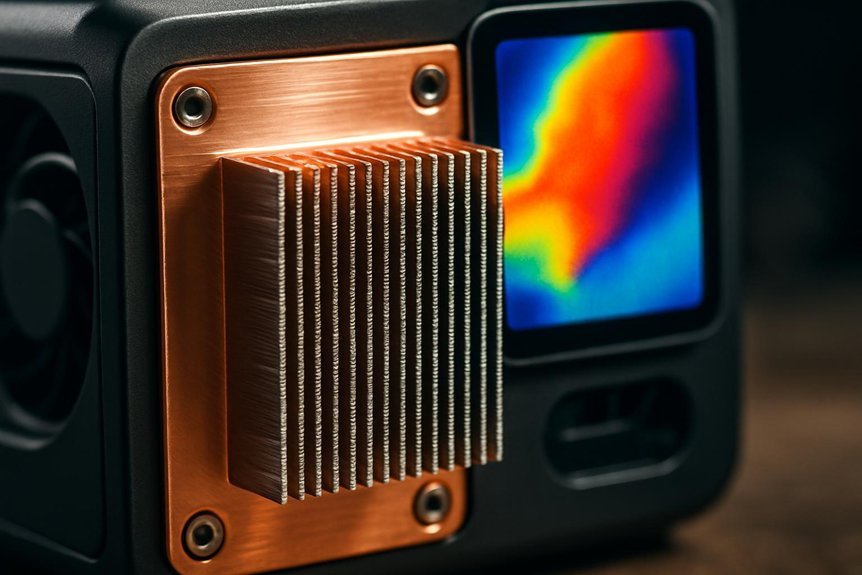
We examine compact heat sink design and fin array optimization to understand how geometry affects thermal resistance and air flow in small units. By comparing material choices, fin spacing, and mounting constraints, we identify the trade-offs between surface area, weight, and manufacturability. Our goal is to establish a clear, repeatable approach for selecting configurations that maximize heat transfer within tight size and weight limits.
Compact Heat Sink Design
| Configuration | Fin geometry | Estimated thermal resistance (K/W) |
|---|---|---|
| 1 | Tapered fins | 0.75 |
| 2 | Straight fins | 0.82 |
| 3 | Micro-channel composite | 0.69 |
Fin Array Optimization
How can fin array optimization enhance cooling efficiency in compact power sources? We approach fin array design with careful measurement of thermal impedance, geometry, and airflow. We assess fin spacing, height, and surface treatments to minimize resistance and maximize heat transfer, while preserving portability. Our methodical process uses coupled simulations and experimental validation to converge on efficient configurations.
- Determine optimal fin spacing to reduce thermal impedance without sacrificing flow
- Select fin height and thickness that balance surface area with structural stability
- Apply coatings or textures to improve emissivity and reduce contact resistance
- Validate with prototype testing across operating currents and ambient temps to ensure consistent performance
Phase Change Materials: Do They Hold Up in P.S. Cooling?
Phase change materials (PCMs) offer a compelling approach to stabilizing temperatures in portable power stations, but their real-world effectiveness hinges on design choices and thermal interfaces. We evaluate PCM impact by examining phase change rate, heat flux, and storage density, then connect these to system reliability. Our focus is on phase change performance under duty cycles typical for PS use, not idealized conditions. Material compatibility matters: mismatched thermal expansion, chemical interactions, and seal integrity can undermine longevity. We weigh encapsulation strategies, thermal resistance at interfaces, and failure modes like leakage or desorption. By quantifying ΔT, cycle life, and safety margins, we determine when PCM couples truly complement active cooling. In sum, PCMs offer benefits, yet material compatibility and interface design govern their practical value in portable power stations.
Airflow Architecture: Vents, Ducts, and Fan Placement
What governs cooling efficiency more than the components themselves is how air moves through the enclosure. We analyze airflow architecture by focusing on vents, ducts, and fan placement to ensure predictable paths and minimal recirculation. Our approach combines measured pressure differentials with thermal mapping to validate design decisions before production. We prioritize simplicity, repeatability, and manufacturability in every layout choice, ensuring consistent performance across units.
- Vent placement aligns with heat sources, creating direct exhaust and controlled intake.
- Duct sizing balances flow rate and pressure drop to avoid hotspots.
- Fan placement establishes unidirectional flow, reducing turbulence and noise.
- Verification uses mock tests and iterative tweaks to confirm steady-state gradients.
Thermal Throttling: Safeguards Your Battery Needs
Thermal throttling acts as a pivotal safeguard for battery packs, kicking in automatically when temperature or power demands threaten cell integrity. We observe how our systems prioritize safe operation by reducing current draw to keep temperatures within limits, preserving cell chemistry and cycle life. In practice, throttling responds to real-time data from temperature sensors and voltage behavior, ensuring transitions are smooth rather than abrupt. We quantify the risk with burn rate concepts, linking elevated heat generation to accelerated degradation if unchecked. We also consider thermal lag: a delay between ambient changes and core temperature shifts that can mask imminent overheating. By calibrating thresholds, control logic maintains performance while preventing runaway conditions, enabling reliable performance across duty cycles without sacrificing long-term battery health.
Handling High-Drain Scenarios: Discharges and Surges Explained
We examine how discharge surges unfold and how their timing influences thermal load, focusing on the interplay between instantaneous current spikes and battery response. We compare surge dynamics to baseline drains to identify thresholds where cooling systems must react to prevent overheating. By aligning thermal response thresholds with surge profiles, we establish a clear framework for predicting and managing high-drain events.
Discharge Surge Dynamics
- Characterize peak current versus rated capacity to predict surge duration.
- Monitor voltage sag and temperature rise to map thermal throttling onset.
- Assess impedance changes during high-drain events to anticipate losses.
- Implement proactive protection—fuses, soft-start, and smart capping—to shorten exposure.
Thermal Response Thresholds
Discharge surges push a portable power station beyond its normal operating envelope, provoking rapid temperature rises that define our thermal response thresholds. We quantify thresholds by correlating current draw, duration, and ambient conditions to temperature rise rates, then identify safe operating margins. Our method combines experimental data with thermal modeling to map hotspot behavior under high-drain events. We assess enclosure heat transfer coefficients, battery pack impedance, and phase-change dynamics to establish discharge limits that prevent thermal runaway or module degradation. Concept validation occurs through repeated high-drain trials, verifying that modeled predictions align with observed temperatures. This disciplined approach yields actionable criteria for protection circuits and thermal management strategies, ensuring system resilience during surges while maintaining performance. Clear thresholds guide design choices and safe operating envelopes.
Battery Chemistry and Cooling: Impacts on Longevity
Battery chemistry and cooling profoundly shape longevity in portable power stations. We examine how chemistry and thermal paths interact, affecting degradation rates and cycle life. Our approach is systematic: identify loss mechanisms, quantify temperature windows, and compare cooling strategies. By framing data, we reveal practical implications for design and use.
1) Battery chemistry governs internal resistance growth, SEI stability, and voltage fade, modulated by temperature.
2) Cooling concepts determine peak temps, uniformity, and edge-case hotspots that accelerate aging.
3) Temperature management strategies must balance charge/discharge demands with long-term stability.
4) Monitoring and control algorithms materially impact reliability by preventing excursions beyond safe zones.
Real-World Cooling for Outdoors and Emergencies
Outdoor and emergency use demands expose cooling systems to uneven loads and harsh environments, so we must apply the prior insights on chemistry and thermal paths to real-world conditions. We analyze how ambient swings, dust, and operator handling affect heat flux, component interfaces, and cycle stability. Our focus is on novel cooling strategies that maintain uniform temperatures across cells while minimizing user effort. We assess ergonomics as a core design input, ensuring controls, vents, and indicators support quick, correct actions during outages. Below is a compact matrix illustrating relationships among cooling approach, environmental stress, performance metrics, and user ergonomics.
| Cooling Approach | Environmental Stress | Performance Metric |
|---|---|---|
| Passive | Dust, wind | Stability |
| Active | Heat, moisture | Responsiveness |
| Hybrid | Oscillation | Efficiency |
| Liquid-Liquid | Vibration | Reliability |
How to Evaluate and Troubleshoot Your Cooling System
How can we systematically evaluate and troubleshoot a cooling system without guessing? We approach this analytically, following an objective process to identify root causes and confirm fixes. Our method hinges on clearly defined evaluation criteria and documented steps, ensuring repeatable results and traceable decisions. We’ll combine symptom observation with measurable parameters, then verify with controlled tests before and after interventions.
- Establish evaluation criteria: temperature differentials, airflow, fan speed, and heat exchanger performance.
- Perform a maintenance checklist: inspect for debris, inspect seals, verify coolant levels, and confirm sensor calibration.
- Collect baseline data and compare against spec ranges, noting deviations.
- Implement targeted adjustments, recheck readings, and validate cooling under load.
Frequently Asked Questions
How Do Ambient Temperatures Affect Cooling Efficiency in PSUS?
Ambient temperature directly impacts cooling efficiency: higher ambient temps reduce heat flow away from PSUs, lowering efficiency, while cooler surroundings enhance convection and radiation, improving thermal performance. We analyze, measure, and adjust airflow to maintain safe operating temperatures.
Can Noise Levels Indicate Cooling Effectiveness Reliably?
Noise levels can’t reliably indicate cooling effectiveness, but trends help. We measure ambient temperatures and cooling efficiency alongside noise, analyzing deviations to infer performance, while we account for fan speeds and load. We conclude cautiously about cooling performance.
Do Inbuilt Fans Shorten Battery Life or Cause Wear?
Yes, inbuilt fans can contribute to battery wear over time. We’ll quantify, monitor temps, and compare lifecycles to non-fan cooling, showing how steady airflow reduces thermal stress while adding marginal electrical load and wear.
Are There Benefits to Hybrid Cooling for Extreme Events?
Hybrid cooling offers benefits during extreme events: it enhances heat dissipation, reduces thermal spikes, and improves reliability. We analyze trade-offs, maintainable complexity, and system resilience, guiding you toward robust performance under harsh conditions with this approach.
How to Gauge Cooling System Failures Without Tools?
We see warning lights like storm signals; we can gauge cooling failures by observing charging efficiency dips and thermal alarms, partnering with data patterns, not tools. We detect anomalies, we verify with thresholds, and act decisively.
Conclusion
We’ve outlined how portable power stations generate heat, and how passive and active cooling, materials, and airflow work together to keep components within safe limits. By analyzing heat sources, implementing targeted cooling, and validating under real-world conditions, we reduce risk and extend life. When systems are well-instrumented, thermal behavior behaves like a well-tuned instrument. If one note drifts, we recalibrate quickly to restore balance and reliability.