We’ve seen a field test where a rugged power pack outlasted a week of field shifts, thanks to solid-state chemistry. Solid-state batteries promise higher energy density, safer operation, and better thermal management for portable power stations. We’ll explore ceramic, glassy, and polymer–inorganic hybrids, their interfaces, and how nanoscale control mitigates dendrites and impedance growth. If you’re designing packs, you’ll want concrete criteria—from materials selection to packaging and BMS integration—before stepping from lab to market.
Key Takeaways
- Solid-state batteries use inorganic or hybrid electrolytes to improve safety and enable higher energy density for portable power stations.
- Ionic transport paths and interfacial stability govern cycle life and efficiency in solid-state cells for reliable portable use.
- Polymer vs ceramic electrolytes offer tradeoffs: polymers ease processing but may limit temperature, while ceramics provide stability at higher voltages.
- Manufacturing scale-up challenges (densification, interfaces, purity) critically impact cost and yield for portable power station production.
- Selection criteria should balance energy density, voltage window, safety margins, thermal management, and compatibility with BMS integration.
Foundations of Solid-State Batteries for Portable Power
Solid-state batteries replace liquid electrolytes with solid ion conductors, which fundamentally alters ion transport and safety profiles. We present foundations that matter for portable power, defining material classes, interfaces, and performance metrics. We examine solid electrolytes—ceramic, glassy, and polymer-inorganic hybrids—and how their conductivity, stability, and compatibility influence cell design. Interfacial phenomena, including grain boundaries and electrode-electrolyte reactions, determine impedance and cycle life, guiding materials selection. We quantify energy density implications from mass and volume constraints, while addressing safety gains tied to nonflammable matrices. Manufacturing scaling emerges as a critical constraint, dictating material processing, defect control, and layer uniformity. Understanding these core principles enables predictable performance in portable power applications and frames subsequent discussions on chemistry-driven improvements.
How Solid-State Chemistry Boosts Energy Density
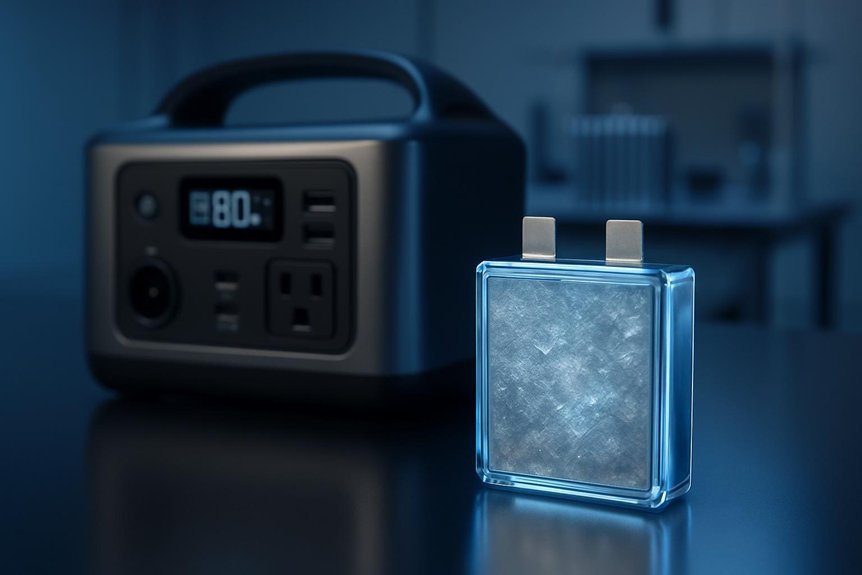
Solid-State Ionic Paths offer continuous, high-conductivity channels that reduce activation barriers for ion transport. In turn, Energy Density Gains arise from tighter electrode packing and safer, higher-voltage operation enabled by solid electrolytes. We explain how these factors jointly enhance energy storage without compromising stability, guiding design toward optimized solid-state chemistries.
Solid-State Ionic Paths
We examine how solid-state ionic pathways enable higher energy density by enabling faster Li+ transport through tailored host lattices and electrolytes, while reducing interfacial impedance and promoting safer cycling. We then quantify transport via ionic conductivity measurements in various solid electrolytes, linking lattice dynamics to mobility. We compare anisotropic diffusion in layered and cubic hosts, noting how dopants modulate vacancy networks and percolation pathways. We assess interfacial chemistry, focusing on dissolution mechanisms that degrade contact and create resistive layers, and we evaluate strategies to suppress them. We examine grain boundary effects, distinguishing bulk-like conduction from GB-enhanced or GB-blocked transport, with impedance spectroscopy clarifying dominant resistive contributions. Our evidence supports design rules that maximize contiguous Li+ channels while minimizing interfacial losses.
Energy Density Gains
Can solid-state chemistry realistically raise energy density, and if so, how? We examine material choices, packing efficiency, and interfacial engineering. By replacing liquid electrolytes with solid ones, we enable higher operating voltages while reducing parasitic losses, yielding higher gravimetric and volumetric energy density. Sulfide and oxide solid electrolytes enable compatible high-capacity cathodes and silicon-rich anodes, expanding usable capacity without compromising safety. Nanoscale grain control improves ionic conductivity and minimizes Li dendrite formation, preserving cycle life. Layered cathodes paired with stable solid electrolytes reduce inactive mass at interfaces, boosting overall energy density. Thermal stability improves due to nonflammable electrolytes and suppressed gas evolution, enabling safer high-temperature operation. In sum, solid-state chemistry can meaningfully enhance energy density while maintaining reliability.
Polymer vs Ceramic Electrolytes: Pros, Cons, and Use Cases
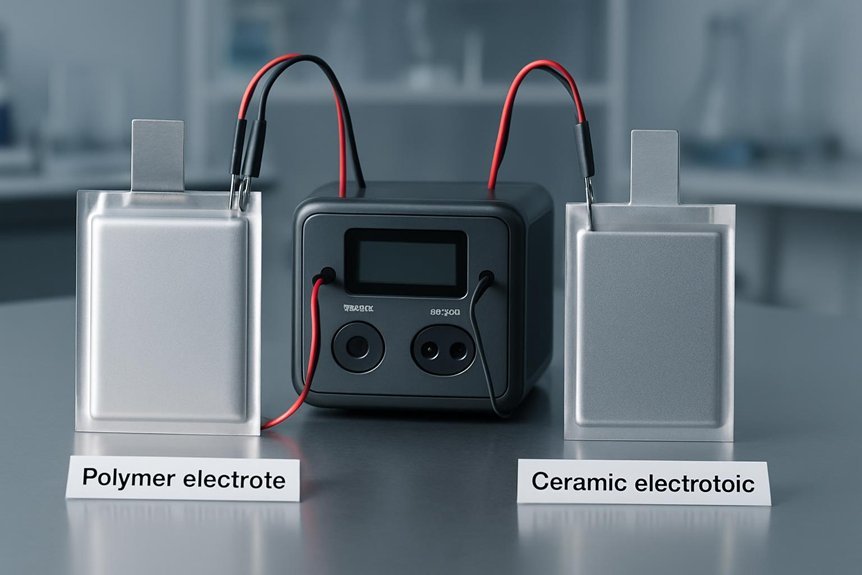
We compare polymer electrolytes for their higher room-temperature ductility, easier processing, and potentially lower interfacial resistance, against ceramic electrolytes that offer greater electrochemical stability and higher ionic conductivity at elevated voltages. We acknowledge the tradeoffs: polymers can suffer from higher shrinkage, lower thermal stability, and safety concerns if plasticizers migrate, while ceramics demand stricter processing and can introduce brittle interfaces. We outline use-case scenarios where cycling stability, operating temperature, and power density dictate material choice, guiding readers toward practical selection criteria.
Polymer Electrolyte Advantages
Polymer electrolytes offer a compelling balance of safety, flexibility, and processability compared with ceramic counterparts, though they trade some energy density and ionic conductivity at room temperature. We examine how polymer synthesis tunes transport, interfaces, and processing windows, impacting real-world performance. In practice, polymer crystallinity modulates segmental mobility and conduction pathways, guiding electrolyte design for portable power stations. Our focus remains empirical: suppression of dendrites, stable interfaces, and scalable fabrication metrics.
- Ion transport enhancement via tailored side chains and amorphous content
- Interfacial compatibility with high-voltage cathodes and lithium metal
- Processability advantages from solution casting and film formation
Ultimately, polymer electrolyte advantages derive from controlled chemistry and morphology, enabling safe, flexible, and manufacturable devices for field use.
Ceramic Electrolyte Tradeoffs
Ceramic electrolytes offer a different set of tradeoffs for portable power stations, balancing high ionic conductivity at room and elevated temperatures with mechanical rigidity and interfacial stability. We evaluate polymer vs ceramic by considering stability windows, dendrite suppression, and manufacturability. Ceramic systems deliver robust chemical and thermal tolerance, enabling higher temperature operation, but prone to high grain boundary resistance and brittle fracture unless engineered. We examine novel ceramic materials that minimize grain boundary effects through dense microstructures and dopant strategies, boosting overall conductivity without sacrificing mechanical integrity. Interfacial compatibility with electrodes remains critical, as impedance rises at contacts can negate bulk gains. We emphasize scalable sintering, thin-film integration, and stack pressure control. In summary, ceramics offer resilience and performance gains when grain boundary effects are mitigated and processing delivers reliable, low-impedance interfaces.
Use Case Scenarios
What scenarios best justify choosing polymer versus ceramic electrolytes in portable power stations, and where do each clearly outperform the other? We compare performance, safety, and manufacturability in real devices, emphasizing empirical results and measurable trends. Polymer electrolytes enable higher energy density at modest temperatures and lower interfacial resistance, benefiting compact PSUs; ceramics excel in high-temperature stability, wide electrochemical window, and robust safety margins under abuse. Tradeoffs arise with mechanical brittleness for ceramics and conductivity penalties for polymers at extremes. We also assess integration with novel anode concepts and space time cooling strategies to optimize thermal management and cycle life.
- Higher-temperature stability vs. superior fracture resistance
- Lower interfacial impedance with optimized ceramics vs. polymer flexibility
- Compatibility with novel anode concepts and space time cooling schemes
Safety and Reliability in Outdoor, Real-World Use
Are solid-state batteries reliably safe in real-world outdoor use, or do environmental factors pose hidden risks? We assess safety and reliability through controlled testing and real-world observations. Our approach combines accelerated safety testing with field data to quantify failure modes under heat, humidity, vibration, and altitude. We examine dendrite suppression, thermal runaway risk, and seal integrity, focusing on pack-level interactions and packaging margins. Results indicate lower electrolyte volatility and reduced gas evolution relative to liquid systems, but moisture ingress and mechanical shocks still demand robust gasketing and rigid cells. We measure field reliability by tracking cycle life, self-discharge, and impedance growth across climates. Overall, safety testing shows favorable margins; practical reliability hinges on ingress protection, thermal management, and vibration damping in portable stations.
Manufacturing Challenges: Scaling Solid-State Cells
Scaling solid‑state cells from lab prototypes to production involves overcoming materials, processes, and supply-chain bottlenecks that aren’t fully captured in small‑format testing. We, as practitioners, examine scale integration challenges that determine yield, defect rates, and cycle life at high volumes. Critical bottlenecks include ceramic electrolyte densification, interface stability, and material purity control, all requiring tight process control and robust statistical methods. We also confront supply chain fragility for precursors, coatings, and tooling, which directly impacts throughput and cost. Our approach emphasizes disciplined process development, rapid qualification, and cost-aware engineering decisions.
- Scale integration risk assessment across fabrication steps
- Supply chain resilience and supplier qualification
- Pilot-to-production transition metrics and gates
How to Choose the Right Solid-State Cell for Your Pack
Selecting the right solid-state cell for a portable power pack hinges on aligning electrochemical performance with system constraints and manufacturing capability. We evaluate energy density, voltage window, cycle life, and safety margins against pack mass, volume, thermal limits, and charge/discharge rates. Material compatibility, manufacturing yield, and integration with BMS influence selection as much as chemistry metrics. We balance performance targets with cost drivers and supply stability, using sounding boards from cross-functional teams to validate assumptions. The table below summarizes tradeoffs to guide decisions.
| Cell Chemistry | Key Tradeoff | Deployability |
|---|---|---|
| Lithium metal | High energy, higher risk | Moderate |
| Sulfide-based | Fast ion transport, moisture sensitivity | Guarded |
| Oxide-based | Robust, lower capacity | Broad |
This framework sharpens choices without overpromising scalability.
Roadmap: From Prototypes to Commercial Portable Power Stations
From prototype validation to market-ready units, our roadmap translates measured performance into repeatable, manufacturable outcomes. We outline milestones that connect lab results to scalable production, with stringent testing and clear pass/fail criteria. Our approach emphasizes reproducibility, life-cycle safety, and integration with lightweight packaging. We advance novel materials through pilot lines, validating electrochemical stability, thermal management, and long-term reliability under real-world usage. Governance frameworks define data governance, traceability, and regulatory alignment to expedite certification. We will minimize risk by staged capital deployment, parallel supplier qualification, and design-for-manufacture practices. Key milestones include module-level validation, pack integration, and field-demonstration units for customer feedback.
- Novel materials assessment and qualification
- Governance frameworks, data traceability, and compliance
- Pilot-to-pilot scale-up with manufacturability gates
Frequently Asked Questions
How Do Solid-State Batteries Perform in Extreme Temperatures Outdoors?
Solid-state batteries maintain stable output in extreme temperature ranges, but outdoor performance degrades at extremes beyond design specs; we observe reduced capacity and slower kinetics, with thermal management and preconditioning improving reliability for outdoor use.
What Are Real-World Cycle Life Expectations for Portable Packs?
“Time is money,” we say, and real world cycle life for portable packs averages several hundred to a few thousand cycles depending on use. We assess portable pack longevity with depth-of-discharge, temperature, and cycling regime.
Are There Recyclability or End-Of-Life Considerations Unique to Solid-State Cells?
We say: yes, there are end-of-life tradeoffs and recycling myths, but solid-state cells introduce novel materials challenges; we must optimize collection, separation, and regulatory compliance to guarantee reusable components and safe disposal.
How Do Manufacturing Tolerances Affect Pack-To-Pack Consistency?
We observe that manufacturing tolerances drive pack to pack variation, reducing uniform performance. We quantify deviations, control processes, and implement statistical process control to minimize disparities, ensuring consistent voltage, capacity, and safety across all packs.
What Are Cost-Per-Watt-Hour Comparisons With Lithium-Ion Packs?
Cost per watt hour for solid state packs varies with chemistry and scale, but we estimate competitive pricing near lithium-ion on a per-watt-hour basis; tolerances affect pack consistency, yet improvements reduce variance across production lots.
Conclusion
We, as clinicians of energy, present a disciplined conclusion: solid-state cells promise higher density, safer operation, and reliable cycling; solid-state interfaces promise lower impedance, longer life, and robust thermal management. We, through polymers and ceramics, calibrate trade-offs with practical packaging, BMS integration, and real-world usage. We, detailing manufacturing, quality control, and supply resilience, push from prototypes to production. We, aligning performance targets with utility, insist on rigorous testing, scalable processes, and transparent validation.