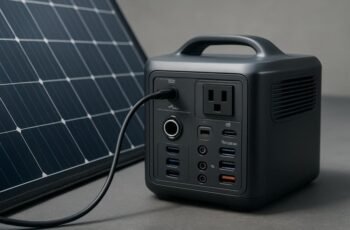
We’ll tell you this is the most precise way to power tools you trust from a compact source. In portable power stations, an internal DC battery drives an inverter that uses high-speed switching and a modulated waveform to synthesize AC, with protection, grounding, and isolation baked in. We’ll cover pure sine and modified sine outputs, how ratings map to real loads, and why the topology matters for surges and runtimes, so you can anticipate behavior before you connect. We’ll keep it tight as you weigh options for your setup.
Key Takeaways
- Portable power stations use an internal DC-AC inverter to convert stored battery DC into usable AC for household appliances.
- They vary waveform: pure sine for sensitive electronics; modified sine for simple devices, affecting compatibility and efficiency.
- Inverter performance hinges on continuous vs. peak (surge) current to handle startup loads and motorized devices.
- Safety features include overcurrent, thermal shutdown, short-circuit protection, isolation, grounding, and fault diagnostics.
- Efficiency and thermal management influence runtime, with modulation control and temperature-aware pacing optimizing power usage.
What an Inverter Does for Portable Power
An inverter converts stored DC from the battery into AC power suitable for household and outdoor electronics. We translate battery voltage to a usable RMS waveform, controlling modulation to minimize harmonics and voltage drop. Our focus is load compatibility, waveform quality, and protection schemas that prevent damage to devices. We monitor inverter efficiency across operating ranges, optimizing switching schemes and transformer utilization to reduce heat generation. Efficient conversion reduces energy loss in the power path, extending runtime for the portable station. We design for predictable behavior under varying loads, surge handling, and output isolation. Heat dissipation is integral: we select heat sinks, ambient design margins, and thermal throttling to maintain stable output. Overall, we provide clean, reliable AC with clear protection and performance metrics.
Pure Sine vs. Modified Sine: Which You Need
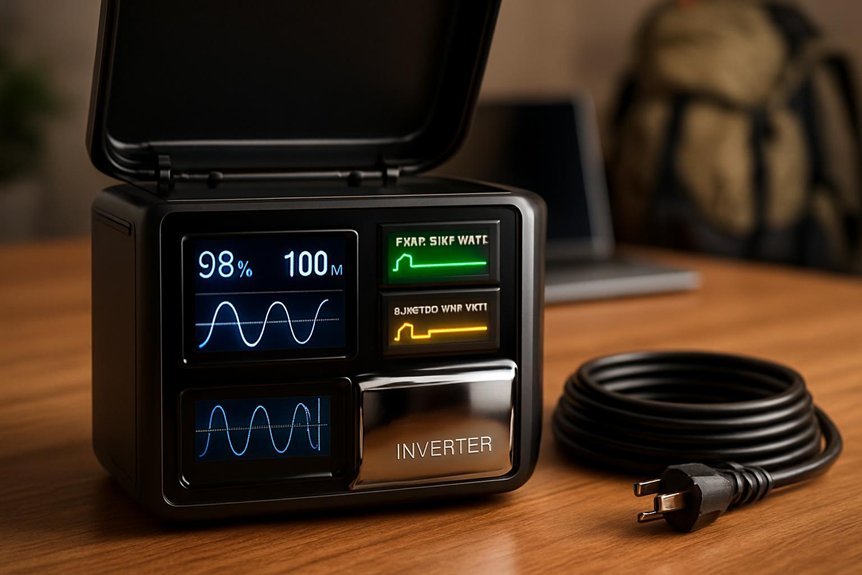
Which power waveform do you actually need: pure sine or modified sine? We evaluate suitability by load type, efficiency, and interference. In portable power stations, pure sine provides clean AC, smooth voltage, and less distortion for sensitive electronics and motors. Modified sine is simpler and cheaper, enough for basic devices like chargers, lamps, and small tools absent precision requirements. When you want reliable runtime with compatible inductive or switched-mode loads, choose pure sine. For simple electronics, modified sine can suffice but may introduce ripple and startup quirks. Our guidance: match waveform to load tolerance, not just price. Below is a quick grid for decision clarity.
| Load type | Preference | Notes |
|---|---|---|
| Sensitive electronics | Pure sine | Lowest harmonic distortion |
| Motors/SMPS | Pure sine or optimized | Smooth startup reduces wear |
| General chargers | Modified sine | Acceptable with limits |
How Inverter Ratings Affect Your Gear
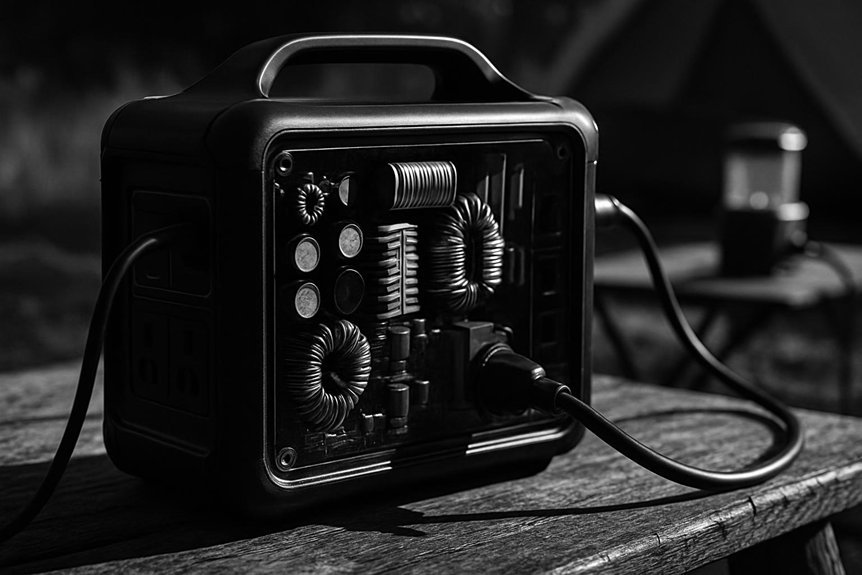
We’ll start by clarifying how inverter power limits interact with real-world loads, so your gear isn’t masked by peak draw. We’ll address appliance startup surge, explaining how brief surges can exceed continuous ratings even when running at nominal wattage. We’ll connect these concepts to your setup, emphasizing margin, efficiency, and protective behavior to prevent tripping or voltage dips.
Inverter Power Limits
| Column A | Column B |
|---|---|
| Continuous current | Peak current |
Appliance Startup Surge
When you power a device with an inverter, the startup surge demands a brief, higher current than the running load, so inverter ratings matter more than nominal continuous output. We examine how appliance load profiles drive transient demand, distinguishing apparent power from real power to assess inrush. Inverter efficiency, waveform (Sine vs. modified sine), and minimum continuous power ratings dictate whether the startup surge can be sustained without voltage drop or hiccups. Peak current often exceeds the labeled running wattage, so surge capability and overload margin are critical. We quantify using crest factors and transformer timing, ensuring the device’s inrush stays within the inverter’s surge rating. Proper sizing aligns appliance load characteristics with headroom for startup surges, avoiding nuisance shutdowns.
Sizing an Inverter for Camping and Job Sites
Choosing the right inverter size for camping and job sites hinges on balancing peak load, duty cycle, and runtime. We start by estimating continuous and peak currents from essential appliances, tools, and chargers, then translate those values into a nominal inverter rating plus headroom. We consider surge handling, transformer vs. switching topology, and efficiency at partial loads to minimize energy waste over long runs. Cable gauge and wire run length determine acceptable voltage drop, heat, and connector ratings, so we select conductors that meet or exceed backfeed and startup transient requirements. We quantify runtime with battery capacity, inverter efficiency, and charging cycles, ensuring cycles align with expected usage patterns. Finally, we document allowable deratings for ambient temperature and enclosure constraints to maintain reliable performance.
Essential Safety Features to Look For
What essential safety features should accompany portable power stations to guard against common failure modes and operator errors? We implement robust protection: input/output overcurrent limits, thermal shutdown, short-circuit protection, and low/high voltage cutoffs. Automatic safety reset ensures safe re-energization after fault clearance without manual intervention. Integrated fault codes provide rapid diagnostics and fault history, guiding maintenance decisions. Clear status indicators (LEDs, display prompts) reduce operator ambiguity. Battery management system (BMS) monitors cell balance, surge tolerance, and state-of-charge alarms. Inverter isolation and leakage detection minimize shock risk. Over-temperature fans and thermal vias sustain reliability under load spikes. A resettable circuit breaker protects downstream devices. Safety features are complemented by documented procedures for fault handling and a discrete fault-code table.
| Feature | Benefit |
|---|---|
| Safety reset | Quick recovery after faults |
| Fault codes | Precise diagnostics |
Wiring and Grounding Basics for Portable Inverters
We’ve covered the safety features that guard against faults; now we apply those protections to how we wire portable inverters and establish solid grounding. Our approach emphasizes wiring basics that preserve electromagnetic compatibility and fault isolation. We select gauge-correct conductors for output, neutral, and protective earth paths, minimizing impedance and voltage drop under load. A dedicated equipment ground bond ties the inverter chassis to the grounding conductor, creating a low-impedance return path for leakage currents. We document terminal polarity, using clearly labeled L and N connections on AC outputs and a robust DC input harness with overcurrent protection. Inverter grounding follows local code, ensuring a single-point earth reference and proper bonding to the portable frame. We verify continuity, insulation integrity, and shielded interconnects where applicable to sustain safe operation.
Practical Setup Tips to Maximize Runtime
We’ll outline practical setup tips to maximize runtime by focusing on Optimized Runtime Tactics and Efficient Power Management. We’ll optimize load profiles, prioritize high-efficiency inverter settings, and manage battery SOC to minimize conversion losses. This discussion will equip you to implement concise, data-driven adjustments that extend runtime without compromising safety.
Optimized Runtime Tactics
Optimized runtime hinges on efficient load management and strategic charging discipline. We calibrate duty cycles by targeting continuous loads within inverters’ rated sine-wave capacity, avoiding peak excursions that trigger thermal throttling. We prioritize dynamic energy budgeting: monitor VA vs. real power (W), and stagger high-draw appliances to prevent inverter saturation. Our approach includes sizing margins for startup surges and employing low-power modes during idle intervals. We assess inverter sizing relative to anticipated runtime, ensuring headroom for inverter efficiency loss. For solar compatibility, we align charging profiles with solar input duration, leveraging maximum power point tracking (MPPT) controllers and duty-cycle optimization to minimize parasitic losses. We document daily runtime targets, validate with iterative testing, and adjust configuration for gradual load ramping rather than abrupt on/off cycling. Continuous monitoring closes the loop.
Efficient Power Management
Efficient power management starts with disciplined load sequencing and tight control of the inverter’s duty cycle. We optimize runtime by staging currents to match peak efficiency regions, avoiding abrupt transients that elevate switching losses. We recommend parallelizing high-draw loads through controlled ramping and using multi-stage inrush suppression to limit surge currents. Implementing precise scheduling reduces duty-cycle variability, preserving inverter efficiency across battery SOC bands. We prioritize steady-state modulation methods, avoiding unnecessary PWM jitter that increases converter losses. Temperature-aware pacing maintains performance within thermal envelopes, minimizing derating. For system health, we monitor battery degradation signals and adjust load sets to sustain capacity, while preserving critical output. These practices balance utilization and longevity, delivering predictable energy delivery without compromising safety or reliability.
Common Inverter Issues and Quick Fixes
Common inverter issues in portable power stations typically surface as sudden shutdowns, audible buzzing, reduced output, or voltage instability. We diagnose through displacement currents, switching noise, and thermal foldback, correlating with load profiles and input impedance. First, we verify protection circuits: overcurrent, overvoltage, and short-circuit guards, ensuring proper tripping thresholds without nuisance interrupts. Next, we assess switching topology integrity—PWM duty accuracy, dead-time alignment, and EMI filtering—to restore clean sinusoidal synthesis. If output remains unstable, inspect cooling efficiency, as elevated junction temperatures degrade inverter efficiency and promote resonance. Consider battery chemistry interactions: high C-rate demands alter DC bus behavior, while aging cells shift impedance and sag under load. Quick fixes include reseating connectors, recalibrating voltage reference, and replacing degraded capacitors, inductors, or MOSFETs within spec.
Real-World Usage: Maintenance and Longevity
We monitor battery health, tracking impedance and cycle life to anticipate capacity loss and timing for recalibration. We maintain cooling and thermal health by validating fan operation, heat sink temps, and ambient exposure to prevent thermal throttling. We establish a regular maintenance cadence that includes firmware checks, connector integrity, and scheduled conditioning cycles to preserve longevity.
Battery Health Monitoring
Battery health monitoring is essential for prolonging the usable life of a portable power station’s battery pack, because real-world usage, charging cycles, and environmental conditions cumulatively affect capacity and internal resistance. We implement state-of-health (SOH) analytics, coulomb counting, and impedance spectroscopy to quantify degradation trends. Our diagnostics track cycle depth, calendar aging, and cell balance to identify imbalances that elevate thermal stress. We correlate voltage, temperature, and current profiles to detect early signs of cell isolation or module failure. Alerts arise when SOH thresholds drop or impedance rises beyond design limits, enabling proactive parcelling of usage. Maintaining battery health mitigates thermodynamic drift and preserves usable energy. We emphasize data-driven scheduling, firmware-calibrated charge limits, and avoidance of thermal throttling during peak loads.
Cooling And Thermal Health
Thermal management directly bounds both performance and longevity, so after establishing battery health metrics we turn to real-world usage implications that heat and cooling systems must robustly handle. We evaluate thermal paths from silicon to enclosure, focusing on impedance, junction temperature, and heat sink effectiveness under load ramps. Cooling strategies encompass active forced-air cooling, liquid cooling loops, and phase-change or heat-pipe supplements for high pulse demands. We define safe operating windows by thermal thresholds, monitoring ambient, case, and component temperatures to prevent derating. System design prioritizes low hotspot differential, adequate airflow, and redundancy in fans or pumps. We also consider enclosure ventilation, thermal inertia, and failure mode mitigation to sustain performance and extend component life.
Regular Maintenance Cadence
Effective maintenance cadence is essential for sustaining performance and longevity in portable power stations, especially under real-world usage where duty cycles and environmental exposure vary. We, as technicians, outline a disciplined schedule focused on routine maintenance and battery health. Daily checks confirm connector integrity, vent cleanliness, and enclosure condition. Weekly verifications include firmware version, inverter cooling fan operation, and relief vent accessibility. Monthly procedures encompass electrolyte monitoring where applicable, capacitance/ ESR readings, and thermal sensor calibration. We emphasize battery health assessment via state-of-health tracking, impedance trends, and charge/discharge efficacy under rated loads. Seasonal cycles require humidity control, gasket inspection, and corrosion mitigation. Documentation of all metrics ensures trend analysis, actionable aging projections, and proactive replacement planning. Adhering to cadence minimizes thermal stress and preserves converter efficiency across the system.
Troubleshooting Flow: Diagnosing Problems Fast
So, how do we diagnose faults quickly in portable power stations? We apply a structured troubleshooting flow that prioritizes fault isolation, rapid verification, and minimal system perturbation. First, confirm symptom scope: load type, waveform integrity, and protection trip history. Next, review fault codes and self-test results from the inverter MCU, cross-checking with firmware release notes to rule out known regressions. Use a top-down approach: assess input AC filtering, DC bus insulation, and transformer windings, then verify switching topology with oscilloscope probes for timing anomalies. Document failure modes precisely, linking findings to design principles and suspected subsystems. Prioritize actionable steps that respect user ergonomics, providing clear, repeatable test sequences and safe shutdown procedures to reduce downtime and maintain system reliability.
Frequently Asked Questions
Can Inverters Power High-Wattage Appliances Simultaneously?
Yes, we can, but only if the inverter sizing covers peak vs continuous power for all loads. We balance peak vs continuous power, ensure simultaneous startup surges, and select adequate inverter sizing to prevent overload or voltage drop.
What Affects Inverter Efficiency Beyond Rating?
We’ll answer: several factors influence inverter efficiency beyond rating. We analyze inverter efficiency factors, including switching losses, thermal throttling, and waveform harmony, while battery chemistry effects modulate voltage sag and internal resistance, affecting overall conversion efficiency.
Do Inverters Require a Ground Fault Circuit Interrupter (GFCI)?
Yes, inverter grounding is advisable; a gfci is often unnecessary in portable units unless local codes demand it. For example, we’ve documented field setups where gfci necessity triggered by wet conditions changes safety margins.
How Do Inverters Handle Battery Depletion and Shutdown Triggers?
We implement inverter shutdown only after battery depletion surpasses low-voltage thresholds, triggering protective shutoffs; battery depletion handling prioritizes safe cessation, preventing deep discharge, with auto-restart disabled until user reset or acceptable charge restoration.
Are Portable Inverters Suitable for Sensitive Electronics?
Yes, portable inverters are suitable for sensitive electronics when you choose pure sine wave models; we ensure inverter safety and manage noise considerations, verifying THD and regulatory compliance to prevent voltage transients harming delicate components.
Conclusion
We’ve covered how inverters in portable power stations convert DC to AC with controlled RMS waveforms, plus the practical choices and safety features you should prioritize. When sizing, match inverter rating to load and surge needs; prioritize pure sine for sensitive gear. Real-time protection, grounding, and isolation keep systems safe under demanding conditions. Think of it like a precision engine: efficient, reliable power under stress, quietly delivering balanced performance you can trust—like a metronome keeping a complex workflow in sync.