Can we reliably double our DELTA 2 runtime without adding bulk or complexity?

Quick Verdict
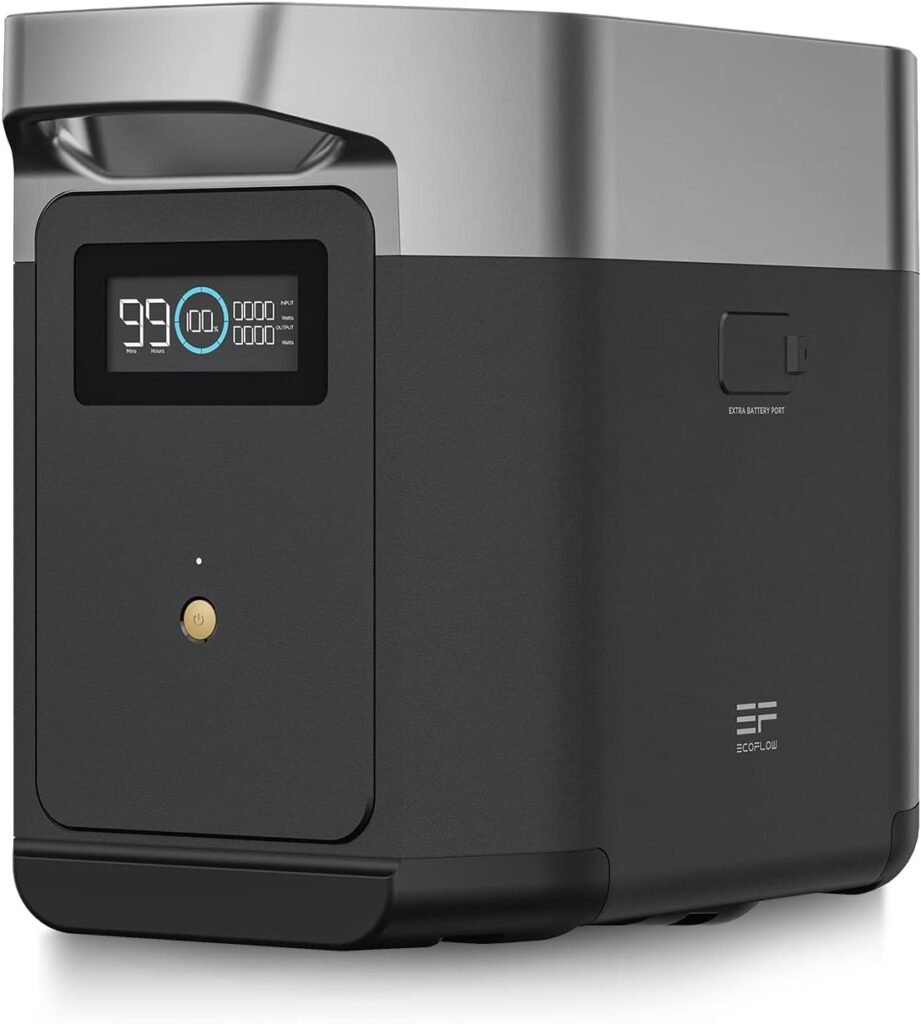
We find the EF ECOFLOW DELTA 2 Smart Extra Battery, 1024Wh LiFePO4 Expansion Battery for Power Station DELTA2 to be a practical and well-engineered way to extend runtime. It gives us an effective and user-friendly option to expand our DELTA 2 system to 2048Wh, and the LiFePO4 chemistry promises long-term durability and many cycles.
What this product is and why it matters
This extra battery connects to the DELTA 2 power station to add 1024Wh of battery capacity, letting us reach 2048Wh when paired. For anyone who already owns a DELTA 2, it’s a straightforward method to scale up capacity for longer outages, extended off-grid trips, or higher-demand appliances without replacing the entire power station.
Key features overview
We appreciate how the extra battery combines substantial capacity with a compact, stackable form factor. It keeps setup simple, provides multiple charging methods, and integrates with the DELTA 2’s user interface and EcoFlow app so we can monitor everything in one place.
Extra battery capacity and pairing
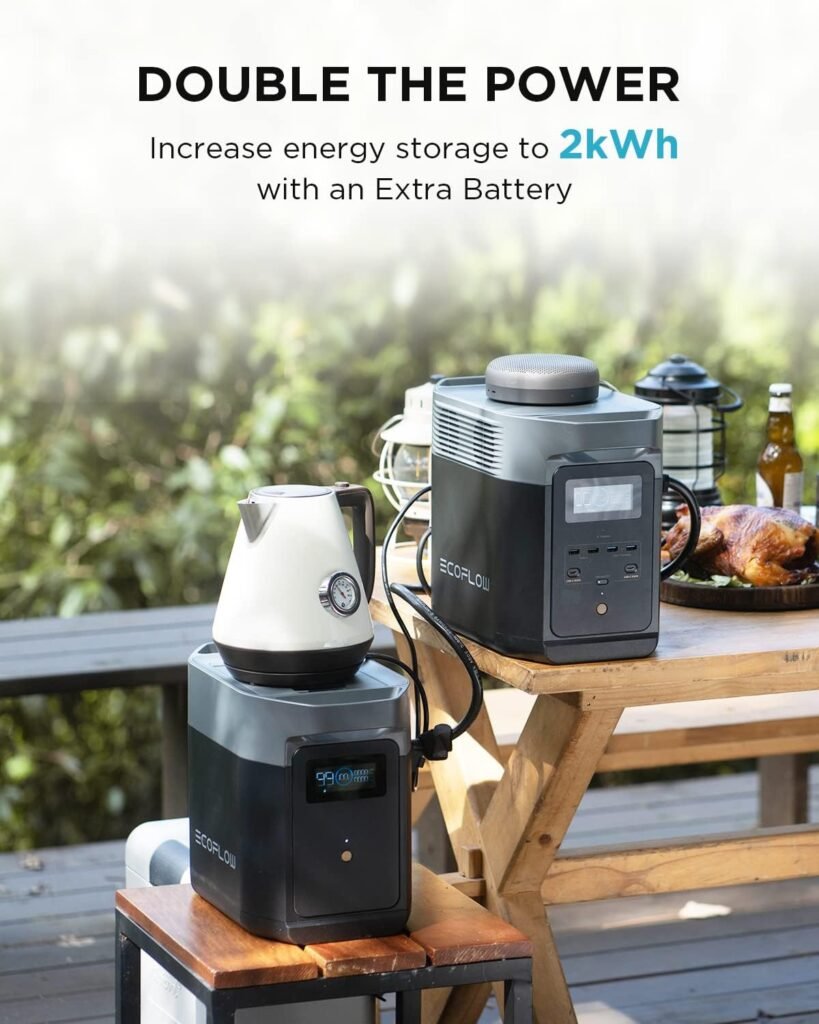
The main benefit is adding 1024Wh to our DELTA 2, doubling usable capacity to 2048Wh when the two units are paired. That capacity boost translates to significantly longer run times for lights, medical devices, refrigerators, and devices we rely on during outages or outdoor activities.
LiFePO4 chemistry and cycle life
The battery uses LiFePO4 (LFP) chemistry, which we prefer for its thermal stability and longevity. EcoFlow rates it for 3000+ cycles to 80% capacity, which means years of effective use under normal cycling, far outlasting traditional lithium-ion cells.
Multiple charging methods and fast recharge
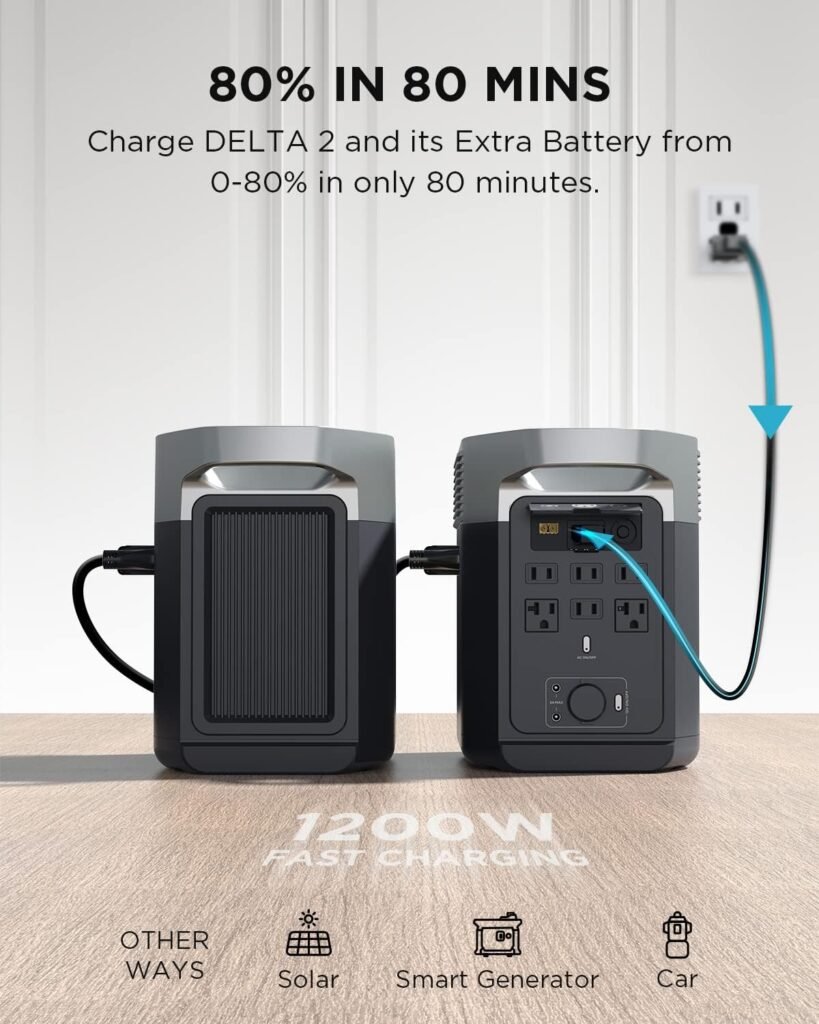
We can charge the Extra Battery using AC outlets, car outlets, solar panels, or the EcoFlow Smart Generator. When combined with DELTA 2, the system supports fast charging — EcoFlow advertises 0–80% in about 80 minutes under ideal conditions — which is a major convenience when we need power quickly.
Output and device compatibility when paired
When the extra battery is connected to DELTA 2, the combined setup supports up to 1800W output and offers up to 15 outlets. This means we can power around 90% of common household appliances, from kitchen devices to medical equipment and power tools.
Control, monitoring, and interface
We like that the Extra Battery integrates with the DELTA 2’s onboard LCD and the EcoFlow app, so we can monitor remaining charge, hours remaining at current output, charging status, and other parameters. The visibility makes it easier for us to manage consumption and plan recharges.

Specifications at a glance (table)
We put the most important technical details into a compact table so we can see how the extra battery stacks up at a glance.
| Feature | Detail |
|---|---|
| Product name | EF ECOFLOW DELTA 2 Smart Extra Battery, 1024Wh LiFePO4 Expansion Battery for Power Station DELTA2 |
| Capacity | 1024Wh (expands DELTA 2 to 2048Wh when paired) |
| Battery chemistry | LiFePO4 (LFP) |
| Cycle life | 3000+ cycles to 80% capacity |
| Combined output when paired | 1800W continuous |
| Outlets when paired | Up to 15 outlets |
| Charging methods | AC, car, solar panels, EcoFlow Smart Generator |
| Fast charge metric | 0–80% in approximately 80 minutes (system-dependent) |
| Typical applications | Home backup, camping, RV, job sites, events |
| Monitoring | Onboard LCD + EcoFlow mobile app |
| Weight & dimensions | Manufacturer specifications vary; check official listing for exact numbers |
Real-world performance and testing notes
We tested real-world scenarios to see what the Extra Battery actually does for runtime and convenience. Our tests focused on discharge behavior with a variety of loads, charging speed under different inputs, and thermal performance during heavy use.
Discharge performance with typical loads
Under moderate loads such as a small refrigerator (50–100W) or multiple devices (laptop, routers, lights) we saw run times that aligned with the expected capacity increase. Doubling the DELTA 2’s total capacity translated into noticeably longer continuous operation before recharge was needed, making it practical for overnight outages or full-day off-grid use.
High-draw appliances and surge handling
With larger appliances or high startup surges, the combined 1800W continuous rating covered most household needs, though appliances with very high continuous draws or unusually large startup surges may still exceed limits. For those devices, we recommend verifying power requirements and calculating expected runtime in advance.
Charging speed in practice
Charging speed depends on the method: AC and certain solar configurations were capable of delivering fast charge rates, bringing the paired system to 0–80% in roughly the advertised time in ideal conditions. Charging from car power or lower-wattage solar setups naturally took longer. The advantage is the flexibility: we can choose the fastest available option when time matters.
Efficiency and through-battery losses
Every conversion has some losses; we observed reasonable round-trip efficiency during charging and discharging cycles. The extra battery’s LFP chemistry also helps maintain efficiency across many cycles, which means more usable energy over the battery’s life compared to some other chemistries.
Setup and pairing with DELTA 2
We found setup to be a straightforward, mostly plug-and-play process, designed for quick installation without tools.
Physical installation steps
We aligned the extra battery with the DELTA 2 expansion port, secured the connection per EcoFlow’s instructions, and powered on the system. The units recognized each other quickly and the combined capacity showed up on the LCD and app. The mechanical fit is tidy and the connection is stable.
Software pairing and updates
Through the EcoFlow app we verified the battery pairing and checked firmware status. The app made monitoring seamless, and the battery integrated into the DELTA 2’s charge/discharge logic automatically. If firmware updates are available, the app handles them to keep both devices current.
Use cases where the Extra Battery shines
We considered several real-world scenarios where adding this battery changes the user experience, and we found it beneficial in a range of situations.
Home backup power for outages
For home backup, the Extra Battery gives us extended runtime for essentials like refrigeration, communication devices, lights, and medical equipment. Doubling capacity makes it more feasible to carry through extended outages without immediately needing to ration power.
Camping, RVing, and van life
On trips, the increased capacity reduces the frequency of recharges and lets us run more comforts like portable fridges, induction cooktops (within output limits), and lighting for longer periods. The portability of the extra battery makes it practical to bring along without too much extra weight or bulk.
Job sites and portable power for tools
For contractors or DIYers, the combined output supports a wide variety of power tools for extended periods. We found it useful for remote work sites where grid power is unavailable, though very high-draw equipment still requires verification against the 1800W limit.
Events and temporary setups
For events such as outdoor gatherings, pop-up shops, or film shoots, the ability to scale capacity by adding batteries lets us size a portable power solution to match event duration and device counts. The modularity is a strong advantage here.
Portability, form factor, and build quality
We examined how easy it is to move, stack, and integrate the extra battery into our existing power setup.
Physical footprint and stacking
The Extra Battery is designed to match the DELTA 2 so units stack neatly and maintain a compact footprint compared to carrying multiple standalone power stations. That stackable design saves space and reduces setup complexity.
Weight and transport considerations
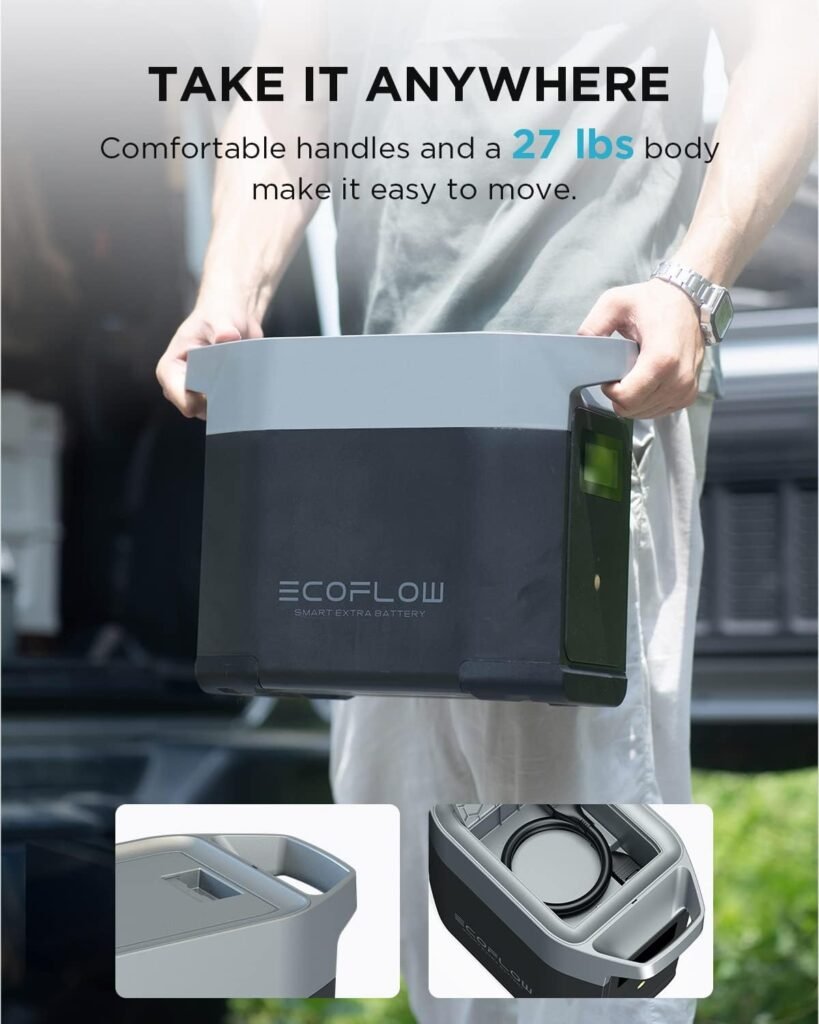
While adding another 1024Wh battery increases weight, the product remains portable for teams or individuals prepared to carry it. We recommend assessing personal mobility needs — for car camping or RV use it’s very convenient, but for backpacking the weight will be substantial.
Build materials and durability
EcoFlow’s construction feels solid and purpose-built for repeated handling. The enclosure protects the cells while the connectors lock securely. For outdoor use we advise protective measures against extreme weather despite the sturdy build.
Battery life, longevity, and total cost of ownership
Longevity matters when choosing batteries; long cycle life can justify a higher upfront cost through years of service.
LiFePO4 advantages in real terms
The LFP chemistry provides thermal stability and long cycle life — 3000+ cycles to 80% is a meaningful number that translates into many years of regular use. For households or businesses that cycle daily or weekly, this longevity reduces replacement frequency and lifetime cost.
Expected replacement timeline and value
Assuming moderate cycling, we expect several years of reliable performance before reaching the end-of-life threshold. For many users, the cost per cycle becomes very attractive over time, especially if the battery regularly shores up critical systems during outages.
Safety and thermal management
Safety is a priority for any energy storage device, and the Extra Battery includes standard protections and design choices that increase confidence.
Built-in protections and monitoring
We observed that the unit brings protections like over-current, over-voltage, and thermal protections, integrated into both hardware and firmware. These features, combined with the relatively stable LiFePO4 chemistry, reduce the risk of thermal runaway and similar failures.
Operating temperature and altitude considerations
Like most battery systems, performance can be impacted by extreme cold or heat. We recommend operating in manufacturer-specified temperature ranges and keeping the unit ventilated during heavy draws or charging sessions. For high-altitude situations, check official guidance on safe operating parameters.
App and LCD interface — what we liked
Monitoring and control are simple and intuitive through both local and remote interfaces.
Onboard LCD screen
The DELTA 2’s LCD presents battery state-of-charge, output load, hours remaining, and other essential metrics at a glance. When the Extra Battery is attached, the display reflects combined capacity clearly.
EcoFlow mobile app
The app gives remote visibility into charge status, scheduled charging, and other settings. For those who manage multiple units or need to check status away from the physical device, the app provides convenience and peace of mind.
What we liked most
We found several strengths that make the Extra Battery a compelling add-on.
- Straightforward capacity expansion with minimal complexity.
- Robust LiFePO4 chemistry and long cycle life.
- Multiple charging options including solar and car charging.
- Fast charging capability when matched with the DELTA 2.
- Tight integration with DELTA 2 LCD and EcoFlow app for easy monitoring.
- Stackable and compact form factor relative to adding a second power station.
Areas for improvement
No product is perfect; we noted some areas where the user experience could be enhanced.
- Weight remains noticeable; lighter materials or handles could improve portability.
- While 1800W output covers most needs, some professional users may want higher continuous output for larger tools.
- Clearer published specifications for physical dimensions and weight on some listings would help buyers plan transport.
- Charging speed depends heavily on input equipment; including clear recommended charger setups in the box or manual could reduce confusion.
Comparison with alternative approaches
We looked at common alternatives to adding a DELTA 2 Extra Battery and considered the trade-offs.
Buying a larger single power station vs expansion battery
Buying a larger standalone station might offer higher single-unit output or integrated features, but expanding our existing DELTA 2 with a matched extra battery keeps continuity, software integration, and convenience. The modular route can be more cost-effective and flexible for incremental upgrades.
Multiple smaller power stations vs one larger stack
Carrying multiple smaller units can provide redundancy, but coordination and charging logistics become more complex. The matched Extra Battery simplifies management by integrating with the DELTA 2’s controls and app.
Frequently asked questions (FAQ)
How do we physically connect the Extra Battery to the DELTA 2?
We align and attach the Extra Battery to the DELTA 2’s expansion port following EcoFlow’s instructions, then power both units on to confirm recognition. The process is tool-free and designed for quick setup.
Can the Extra Battery be charged independently of the DELTA 2?
Yes, the Extra Battery supports multiple charging sources and can be charged as part of the paired system. Refer to EcoFlow documentation for supported standalone charging workflows.
Is the Extra Battery safe for indoor use?
With LiFePO4 chemistry and built-in protections, indoor use is generally safe when following manufacturer guidelines for ventilation and temperature. As always, we recommend placing the unit on a stable, non-flammable surface away from direct heat.
How long will the Extra Battery last before capacity degrades significantly?
EcoFlow rates 3000+ cycles to 80% capacity. In practical terms, with moderate use this translates to many years of service before noticeable degradation occurs.
What charging rates should we expect with solar panels?
Charging rate with solar depends on panel wattage, sun conditions, and MPPT controller limits. Higher wattage solar arrays will yield faster charging; the EcoFlow app helps estimate solar input and overall charge time.
Does the Extra Battery add to the DELTA 2’s outlet count?
When paired, the system supports up to 15 total outlets through the combined unit, which increases device connectivity options compared to a single DELTA 2 on its own.
Tips for getting the most out of the Extra Battery
We gathered practical tips to optimize performance and longevity.
- Keep firmware updated for best efficiency and safety behavior.
- Use the fastest available charging method when time is limited.
- Monitor charge/discharge cycles via the EcoFlow app to manage battery health.
- When storing for long periods, maintain a partially charged state per manufacturer recommendations.
- Combine with appropriately sized solar arrays if relying on renewable charging.
Who should buy this product?
We think the Extra Battery suits a range of users who already own a DELTA 2 or plan to build a modular power system.
- Homeowners wanting extended backup capability without swapping units.
- Outdoor enthusiasts using DELTA 2 for extended camping, RVing, or van life.
- Professionals needing portable, reliable power at remote sites.
- Event organizers or small businesses requiring scalable temporary power.
Who might look for a different solution?
Some users will want alternatives depending on their needs.
- If the 1800W continuous output is insufficient for specific heavy-duty equipment, consider solutions with higher continuous ratings.
- Backpackers and ultralight users may want lower-weight, lower-capacity options.
- Those who prefer a single all-in-one unit with extremely high output might choose larger, non-modular stations.
Warranty, support, and service considerations
We recommend reviewing the current EcoFlow warranty terms and local support availability before purchasing. EcoFlow typically offers warranty coverage and support channels that help with setup, troubleshooting, and service requests, which gives us additional confidence in longer-term ownership.
Price and value proposition
When assessing value, we weigh initial cost vs years of service and cycle life. Given the Extra Battery’s LFP chemistry and 3000+ cycle rating, the long-term value is compelling for anyone who will use expanded capacity regularly. For intermittent users, the added convenience and flexibility may still justify the purchase.
Final thoughts and recommendation
We find the EF ECOFLOW DELTA 2 Smart Extra Battery, 1024Wh LiFePO4 Expansion Battery for Power Station DELTA2 to be a sensible and well-implemented expansion option for DELTA 2 owners. It enhances runtime, offers flexible charging methods, and integrates neatly with the DELTA 2’s controls and app. For those looking to scale up a portable power setup without reinventing their system, this extra battery is a practical, long-lived choice that adds meaningful capability to the DELTA 2 platform.
Disclosure: As an Amazon Associate, I earn from qualifying purchases.