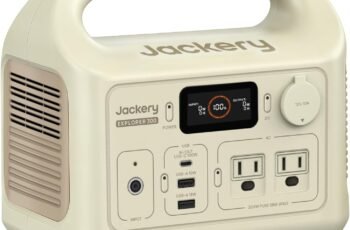
We find the EF ECOFLOW RIVER 3 Max a portable 572Wh power station suited to small devices, gaming gear, and home-office backup. Its 600W continuous output, three UPS-protected AC outlets, and sub-10-millisecond switchover help protect computers and network equipment, while X-Boost supports some compatible higher-wattage loads. At 10.4 pounds, it’s easy to transport, but limited capacity won’t sustain demanding appliances for long. We’ll compare its features, benefits, and trade-offs to help you judge whether it fits your needs.
Key Takeaways
- The RIVER 3 Max pairs a 286Wh power station with a 286Wh EB300 battery for 572Wh total capacity.
- It delivers 600W continuously, with X-Boost up to 1,200W for compatible devices; check appliance requirements before connecting.
- Three AC outlets provide UPS backup with battery switching in under 10 milliseconds, plus alerts and app-based controls.
- At 10.4 pounds, it’s portable and quiet at 30 dB, with LiFePO4 cells rated for 3,000 cycles and a five-year warranty.
- Its capacity suits small electronics and home-office gear, but demanding appliances and extended outages may require a larger unit.
572Wh Portable Power Station
Although the RIVER 3 Max combines two units, its 572Wh capacity comes from a 286Wh RIVER 3 Plus power station and a 286Wh EB300 extra battery. This paired design offers more stored energy than the standalone RIVER 3 Plus, while keeping the system portable at 10.4 pounds.
For camping power, we can use the capacity to run compatible devices away from outlets; at home, it can provide emergency backup during an outage. Its 600W steady output supports everyday electronics, and X-Boost raises output to 1,200W for compatible loads. We should compare that rating with each device’s requirements before connecting it.
Detailed features
Beyond its 572Wh capacity, the RIVER 3 Max adds features for backup power, device protection, and remote control. Three AC outlets provide UPS device protection, switching to battery power in under 10 milliseconds—faster than many basic backup units.
For compatible PCs and NAS devices, EcoFlow software can trigger automatic data saving when charge runs low; LED, app, and software alerts keep us informed. Bluetooth and Wi-Fi enable smart app controls, including charging-speed adjustment, scheduled charging, power-saving mode, and low-battery notifications.
The EB300 connects through Pogo Pin technology and adds a 140W USB-C input/output port, expanding connection options beyond the station’s built-in outlets.
Pros and Cons
We’ll weigh the River 3 Max’s strengths, including its 572Wh capacity, fast UPS switching, and durable LiFePO4 battery, against its limitations.
We’ll compare its 600W continuous output and 10.4 lb weight with the needs of larger loads and frequent transport. This balance will show where the system offers practical value and where competing options may fit better.
Pros
The RIVER 3 Max’s main advantage is its balanced combination of capacity, backup protection, and portability: its 572Wh capacity and 600W output suit small electronics and many low-power appliances, while three UPS-supported outlets switch over in under 10 ms to help protect computers and network equipment.
Compared with smaller backup units, it offers more capacity without becoming difficult to carry at 10.4 lb. We also get USB-C, USB-A, and car-charger outputs, plus app-based controls and alerts.
Its UPS protection supports safer shutdowns, while 30 dB quiet operation suits home offices. LiFePO4 cells, a five-year warranty, and 90-minute charging add practical value.
Cons
Although the RIVER 3 Max offers useful backup features, its 572Wh capacity and 600W continuous output limit it to smaller devices and low-power appliances; demanding equipment may exceed its output, and larger loads will drain the battery quickly.
This Limited capacity makes it less suitable than higher-capacity stations for extended outages or powering several appliances at once. X-Boost reaches 1,200W, but it doesn’t raise the continuous rating, so we shouldn’t treat it as a substitute for stronger output.
The EB300 adds capacity, yet its accessory cost may make expansion less attractive than buying a larger unit. We also get only one USB-C port.
Concluding thoughts
For compact backup power, the EF ECOFLOW RIVER 3 Max pairs 572Wh of capacity with a 600W output, a sub-10ms UPS, and a 10.4 lb design. We see its strongest advantage in combining portable power with fast computer protection, app controls, and a five-year warranty.
The LiFePO4 battery, rated for 3,000 cycles, also outlasts many lower-cycle alternatives. However, 600W limits heavier appliances, while X-Boost doesn’t replace higher continuous output.
The ideal user needs backup for a home-office setup, gaming gear, or small devices, plus easy transport. For your buying decision, compare its capacity and portability against larger, higher-output power stations.
Frequently Asked Questions
Can the RIVER 3 Max Power a CPAP Machine Overnight?
Yes, we can power a CPAP overnight, but runtime depends on its humidifier power draw. With 572Wh capacity, we’d recommend CPAP runtime planning around measured consumption; disabling heated humidification generally extends operation substantially.
Is the EB300 Extra Battery Removable for Separate Use?
Yes, we can detach the EB300, but it isn’t designed for independent operation as a standalone power station. Unlike a separate unit, it expands the RIVER 3 Plus; EB300 portability comes from its compact, 286Wh battery.
Can It Be Charged From a Vehicle While Driving?
Yes, we can recharge it while driving through its 12V car-charger input. For faster Driving recharge, consider compatible Alternator charging equipment; the listed specifications don’t confirm alternator charging support or recharge speed.
Does the Five-Year Warranty Cover the EB300 Battery?
We can’t confirm that the five-year warranty covers the EB300 battery; like a fuse protecting a circuit, coverage depends on terms. Warranty coverage and Battery exclusions aren’t specified here, so check EcoFlow’s warranty documentation before relying on protection.
Can It Power Devices While Charging?
Yes, we can use pass through power for simultaneous charging and device operation. The available specifications don’t confirm whether every outlet supports it, so we’d verify compatibility with EcoFlow before relying on uninterrupted power.
Conclusion
The RIVER 3 Max makes a persuasive case for portable backup: 572Wh, 600W output, UPS support and a compact 10.4-pound design cover more ground than a basic battery pack. We’d still match its capacity to realistic needs; a gaming PC won’t run indefinitely just because the app looks reassuring. Its expansion, quiet operation and LiFePO4 chemistry add practical value, while the price and charging details deserve comparison. For travel and short outages, it’s capable—not a tiny power plant.