DARAN Portable Power Station: Quick Overview
Keeping phones, laptops, lights, and small appliances running on a camping trip or during a short outage doesn’t always justify carrying a full-size generator. The DARAN Portable Power Station is aimed at that middle ground: a compact battery backup for moderate-power electronics rather than heating appliances or whole-home equipment. Listed at $165.99, reduced from $189.99, it is shown as In Stock for shoppers considering portable power.
The core package combines a 192Wh LiFePO4 battery, 300W continuous output, two AC outlets, eight total output ports, and three recharge methods: wall power, a vehicle charger, or a separately purchased solar panel. That makes it potentially useful for personal electronics, lighting, cameras, and selected small devices. We would not treat it as suitable for kettles, hair dryers, microwaves, heating equipment, or other high-wattage loads.
Our early view is straightforward: the DARAN Portable Power Station looks worth considering when portability and connection variety matter more than long runtime. The documented specifications support that assessment; customer-review conclusions require a current rating, review count, and representative comments, none of which are included in the supplied listing data.

DARAN Portable Power Station Specifications and What They Mean
The headline figures describe a small, personal-device power source. The DARAN Portable Power Station has a 192Wh capacity and a 300W continuous AC output, so shoppers need to assess both how much energy a device consumes and whether its operating or startup demand fits the output ceiling.
| Specification | Listed detail | Practical meaning |
|---|---|---|
| Battery capacity | 192Wh | Determines the approximate energy reserve |
| Continuous AC output | 300W | Sets the sustained AC load limit |
| AC output | 110V | For compatible AC equipment |
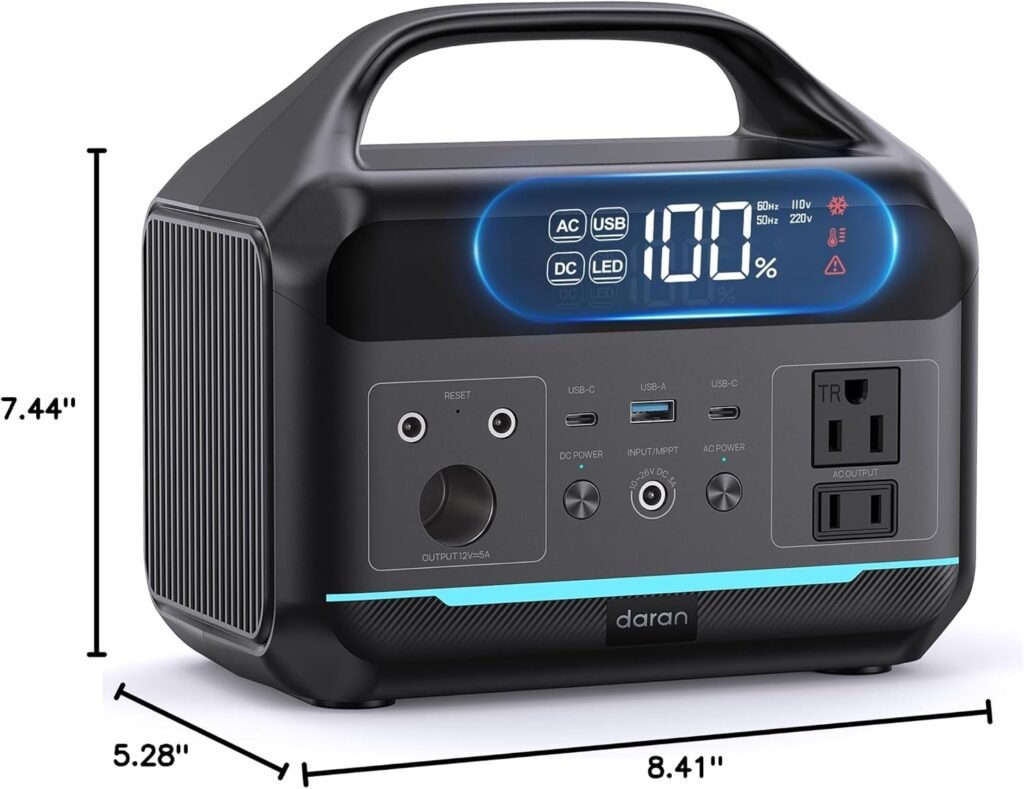
| Weight | Approximately 5.84 pounds | Manageable for transport |
| Dimensions | 8.41 × 5.28 × 7.44 inches | Useful when planning storage space |
Watts describe the rate at which a device draws power, while watt-hours describe the station’s stored energy. A 300W rating does not mean the battery contains 300Wh, and a 192Wh battery does not guarantee 192Wh delivered to a load because conversion losses reduce usable energy.
For a rough estimate, divide 192Wh by the device’s approximate wattage, then reduce the result to allow for real-world efficiency losses. For example, a continuously running 60W load would produce a theoretical result of 3.2 hours before losses, not a guaranteed runtime. Motor-driven equipment can also require a startup surge above its normal running wattage, so check that requirement before connecting it to the DARAN Portable Power Station.
Key Features of the DARAN Portable Power Station
The DARAN Portable Power Station uses a LiFePO4 battery. That chemistry is generally associated with better thermal stability and longer cycle longevity than some conventional lithium-ion designs, although the supplied information does not state a cycle count or guaranteed service life. The built-in handle and compact enclosure should also make it easier to move between a tent, vehicle, fishing spot, or home office.
A 300W continuous output is most appropriate for low- to moderate-draw equipment such as phones, tablets, laptops within the relevant charging limit, cameras, drones, lights, and selected small appliances. The practical benefit is flexibility rather than brute force. We would match each device’s actual adapter rating instead of relying on the product description’s broad compatibility wording.
The advertised 110V AC outlets are different from the USB and DC outputs. A device with a suitable USB input can often be charged directly through USB, avoiding an unnecessary DC-to-AC-to-DC conversion. That may make better use of the stored energy, although the actual benefit depends on the device and charging circuit.
Solar recharging is listed, but no panel is included in the supplied description. Anyone building a complete off-grid setup must therefore add the cost of a compatible panel and confirm its connector and electrical specifications before purchase.
Ports and Device Compatibility
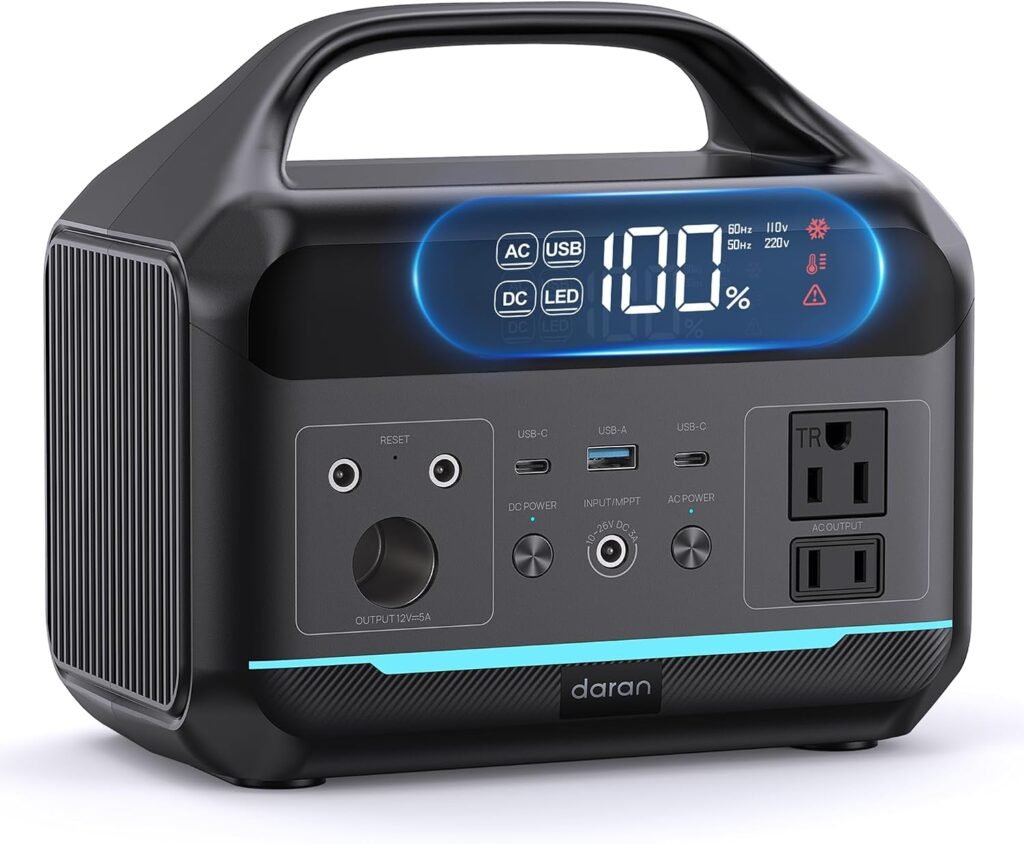
The DARAN Portable Power Station provides 2 × 300W AC outlets, 1 × 12V car socket rated at 120W, 2 × DC5521 ports, 1 × USB-A rated at 18W, 1 × USB-C rated at 30W, and 1 × USB-C PD rated at 60W. This is a useful spread for a mixed group of personal electronics, vehicle accessories, and low-voltage equipment.
The 60W USB-C PD connection is the most capable direct-charging option for compatible laptops, tablets, handheld consoles, and fast-charging phones. The separate 30W USB-C port is better suited to smaller electronics, while USB-A remains useful for older cables and accessories. The car socket and DC5521 ports may suit equipment designed for those connectors, but connector fit alone does not confirm electrical compatibility.
We recommend this four-step check before connecting a device:
- Find the device’s input wattage or calculate watts from volts multiplied by amps.
- Check whether its adapter or startup requirement exceeds the station’s output rating.
- Confirm the connector, voltage, and polarity where relevant.
- Leave headroom for startup demands and the other devices running at the same time.
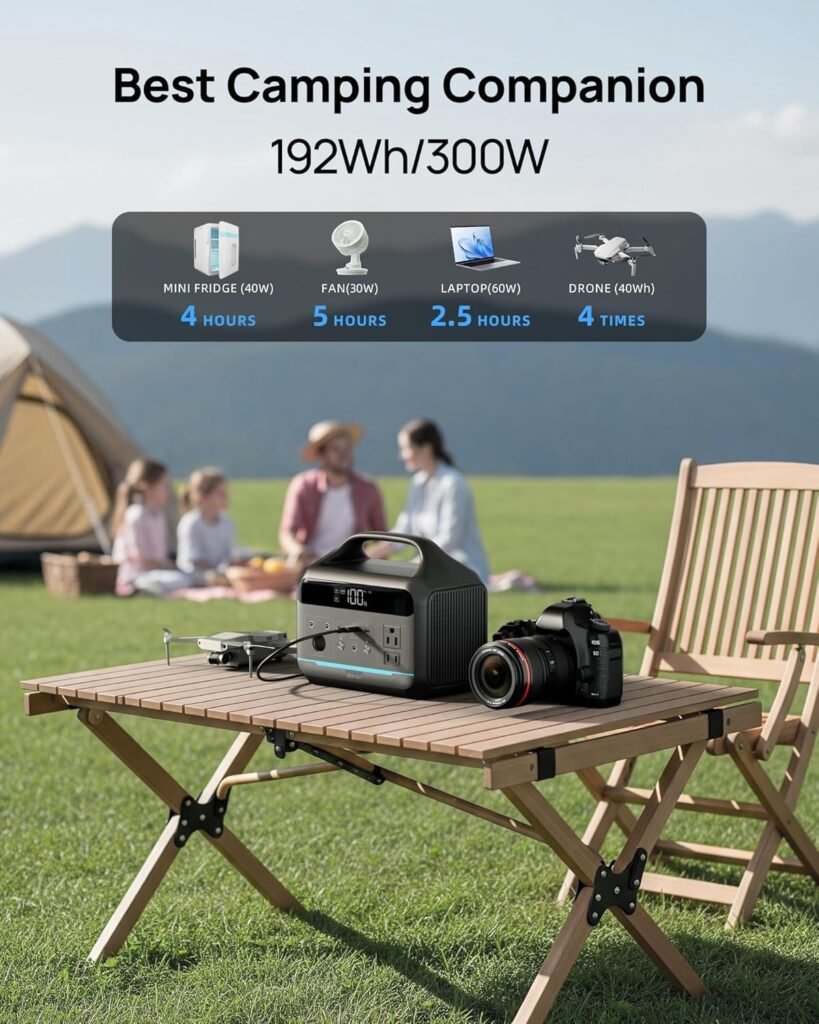
A mini fridge, drone charger, laptop, or camera setup may work depending on its real draw, but we cannot promise an exact runtime without measured testing. Several low-draw devices can run together only if their combined demand stays within the applicable output limits.

Recharging the DARAN Portable Power Station
The DARAN Portable Power Station supports three listed recharge routes: an AC wall outlet, a car charger, and a solar panel sold separately. Wall charging is the sensible preparation method before leaving home. Vehicle charging is convenient during a road trip, while solar charging becomes more useful when staying away from mains power for extended periods.
The supplied product information does not state the AC recharge time, car-charge time, solar input wattage, or solar charging duration. We therefore won’t turn those missing figures into estimates presented as specifications. Weather, panel size, battery state, cable losses, and sunlight conditions would also affect any solar result.
Our preparation routine would be:
- Fully charge the unit from a wall outlet before departure.
- Test every port needed for the trip while still at home.
- Pack the correct AC, USB, DC, and vehicle cables.
- Confirm the chosen solar panel’s voltage, connector, and compatibility.
- Keep a backup charging plan if cloudy weather could affect solar input.
The solar option adds flexibility, but it is not a complete solar package at this price because the panel must be purchased separately. Buyers should include that extra cost when comparing the DARAN Portable Power Station with alternatives that may include different accessories or more detailed solar specifications.
Battery Safety and Long-Term Use
The DARAN Portable Power Station is described as having a smart Battery Management System with overcharge, over-discharge, over-current, short-circuit, and temperature-control protections. In practical terms, those safeguards are intended to monitor charging and discharging conditions and reduce the risk associated with abnormal current, excessive discharge, short circuits, or unsuitable temperatures.
Safety circuitry is not a substitute for sensible operation. We would use the correct cables, keep ventilation openings clear, avoid covering the enclosure during operation, and follow the manufacturer’s charging instructions. LiFePO4 chemistry and temperature monitoring may appeal to people planning repeated camping or emergency-backup use, but the listing does not provide a specific lifespan, cycle count, operating-temperature range, or replacement timetable.
For storage, keep the station in a dry location with moderate temperatures, inspect the housing and cables for damage, and check its charge periodically rather than leaving it untouched for months. Before relying on it for an emergency, test the devices that matter most.
The documented protections should be separated from unverified claims about long-term performance. Consult the manual for storage percentages, temperature limits, warranty coverage, and replacement procedures. Those details could materially affect ownership value beyond the stated battery chemistry.
What Customers Are Saying About the DARAN Portable Power Station
We cannot responsibly assign a star rating or review count to the DARAN Portable Power Station from the supplied material because neither figure is provided. The listing confirms the specifications, but a credible customer-feedback analysis also needs the current rating, total review count, and representative comments. We will not manufacture those numbers or present unverified praise as a recurring pattern.
That evidence boundary matters for the themes shoppers normally want answered: portability, carrying comfort, charging flexibility, port selection, low-draw performance, and usefulness during camping or short outages. The supplied data also does not establish how many buyers mention laptop charging, mini-fridge operation, fan noise, display accuracy, recharge speed, battery retention, solar compatibility, or durability.
When a review dataset is available, we would separate repeated observations from isolated complaints and report the number of reviewers mentioning each concern. Conflicting reports should be examined alongside device wattage, charging method, ambient temperature, and length of use. A complaint about a mini fridge, for example, may reflect startup surge or compressor cycling rather than the same experience someone has while charging a phone.
For now, the fair conclusion is limited: the DARAN Portable Power Station has a clearly described port and battery specification, but customer satisfaction cannot be rated from the information supplied.
DARAN Portable Power Station for Camping, RVs, and Travel
For camping and travel, the DARAN Portable Power Station is best viewed as a personal-electronics companion. Its approximately 5.84-pound carry weight, compact 8.41 × 5.28 × 7.44-inch footprint, ergonomic handle, AC outlets, USB-C connections, and 12V car socket suit situations where we need phones, lights, camera equipment, drone chargers, or other modest loads away from a mains outlet.
That capacity is more persuasive for short trips than for extended RV living. It can supplement personal electronics and selected small devices, but it is not a realistic substitute for a larger battery system when the aim is to run a refrigerator for long periods, cook, heat a space, operate air-conditioning, or support other high-draw appliances.
Before leaving, we would charge the station, pack each required AC or USB cable, include a compatible solar panel if off-grid recharging is necessary, and estimate each device’s expected use. This makes it easier to identify whether the stored energy is enough for the itinerary rather than discovering the limitation at the campsite.
The design may be more convenient than a heavier, higher-capacity station for a short fishing trip, remote-work day, or weekend away. The trade-off is shorter runtime, which is why the DARAN Portable Power Station makes more sense for light travel than for a power-hungry RV setup.
DARAN Portable Power Station for Home Emergency Backup
During a short outage, the DARAN Portable Power Station could help keep phones, internet equipment, LED lighting, laptops, and selected medical-device accessories operating, provided each device’s electrical requirements are confirmed first. Two AC outlets and several USB/DC connections are useful when multiple household members need to recharge phones or tablets at the same time.
We would not describe it as whole-home backup. Its 300W continuous limit and 192Wh capacity are unsuitable for central heating, kettles, hair dryers, microwaves, air-conditioning, or large refrigerators. Devices with motors or compressors may also have startup requirements that exceed their normal running figures.
For outage preparation, make a list of essential devices, record each wattage, estimate the hours needed, and prioritize direct USB or DC charging where compatible. Reserve AC output for equipment that genuinely requires it. This reduces avoidable conversion losses and helps preserve the battery for the most important load.
Test the station with the intended emergency devices before an outage, not after one begins. We would also check whether sensitive electronics require a particular output waveform or UPS-style pass-through function, because those details are not supplied. That check is especially relevant if continuous internet or medical-support equipment is a priority.
Is the DARAN Portable Power Station Good Value at $165.99?
At $165.99, the DARAN Portable Power Station is listed $24.00 below its stated original price of $189.99. We can assess that visible price difference, but we cannot say how long the promotion will last. The more useful question is whether the station’s capability matches the buyer’s actual devices.
The complete setup cost may be higher than the unit price. Shoppers may need charging cables that are not already available, and anyone relying on solar power must buy a compatible panel separately. That should be included in the budget before comparing this station with a package that offers different accessories.
The strongest value case is for someone who wants a relatively light 192Wh battery for phones, laptops within the charging limit, lights, cameras, drones, and occasional short outages. It is weaker for buyers expecting long-duration appliance operation or high-wattage emergency power.
Our buying test is simple: identify the highest-wattage device, estimate expected watt-hours, confirm whether the 60W USB-C PD output is sufficient, and decide whether the available connections justify the price. On documented specifications alone, the DARAN Portable Power Station looks like a reasonable moderate-power option, but the missing current review evidence prevents a stronger customer-satisfaction conclusion.
Who Should Buy the DARAN Portable Power Station?
The best-fit buyer for the DARAN Portable Power Station wants portable support for personal electronics, camping equipment, remote work, road trips, fishing, or brief household outages. The product is particularly attractive to people who value several connection types, a 60W USB-C PD output, a 12V vehicle socket, and the choice of wall, vehicle, or separately purchased solar recharging.
We would look elsewhere for whole-home backup, long-duration RV living, high-wattage cooking or heating, and appliances whose startup surge exceeds the station’s limits. A small footprint and manageable carry design cannot compensate for insufficient energy storage when the intended load is demanding.
Before ordering, write down the highest-wattage device, total expected watt-hours, preferred recharge method, portability requirements, and maximum acceptable price. Then check the current listing for price, stock status, warranty terms, recharge specifications, and customer-review trends, since those details can change after publication.
For shoppers, the decision is therefore practical rather than aspirational: choose the DARAN Portable Power Station when its documented output, capacity, and port mix fit your light-duty plan. Choose a larger alternative when runtime, surge capacity, or detailed charging support matters more than compact transport.
Pros and Cons
Pros
- 192Wh LiFePO4 battery chemistry with stated Battery Management System protections
- 300W continuous output with two AC outlets and eight total output connections
- 60W USB-C PD port plus 12V car socket and direct USB/DC charging options
- Approximately 5.84-pound portable design with an ergonomic handle
- Three recharge methods, including solar support with a separately purchased panel
Cons
- Solar panel is not included
- AC, car, and solar recharge times are not stated in the supplied product data
- 192Wh capacity is modest for refrigerators, RV appliances, and extended outages
- 300W continuous output limits compatibility with high-wattage or surge-heavy devices
- Current star rating, review count, and representative customer comments were not provided
Final Verdict
Key Takeaways
- The $165.99 station combines a 192Wh LiFePO4 battery, 300W continuous output, and eight output connections in a portable format.
- Its 60W USB-C PD port, 12V car socket, AC outlets, and three recharge methods suit personal electronics, camping, travel, and brief outages.
- Solar recharging requires a separately purchased panel, and the supplied data does not state recharge times or solar input wattage.
- The station is not a whole-home backup and should not be selected for high-wattage heating, cooking, or long-duration appliance use.
- No current customer rating, review count, or representative review dataset was supplied, so customer sentiment remains unverified.
Frequently Asked Questions
What is the capacity of the DARAN Portable Power Station?
It has a listed 192Wh LiFePO4 battery. Actual usable energy and runtime will be lower than the headline capacity because conversion losses and device power draw affect results.
Can it run a refrigerator or mini fridge?
It may run a compatible mini fridge if the device’s running and startup requirements fit the station’s limits, but the supplied information does not provide measured runtime or surge testing. It should not be treated as a guaranteed long-duration refrigerator supply.
Does the solar panel come included?
No. The product description lists solar recharging, but the solar panel is sold separately. Buyers should verify the panel’s voltage, connector, and compatibility before purchasing.
How many output ports does it have?
The listing describes eight total output connections: two AC outlets, one 12V car socket, two DC5521 ports, one USB-A port, one 30W USB-C port, and one 60W USB-C PD port.
Is it suitable for whole-home emergency backup?
No. The 192Wh capacity and 300W continuous output are intended for personal electronics and selected low-power devices, not central heating, kettles, microwaves, hair dryers, air-conditioning, or large appliances.
Disclosure: As an Amazon Associate, I earn from qualifying purchases.