Imagine a battery that balances safety, longevity, and environmental impact against one that emphasizes portability and rapid charging. As we analyze LiFePO4 versus lithium-ion power stations, it’s clear that each technology offers distinct advantages suited to specific applications. Understanding these differences requires a careful examination of performance, safety, and cost factors. Exploring these nuances can help determine which power station aligns best with your needs and priorities.
Key Takeaways
- Lifepo4 offers higher safety, thermal stability, and longer cycle life compared to lithium-ion power stations.
- Lithium-ion power stations are more portable and have higher energy density for lightweight, outdoor use.
- Lifepo4 batteries are easier to recycle, reducing environmental impact and supporting sustainability.
- Lithium-ion stations typically feature faster charging for quick deployment and extended usage.
- Cost differences: Lifepo4 has higher upfront costs but lower maintenance and longer lifespan.
What Are Lifepo4 and Lithium-Ion Power Stations?
Have you ever wondered how portable power solutions differ at a technical level? Lifepo4 and lithium-ion power stations utilize distinct chemistries that influence performance and sustainability. Lifepo4 batteries feature a stable chemistry with a longer lifespan, making them less prone to thermal runaway. Lithium-ion stations often use cobalt or nickel-based chemistries, which can offer higher energy density but pose challenges in battery recycling. The environmental impact of these systems is significant; Lifepo4 batteries are easier to recycle, reducing hazardous waste, whereas lithium-ion batteries require complex processes that can generate harmful byproducts. Understanding these differences helps us evaluate their sustainability, emphasizing the importance of battery recycling efforts and minimizing environmental impact in portable power solutions.
How Do Lifepo4 and Lithium-Ion Batteries Differ in Performance?
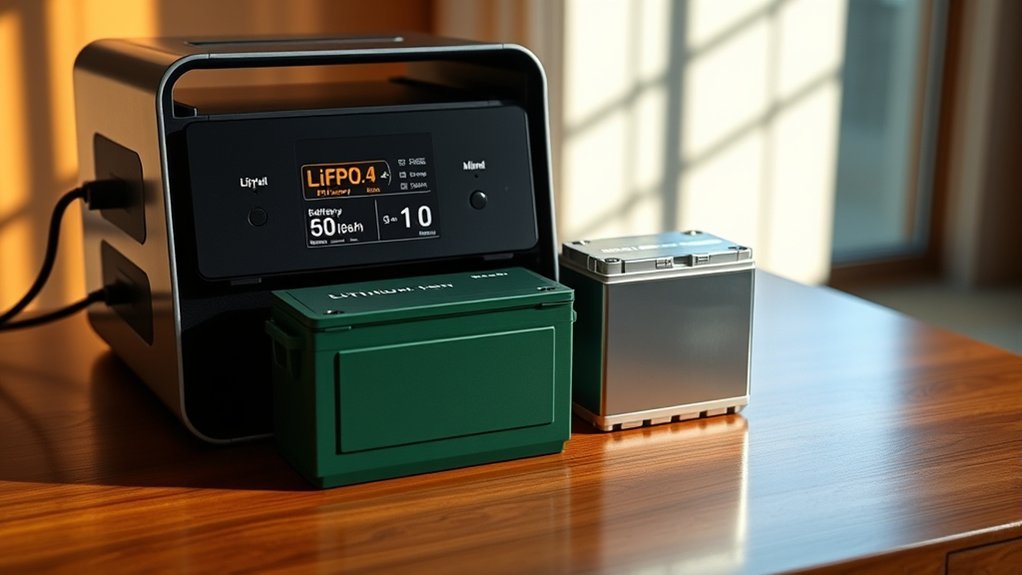
While both Lifepo4 and lithium-ion batteries are widely used in power stations, their performance characteristics differ markedly due to their chemical compositions. Lifepo4 batteries generally exhibit higher thermal stability, resulting in better safety and longer cycle life, which benefits sustained power delivery. In contrast, lithium-ion batteries typically offer higher energy density, enabling more compact designs and increased runtime. These differences influence battery recycling processes; Lifepo4’s stable chemistry simplifies recycling and reduces environmental impact, whereas lithium-ion batteries pose more challenges due to toxic materials. Additionally, Lifepo4’s environmental footprint is lower, with fewer hazardous waste concerns. Overall, these performance distinctions directly affect operational efficiency, safety, and the sustainability profile of power station implementations.
Which Battery Type Offers Greater Safety and Longevity?
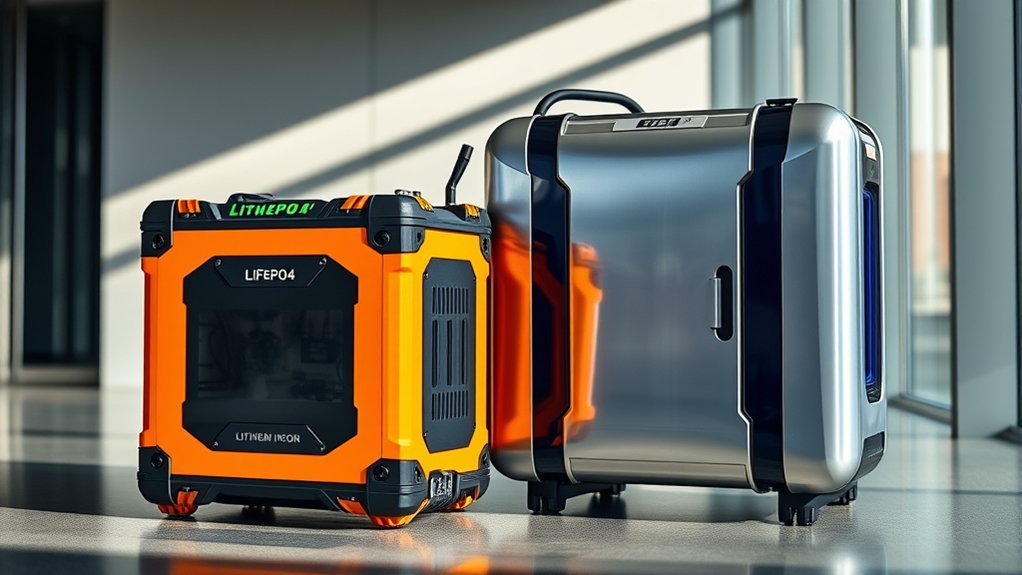
When evaluating safety and longevity, Lifepo4 batteries generally outperform lithium-ion counterparts due to their inherent chemical stability. Lifepo4’s stable chemistry minimizes thermal runaway risks, making them safer for large-scale applications. Their longer cycle life enhances overall longevity, reducing replacement frequency. Additionally, Lifepo4 batteries facilitate more efficient battery recycling, which mitigates environmental impact by enabling safer disposal and material recovery. In contrast, lithium-ion batteries are more prone to degradation and thermal instability, increasing safety concerns and shortening operational lifespan. The environmental footprint of Lifepo4 is also lower because their chemical composition produces fewer hazardous byproducts during recycling. Overall, Lifepo4 offers a more durable, safer option with reduced ecological consequences, making it a superior choice for long-term, sustainable energy storage solutions.
How Do Costs and Maintenance Compare Between the Two?
Although Lifepo4 batteries typically entail higher upfront costs compared to lithium-ion batteries, their lower maintenance requirements and extended lifespan can make them more cost-effective over time. Lifepo4 batteries require less frequent replacement, reducing overall lifecycle costs and minimizing the environmental impact associated with battery disposal. Additionally, their safer chemical composition lowers the risk of thermal runaway, decreasing maintenance and safety concerns. From an environmental perspective, Lifepo4 batteries are easier to recycle due to fewer toxic materials, supporting sustainable battery recycling practices. In contrast, lithium-ion batteries may involve more complex recycling processes and pose greater environmental hazards if improperly disposed of. Overall, the initial investment in Lifepo4 can be offset by reduced maintenance needs and a more favorable environmental footprint.
What Are the Best Use Cases for Lifepo4 vs Lithium-Ion Power Stations?
Lifepo4 and lithium-ion power stations each excel in different application contexts due to their distinct characteristics. Lifepo4’s safety, longer cycle life, and thermal stability make it ideal for emergency preparedness, where reliability is critical. Lithium-ion’s higher energy density suits outdoor adventures, providing lightweight, portable power. For specific use cases:
| Use Case | Suitable Power Station Type |
|---|---|
| Emergency Preparedness | Lifepo4 |
| Outdoor Adventures | Lithium-ion |
| Heavy-Duty Applications | Lifepo4 |
| Lightweight Travel | Lithium-ion |
Understanding these distinctions helps users select the best power station for their needs, whether ensuring safety during emergencies or maximizing portability in outdoor activities.
Which Power Station Is the Right Choice for Your Needs?
Choosing the right power station depends on analyzing battery chemistry, capacity options, and portability to match specific needs. Lifepo4 offers enhanced safety and longer lifecycle, while lithium-ion provides higher energy density and compactness. Evaluating these technical differences helps determine which is best suited for your application.
Battery Chemistry Differences
The fundamental differences in battery chemistry markedly influence the performance, safety, and lifespan of power stations. Lithium Iron Phosphate (LiFePO₄) batteries offer enhanced thermal stability, reducing risk of thermal runaway, while lithium-ion variants can be more energy-dense but less stable. These chemistry distinctions also impact environmental considerations; LiFePO₄ batteries are more environmentally friendly due to safer materials and easier recycling processes. Conversely, traditional lithium-ion batteries pose greater challenges for battery recycling and have a higher environmental impact.
Key differences include:
- Thermal Stability — LiFePO₄ is safer under high temperatures.
- Energy Density — Lithium-ion batteries typically store more energy per weight.
- Lifecycle & Durability — LiFePO₄ generally offers longer cycle life.
- Environmental Impact — LiFePO₄ batteries are more sustainable and easier to recycle.
Power Capacity Options
When selecting a power station, understanding the range of capacity options is essential to guarantee it meets your energy requirements. Lithium-ion and LiFePO4 batteries offer varying capacities, typically measured in watt-hours (Wh). Lithium-ion models often provide higher energy densities, enabling larger capacities in compact designs, but may pose greater challenges for battery recycling and environmental impact. Conversely, LiFePO4 batteries generally have lower energy densities but are more environmentally friendly, with easier recycling processes and a longer lifespan. Evaluating capacity options involves balancing immediate energy needs with considerations of battery longevity and environmental sustainability. Larger capacities support extended use but may increase the environmental footprint unless proper battery recycling processes are in place. Ultimately, selecting the right power station hinges on aligning capacity with both performance demands and environmental responsibility.
Usage and Portability
While both LiFePO4 and lithium-ion power stations are designed to provide mobile energy solutions, their suitability largely depends on specific usage scenarios and portability requirements. LiFePO4 stations generally have slower charging speeds, which can be a drawback for quick deployments, but they offer a longer lifespan and lower environmental impact. Lithium-ion units typically charge faster, making them suitable for rapid needs, but their environmental footprint is higher due to more complex recycling processes.
Consider these factors:
- Charging speed: Lithium-ion is faster, ideal for time-sensitive applications.
- Portability: Lithium-ion units tend to be lighter and more compact.
- Environmental impact: LiFePO4 batteries are more eco-friendly.
- Usage scenario: Choose based on speed, weight, and sustainability needs.
Frequently Asked Questions
How Environmentally Friendly Are Lifepo4 and Lithium-Ion Power Stations?
We find that LiFePO4 batteries are more environmentally friendly due to longer battery lifespan and safer chemistry, reducing waste. Although initial cost is higher, their durability outweighs lithium-ion’s cheaper cost, making them more sustainable overall.
Can Lifepo4 and Lithium-Ion Batteries Be Recycled Effectively?
We find that both LiFePO4 and lithium-ion batteries can be recycled effectively, extending battery lifespan and reducing waste, though LiFePO4’s longer lifespan and lower cost comparison make it more sustainable and economically advantageous for recycling efforts.
What Are the Charging Times for Each Battery Type?
Charging times symbolize the race against battery lifespan and efficiency; LiFePO4 batteries typically reach full charge faster, around 4-6 hours, while lithium-ion cells may need 5-8 hours, influencing overall charging efficiency and longevity.
Are There Temperature Limitations for Using These Power Stations?
We find that LiFePO4 batteries exhibit superior temperature resilience and storage stability, operating efficiently across wider temperature ranges, while conventional lithium-ion power stations are more susceptible to temperature fluctuations, affecting performance and longevity under extreme conditions.
How Do Battery Warranties Differ Between Lifepo4 and Lithium-Ion Options?
Battery warranties vary like a well-tuned engine; LiFePO4 offers longer battery lifespan warranties, often 10+ years, while lithium-ion warranties typically range 2-5 years. Cost comparison favors LiFePO4’s durability, despite higher initial investment.
Conclusion
Ultimately, choosing between LiFePO4 and lithium-ion power stations is like selecting the right tool for a precise job; each has its strengths. LiFePO4 offers a sturdy, reliable foundation for demanding applications, while lithium-ion provides agility and portability for on-the-go needs. By analyzing your specific energy demands, safety priorities, and budget, you can align your choice with a strategic vision—transforming raw power into a dependable, well-tuned energy solution.