You may not realize that noise performance is as much about signal integrity and disturbance rejection as it is about silent measurements. We’ll map noise budgets, define metrics, and link materials, shielding, and layout to measurable outcomes. Our discussion stays grounded in practical choices—balancing weight, cost, and thermal impacts while preserving traceability and reliability. Stay with us as we connect diagnostics, controls, and power integrity to deploy robust, repeatable quiet-operation strategies.
Key Takeaways
- Define and separate signal from noise using context-specific thresholds across frequency content, amplitude, and temporal behavior to guide design targets.
- Use noise budgeting and standardized measurement practices (SNR, THD, spectral density) with traceable calibration for repeatable comparisons.
- Employ layered shielding, damping materials, and loss mechanisms to achieve broadband attenuation while balancing weight, cost, and thermal management.
- Implement active and passive control strategies with disturbance rejection and diagnostics to maintain quiet operation over lifecycle.
- Incorporate vibration isolation, mounting consistency, and clear reference conditions to ensure repeatable measurements and predictable noise performance.
Defining Noise in Engineering: What Counts and Why It Matters
Defining noise in engineering requires clarity about what counts as extraneous disturbance versus acceptable signal. We define noise as unintended, irrelevant, or unpredictable components that obscure, alter, or degrade system performance. Our focus is on preserving the integrity of the useful signal while distinguishing it from perturbations. The boundary between signal and noise is context dependent; in one application, a certain jitter might be tolerable, while in another, it becomes unacceptable. We evaluate noise sources by frequency content, amplitude, and temporal behavior, then categorize them for mitigation or acceptance. This framing helps us set design targets, choose filtering or shielding strategies, and justify performance specifications. By stating what counts as noise, we align expectations and enable rigorous engineering decisions. We invite readers to adopt this defensible, context-aware perspective.
Noise Measurement 101: Metrics, Units, and Standards
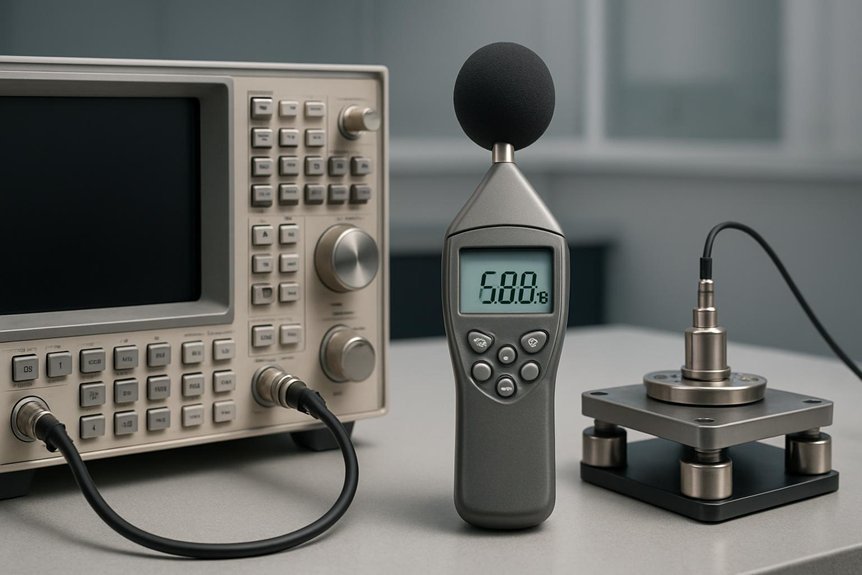
We summarize the core measurement metrics, highlighting how signal-to-noise ratio, total harmonic distortion, and spectral density quantify performance. We then map these metrics to standard units and calibration procedures, ensuring traceability and repeatability across tests. Finally, we address the applicable standards that govern measurement setups, data integrity, and reporting formats to establish a common framework.
Measurement Metrics Overview
How do we quantify noise in a way that’s both meaningful and comparable across systems? We approach measurement metrics with a focus on reproducibility, sensitivity, and relevance to performance. We distinguish between absolute and relative quantities, using spectral density, integrated root-mean-square, and peak or crest factors to capture different impact channels. We select metrics aligned with the system’s bandwidth, dynamic range, and operational environment, ensuring that units are consistent and traceable to referenced standards. Noise budgeting emerges as a planning tool, allocating permissible spectral components and temporal excursions to maintain overall performance. We discuss signal quieting as a design objective, quantifying how modifications in shielding, isolation, and filtering translate to measurable noise reductions. Our framework emphasizes comparability, traceability, and actionable insight for engineering tradeoffs.
Standards and Units Essentials
Standards and units provide the backbone for consistent noise measurement across systems. We address how metrics, length, and amplitude scales translate into actionable comparisons, ensuring traceability from sensors to specifications. Our approach emphasizes reproducible procedures, documented uncertainty, and clear labeling of reference conditions. When we discuss noise budgeting, we quantify contributions from sources, paths, and environments to derive an intelligible lifecycle profile. Specifications hinge on defined spectral weightings, calibration states, and measurement durations, enabling meaningful interoperability between equipment and test rigs. We also consider vibration isolation as a design constraint, requiring consistent footing for sensors and repeatable mounting. By aligning units, methods, and acceptance criteria, we reduce ambiguity and support engineering decisions that optimize performance without overengineering.
Practical Materials and Shielding for Noise Reduction
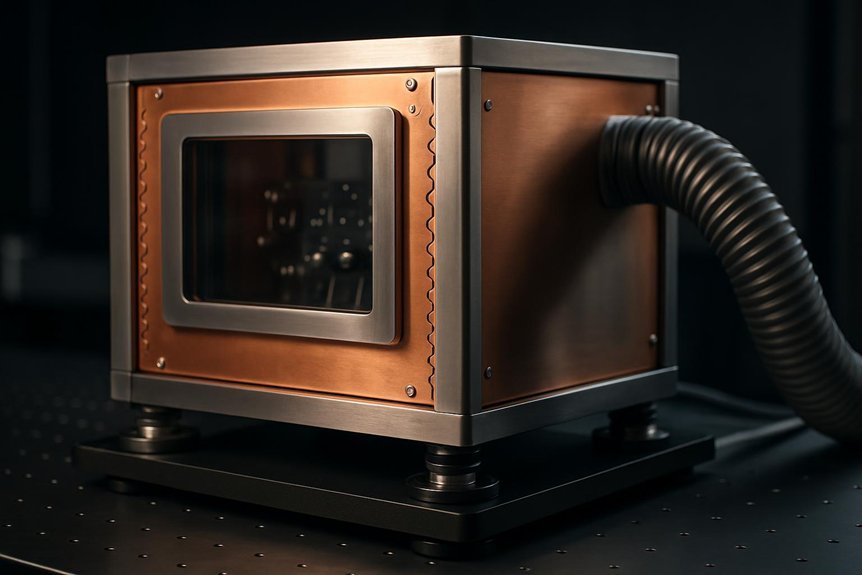
What practical materials and shielding strategies most effectively reduce noise without compromising system performance? We analyze material choices and configuration methods that balance attenuation with weight, cost, and thermal management. We prioritize high-damping polymers and viscoelastic layers for targeted frequency bands, paired with rigid substrates to preserve structural integrity. Shielding composites with conductive fillers offer electromagnetic attenuation while maintaining mechanical stiffness; we assess percolation thresholds, filler alignment, and interfacial bonding to minimize resonance. Layered constructs, combining lossy coatings, metallic foils, and air gaps, yield broadband suppression when tuned to source characteristics. We quantify performance through insertion loss, noise floor shifts, and thermal implications, ensuring manufacturability and reliability. In practice, selecting material damping and tailored shielding composites optimizes noise reduction without degrading system efficiency.
Control Strategies for Quiet, Stable Systems
Control strategies for quiet, stable systems hinge on deliberate disturbance rejection and proactive state management. We identify noise sources, model dynamics, and prescribe compensators that minimize excitation transmission without sacrificing responsiveness. Our approach blends feedforward disturbance rejection with robust feedback to sustain quiet operating envelopes under varying load profiles. We quantify acceptable deviation via tight performance specs and translate them into controller gains, filters, and scheduling rules. Silent torque emerges as a critical design metric: we tailor actuation profiles to suppress torque ripple and harmonics that couple into structural paths. Vibration budgeting guides component selection and isolation strategies, allocating allowable energy across modes to prevent resonance amplification. We validate through closed‑loop simulations and targeted experiments, iterating until measured quietness meets the prescribed stability criteria.
Power and Signal Integrity: Routing, Grounding, and Layout Practices
We leverage the quiet-operating insights from our prior control strategies to emphasize how power delivery and signal fidelity shape overall system performance. We analyze routing, grounding, and layout to minimize impedance, crosstalk, and noise injection. Routing considerations focus on separating high‑speed traces from noisy power lines, using controlled impedance methods, and preserving return paths with contiguous ground planes. We implement star or near‑field shielding schemes where applicable and place decoupling close to power pins to stabilize local rails. Grounding practices prioritize a single reference, low‑impedance paths, and proper chassis bonding to prevent ground loops. Layout discipline enforces consistent trace widths, clear vias, and thermal relief to avoid susceptibility to thermal drift. Overall, meticulous routing and grounding yield robust signal integrity under load and transients.
Diagnostics for Early Noise Detection and Verification
Early detection of noise hinges on continuous, targeted diagnostics that expose deviations before they escalate. We approach diagnostics as an integrated workflow: baseline establishment, real-time monitoring, and verification checks. We implement detection algorithms that quantify anomalies in spectral, temporal, and statistical domains, enabling rapid triage of suspect channels. Sensor calibration remains essential; we conduct periodic, traceable calibration to align sensor output with reference standards, ensuring that drift and nonlinearity don’t mask true faults. Verification involves cross-validation across redundant sensors and independent measurement modalities to confirm true positives. We document thresholds, confidence levels, and corrective actions, maintaining traceability for audit purposes. By correlating environmental, electrical, and mechanical indicators, we distinguish incidental fluctuations from meaningful noise signatures, delivering actionable insights without false alarms. This disciplined approach supports proactive maintenance and robust performance.
Cost–Performance Trade-offs in Noise Control
What are the practical implications of balancing cost with performance in noise control, and how do we quantify these trade-offs? We confront a structured framework: we must optimize outcomes while respecting budgets, using cost optimization as a guiding metric and noise budgeting as a constraint. We assess material choices, enclosure designs, and active suppression against attenuation targets, lifecycle costs, and reliability.
| Factor | Impact on Cost | Impact on Performance |
|---|---|---|
| Materials | Moderate upfront; long-term savings | Attenuation per weight varies |
| Damping treatments | Installation cost; maintenance | Noise reduction effectiveness |
| Active control | Power, integration cost | Real-time disturbance suppression |
| Maintenance | Ongoing expense | Consistent performance |
| Lifecycle | Total cost of ownership | Predictable noise compliance |
We quantify trade-offs via objective functions, aligning cost optimization with specified noise budgets to achieve robust, economical control.
Real-World Case Studies: Quiet Labs and Industrial Silence
In real-world settings, quiet labs and industrial facilities reveal how noise control strategies translate from theory to practice. We examine case data, instrumentation logs, and post-implementation audits to quantify gains and remaining gaps. Our focus is on reproducible methods that deliver measurable reductions without compromising throughput or safety. In a silent lab, isolation barriers, vibration damping, and airborne sound management converge with control-system tuning to sustain stable operating envelopes. Industrial hush emerges when zoning, ductcraft, and equipment selection align with maintenance cycles and energy profiles, preventing performance trade-offs. We compare pre- and post-implementation metrics, identify unintended coupling effects, and document best practices for commissioning. Readers gain a concise framework for evaluating options, validating results, and extending quiet-operation strategies to new facilities.
Frequently Asked Questions
How Is Acoustic Noise Distinct From Electrical Noise in Systems?
Acoustic noise differs in source and path; it’s mechanical vibrations transferred through structures, while electrical noise is electrical interference within circuits. We analyze acoustic isolation and electrical shielding to minimize respective channels of disturbance and maintain signal integrity.
Can Noise Be Beneficial in Any Engineering Contexts?
Yes, sometimes the noise is beneficial randomness that enhances robustness; we leverage noise enabled sensing to extract signals. We’ll show how controlled noise improves detection, calibration, and exploration, guiding designs toward resilient, adaptive systems.
What Are Non-Destructive Methods for Detecting Hidden Noise Sources?
We detect hidden noise non invasively using synchronized sensing, spectral anomaly analysis, and vibration tomography. We quantify sources with non invasive probes, cross-validate with emitters, and map contours to isolate hidden noise without disturbing operation.
How Do Temperature Fluctuations Affect Long-Term Noise Stability?
In a hypothetical case, temperature drift degrades long term stability by causing gradual offsets. We’ve observed that even small ambient shifts matter; we quantify effects to preserve long term stability, and we design compensation for temperature drift.
What Is the Role of Software in Passive Noise Mitigation?
We use software strategies to implement passive noise mitigation, analyzing signals and environments to reduce interference. We rely on data driven diagnostics to quantify noise sources, validate suppression, and adapt controls, delivering precise, continuous quiet for readers.
Conclusion
We’ve shown how noise-free operation rests on precise measurement, disciplined shielding, and robust control strategies. In practice, a single misrouted ground can ripple into hours of debugging—think of a lab freezer that hissed louder than its pump until a stray loop was reined in, dropping vibration energy by 40%. By budgeting every dB, we ensure reproducible quiet across lifecycles, balancing cost, weight, and performance while meeting target specifications with verifiable confidence.